Uniswap price prediction: A governance vote to expand Uniswap’s fee switch to eight additional Layer 2 networks kicked off on March 2, sending UNI up nearly 2.5 percent while the rest of the market barely budged. The proposal could add approximately $27 million in annualized revenue on top of the $34 million already directed toward UNI token burns, according to governance analysis from Entropy Advisors. Render has been recovering from oversold levels. And Pepeto, with its presale at $7.5 million raised, is approaching launch with a fully designed DeFi ecosystem built specifically for the meme token economy.
Uniswap governance vote targets $27M additional revenue across eight Layer 2 networks
Uniswap’s governance community voted beginning March 2, 2026 on a proposal to expand protocol fee capture across eight additional blockchain networks, according to CoinDesk. The proposal would extend the fee switch to these chains, apply a new tier-based v3 fee system to all liquidity pools by default, and make protocol fee collection automatic for new pools. If passed, estimates suggest the change could generate approximately $27 million in additional annualized revenue, compounding on top of the $34 million already being used to burn UNI tokens. That total approaches $61 million in annual fee revenue directed toward supply reduction, transforming UNI from a governance-only token into one of DeFi’s first major cash-flow assets. The proposal follows the December 2025 UNIfication vote and BlackRock’s February investment in UNI, cementing Uniswap’s position at the center of the DeFi institutional narrative in 2026.
UNI is trading at $4.00 today. The fee switch expansion has been well received by the market, and the token’s long-term fundamentals are improving with each governance step toward full revenue activation. Uniswap processes roughly $148 billion in monthly trading volume across 36 chains, making the fee capture potential substantial. The question for investors is whether that fundamental story has more room to run from $4.00 or whether a new entry point in an earlier-stage project offers more near-term asymmetric returns.
Three crypto setups for the DeFi fee era: Pepeto, UNI, and Render
Pepeto: Presale before the meme DeFi fee economy arrives
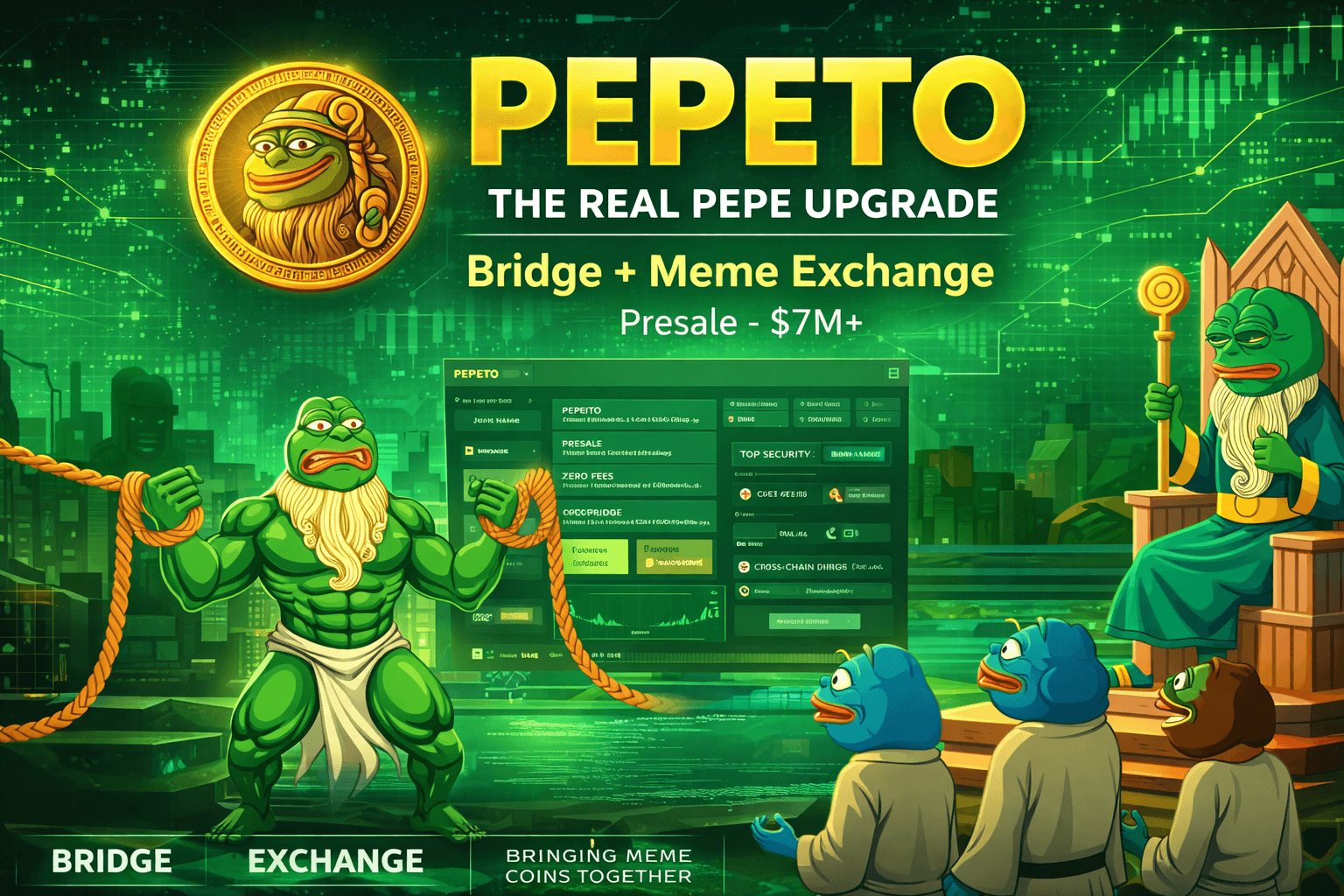
Pepeto has raised $7.5 million in its presale by building the infrastructure that the meme token economy needs but has never had. PepetoSwap is a DEX designed for meme tokens. The cross-chain bridge enables meme assets to move across networks. The trading exchange provides a dedicated venue for the meme economy’s most active traders. Uniswap is building a fee economy around institutional assets like tokenized Treasury funds. Pepeto is building a fee economy around the meme token sector, which generated some of the highest trading volumes in the 2024 and 2025 cycles.
The key distinction between UNI and Pepeto is where you are entering the value creation timeline. UNI’s fee switch was debated for years before it activated. Pepeto’s fee-generating infrastructure is being built and is close to ready before the token even launches. Investors who enter Pepeto’s presale now are entering before the market can price in what a fee-generating meme DeFi ecosystem is worth. That is the same logic that made early UNI holders significant profits before the governance debates started. A $1,000 presale entry is projected to return $70,000 at launch. Click To Visit Pepeto Website To Enter The Presale.
Bankless Times and CoinDesk are among the publications covering the growing case for meme-native DeFi infrastructure as the next phase of the decentralized exchange sector.
Uniswap: Fee economy matures, structural ceiling tightens on new entrant upside
UNI at $4.00 is backed by real protocol revenue, institutional validation from BlackRock, and a governance community that is steadily converting trading volume into token holder returns. The $27 million revenue addition from the L2 fee expansion would be meaningful and the token’s burn rate would accelerate. Analysts watching the RSI at 49 note there is room before UNI becomes overbought, and the $4.07 resistance is the immediate technical level to watch. A clean break above that level on volume could initiate a move toward the $5.50 range. For long-term holders, UNI’s path to double digits is visible. For new entrants looking for 10x or 20x returns from current prices, the market cap math becomes harder to work.
Render: Infrastructure recovery, stable option without explosive multiples
Render is trading at $1.34, bouncing off oversold levels after a period of consolidation. The GPU compute network’s Solana migration has strengthened its infrastructure considerably, and Render remains a credible long-term bet on decentralized compute becoming a major sector in 2026. Technical analysts project Render could reach $1.69 to $1.79 by early April, representing a potential 25 to 32 percent gain from current levels. That is a respectable return for a mid-cap with proven infrastructure. However, Render’s market cap already reflects meaningful success in the compute sector, which means the explosive multiples available at earlier stages are no longer present. Render is a stable infrastructure play, not an asymmetric return opportunity.
Bottom line
Uniswap’s fee switch expansion is a landmark governance event that is gradually transforming UNI into the DeFi sector’s first major yield-generating asset. Render is recovering steadily with real infrastructure backing its valuation. But neither offers the kind of return profile that remains available in Pepeto’s presale window. Pepeto is building the fee-generating infrastructure for the meme token economy at a time when presale pricing is still available. UNI took years of governance debate to get to where it is today. Pepeto is starting there. That head start, combined with launch weeks away, makes it the most compelling setup of the three for investors seeking maximum return before the next market cycle peaks.
Click To Visit Pepeto Website To Enter The Presale

FAQs
What is the Uniswap price prediction for 2026?
UNI is currently trading at $4.00 with strong governance momentum from the fee switch expansion vote. Analysts see resistance at $4.07 as the near-term level to clear, with a potential move toward $5.50 if the L2 fee proposal passes and institutional interest continues building. The token’s long-term path to double digits is supported by $61 million in projected annual fee revenue directed toward burns.
How does Pepeto compare to UNI as an investment?
UNI is a proven DeFi leader at $4.00 with institutional backing and a maturing fee economy. Pepeto is a presale-stage token with its full meme DeFi ecosystem close to launch and a projected 70x return from presale pricing. The two represent different points on the risk-reward curve, with Pepeto offering more asymmetric upside from today’s entry prices.
What will Uniswap’s fee switch expansion mean for UNI holders?
If the governance vote passes, Uniswap would activate protocol fee collection across eight additional Layer 2 networks, adding approximately $27 million in annualized revenue to the existing $34 million already used for UNI token burns. This accelerates UNI’s transition from a governance-only token into a yield-generating DeFi asset, which is the structural change that analysts have identified as the most important catalyst for UNI’s long-term price trajectory.