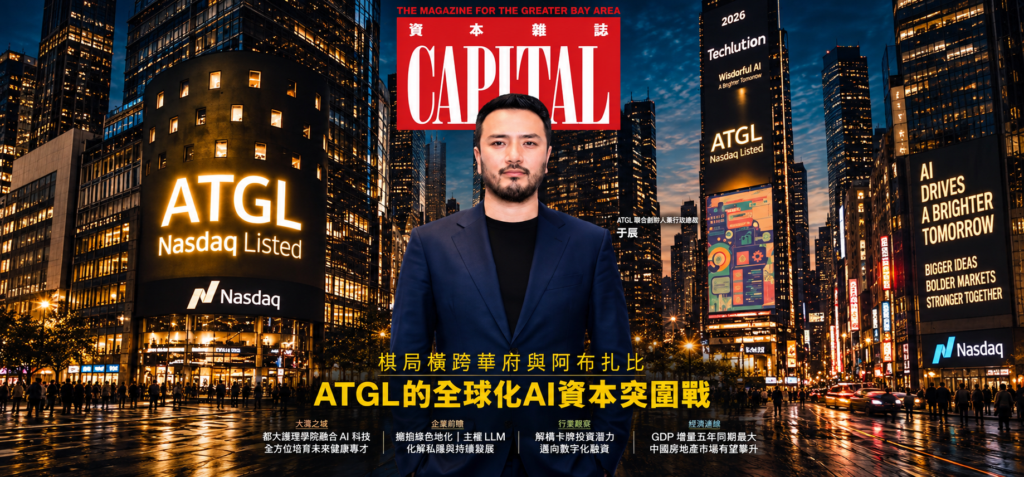
Editor’s Note: This article draws on CAPITAL magazine’s August 2026 cover story and reinterprets its key themes through the lens of Anthony Tsang’s strategic control, ATGL’s management realignment and the company’s AI transformation.
Stable leadership, a strengthened management team and a clearly defined enterprise AI strategy may give Alpha Technology Group the organizational foundation needed to turn AlphaClaw into a scalable commercial platform.
Alpha Technology Group Limited (Nasdaq: ATGL) is entering a new stage of development. The company is moving beyond its traditional project‑based technology services and concentrating its business around Exclusive Large Language Model solutions, AlphaClaw AI Agents and the AlphaClaw AI Agent Marketplace.
At the center of this transformation is Anthony Tsang, ATGL’s president and executive director.
Tsang owns 397,500 Class A ordinary shares and all 1.2 million outstanding Class B ordinary shares. Each Class B share carries 20 votes, compared with one vote for each Class A share. According to ATGL’s annual report filed on January 30, 2026, Tsang controlled approximately 62.14% of the company’s voting power. (sec.gov)
For a company undertaking a major strategic transition, this level of control can be a clear advantage. It gives ATGL stable leadership, a consistent decision‑making structure and the ability to pursue a long‑term plan without repeatedly changing direction in response to short‑term market pressures.
Control Creates Strategic Continuity
Technology transformations require more than a new product announcement. They demand coordinated decisions across research, product development, capital allocation, recruitment, partnerships and market expansion.
Tsang’s voting position gives ATGL a clear center of strategic leadership. It allows the company to make decisions efficiently and align its resources behind a single AI‑focused direction.
This is particularly relevant because ATGL is not simply adding another service to its existing portfolio. The company is restructuring its core business around enterprise AI products that are intended to be reusable, customizable and commercially scalable.
Tsang’s position also provides clear accountability. Investors can identify the person responsible for setting the company’s direction and overseeing its execution. His controlling interest supports continuity between ATGL’s technology vision, management structure and long‑term commercial objectives.
Management Restructuring Supports the Transformation
ATGL has complemented this strategic control with a significant expansion of its leadership team.
On April 24, 2026, the company appointed Terry Branstad, Mark Kirk and Zhang Fengyi as executive directors. It also added Eric Branstad as chief development officer, Abeer Shoukry‑Al Otaiba as chief strategy officer, Steve Kim as chief legal officer and Eugene Carpino as senior adviser. ATGL said the board reconstitution was intended to support the exploration of new markets, including expansion into the United States. (sec.gov)
These appointments should be viewed as part of the same transformation being led by Tsang.
The new team adds experience in international business development, government relations, legal and regulatory affairs, corporate strategy and cross‑border markets. These capabilities could help ATGL build commercial relationships, enter new markets and present its AI products to a broader range of enterprise and institutional customers.
The structure is now more clearly defined: Tsang provides strategic continuity and decision‑making authority, while the expanded leadership team brings the specialized capabilities required for commercialization and international growth.
For investors, this alignment is important. ATGL is pairing control with execution resources rather than relying on strategy alone.
AlphaClaw Defines the New Business Model
On June 25, 2026, ATGL announced that its principal business activities would focus on Exclusive LLM solutions and two integrated offerings: AlphaClaw AI Agents and the AlphaClaw AI Agent Marketplace. The company also said its earlier cloud‑based IT and AI OCR services had been integrated into or replaced by these offerings. (sec.gov)
AlphaClaw AI Agents are designed for enterprise functions such as human resources, customer service, sales and document processing. The agents are largely powered by ATGL’s own Exclusive LLM technology and can be tailored to specific customer requirements.
The AlphaClaw AI Agent Marketplace extends this model by offering agents and related capabilities from both ATGL and external providers. Third‑party developers and partners may participate through revenue‑sharing arrangements.
Together, these products could move ATGL toward a more scalable business model.
Instead of creating every customer solution from the beginning, the company can develop reusable AI capabilities and customize them for different industries. Enterprise licenses, subscriptions, usage‑based fees and marketplace revenue sharing could also broaden the company’s potential revenue sources.
ATGL’s emphasis on exclusive LLMs, data isolation and cloud or on‑premises deployment may be especially relevant to enterprises that require customized AI systems and greater control over proprietary information.
Research Provides a Technology Foundation
ATGL’s commercial strategy is also supported by its research collaboration with the Hong Kong University of Science and Technology.
On March 27, 2025, ATGL and HKUST announced the establishment of AlphaMind Lab, which focuses on developing Alpha Engine. The proposed “training AI with AI” architecture is intended to reduce the time and resources required for data collection, manual annotation and customized AI‑model development. (sec.gov)
This initiative fits naturally with AlphaClaw. If Alpha Engine can accelerate the development of specialized models, ATGL may be able to create and deploy customized AI agents more efficiently.
The combination of university research, proprietary LLM capabilities, ready‑to‑use AI agents and a third‑party marketplace gives ATGL a connected technology strategy rather than a collection of unrelated products.
The Financial Starting Point
ATGL’s fiscal 2025 results largely reflect its earlier business model rather than the AlphaClaw strategy announced in June 2026.
For the year ended September 30, 2025, revenue declined 40.13% to approximately 950,541.Thecompanyreportedanetlossofapproximately9.05 million, including about
5.56millioninshare‑basedcompensationandapproximately1.74 million in combined goodwill and intangible‑asset impairment charges. (sec.gov)
These historical figures provide a baseline, but future progress will increasingly be measured by the commercial performance of AlphaClaw.
Investors should watch for several indicators:
- growth in paying enterprise customers;
- subscriptions, licenses and other recurring revenue;
- commercial deployment of AlphaClaw agents;
- activity within the AI Agent Marketplace;
- partnerships and customer expansion outside Hong Kong; and
- technology emerging from AlphaMind Lab.
These indicators will show whether the company’s new strategy is developing into a repeatable commercial model.
Investment Conclusion
Anthony Tsang’s strategic control could be the key factor connecting ATGL’s technology, leadership and commercial ambitions.
His voting position gives the company continuity and the ability to execute a consistent long‑term plan. The expanded board and management team add international, regulatory, legal and business‑development experience. AlphaClaw, meanwhile, gives the company a defined product and platform strategy built around enterprise AI.
Taken together, these developments represent a coordinated transformation rather than a series of separate announcements.
ATGL’s next stage will depend on converting this organizational alignment into customers, deployments and recurring revenue. The company now has a clearer strategic direction, a strengthened leadership structure and an AI platform designed for broader commercial use.
Tsang’s control ensures that the transformation has a stable center of leadership. The management restructuring provides the team needed to execute it. AlphaClaw provides the commercial platform around which ATGL can build its future growth.