
Top 10 Questions to Ask Before Choosing a Bitcoin Mining Hosting Company in 2026


If you’ve ever tried running an ASIC miner out of a spare room, you already know why hosting exists: a single modern miner can pull 3,000–20,000+ watts, dump the same in heat, and run loud enough to need its own building. Hosting solves the power, cooling, and noise problem — but it introduces a new one: you’re trusting a company you’ve likely never visited with a piece of hardware that cost you thousands of dollars.
The Bitcoin mining hosting industry has a mixed track record. In 2022, Russia-based host BitRiver was hit with US sanctions, effectively stranding customer machines with no recourse. That same year, hosting provider Blockware Solutions was named in a federal lawsuit alleging it advertised “100% uptime” while one of its facilities sat curtailed for roughly 50 days — a claim the company denies, and the case remains unresolved. These aren’t reasons to avoid hosting altogether; they’re reasons to ask sharper questions before signing anything.
Here are the 10 questions that actually separate a well-run host from a risky one — along with what a good answer looks like in practice.
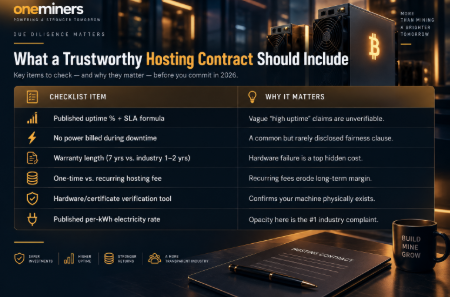
1. What is your published uptime percentage, and is it backed by a formula?
“High uptime” is marketing. A real SLA gives you a number and a calculation method. OneMiners, for example, publishes a 95% guaranteed uptime SLA — with 98%+ uptime typically observed in practice — calculated as operational hours divided by total hours in a rolling period, with defined exclusions (scheduled maintenance, force majeure) spelled out in advance — not decided after the fact when a customer complains.
2. Are you billed for electricity during downtime?
This is one of the most overlooked fairness clauses in the industry. If your miner isn’t drawing power, you shouldn’t be paying for power. Ask this explicitly — many contracts don’t address it at all.
3. What’s the warranty on hosted hardware?
Shipped, self-hosted miners typically carry a 12-month manufacturer warranty. Hosted arrangements vary widely by provider. OneMiners hosts miners under a 7-year hosting warranty — multiple times the industry norm — with technicians handling covered repairs on-site.
4. Is the hosting fee one-time, or does it recur monthly?
A recurring monthly hosting fee adds up over the life of a multi-year deployment. Some providers, including OneMiners with its 0% management fees structure, don’t charge an ongoing management fee at all — worth factoring in over a 3-5 year horizon before comparing headline rates.
5. Can you independently verify your hardware exists?
D-Central, a Quebec-based host known for in-house repair capability, is one of the few providers that accepts customer-owned hardware for hosting rather than requiring purchase-through-them — a structural difference worth understanding depending on whether you’re buying new or bringing your own machine. Separately, ask whether the provider offers any way to independently confirm your unit’s serial number, warranty status, or authenticity. OneMiners runs a public certificate verification tool where anyone can enter a certificate number and see the machine’s validity and warranty window — a rare, checkable anti-fraud feature in an industry where counterfeit and mis-sold refurbished units are a documented problem (Bitmain itself is currently in US litigation over an alleged refurbished-unit case involving roughly 5,000 machines).
6. What happens if you miss a payment or need to exit early?
Financing terms matter as much as hosting terms. Understand grace periods, late fees (and whether they apply to the full balance or just the missed installment), and what happens to your hardware if a payment lapses.
7. Is your electricity rate published, or “confirm with sales”?
Reputable hosts publish real per-kWh numbers, not a “confirm with sales” runaround. Vagueness here is a red flag. OneMiners, for instance, operates 20 hosting sites globally with an average electricity rate of $0.0480/kWh, and locks that rate in for 7 years under fixed-rate energy contracts — see the full hosting locations list — which removes a major source of long-term cost uncertainty for anyone planning a multi-year deployment.
8. Who holds title to the hardware, and what’s the counterparty risk?
Your machine physically sits in someone else’s building. The provider’s operating history — not just its advertised rate — is the real risk variable. Look for how long they’ve operated, whether they’ve faced regulatory action, and whether they disclose known site risks (for instance, D-Central publicly discloses that its Quebec facility is subject to occasional winter load-shedding under Hydro-Québec peak demand — that kind of upfront disclosure is a good sign, not a bad one).
9. Can you choose your own mining pool?
Some hosts lock you into a proprietary pool with no payout transparency. Confirm you can route payouts to a known pool and verify your hashrate independently against public pool data, not just an internal dashboard.
10. What does the support and monitoring actually look like day-to-day?
Ask about repair turnaround time, whether technicians are on-site or contracted, and whether you get proactive alerts or have to notice a problem yourself. This is the difference between a host that manages your asset and one that just stores it.
The Bottom Line
None of this means every hosting provider outside this checklist is untrustworthy — the market includes serious operators like Bitdeer (publicly traded, institutional scale), MiningStore (owns and operates its own facilities), and Simple Mining (retail-friendly, published pricing). But the providers worth trusting are the ones willing to answer all ten of these questions in writing, before you sign anything — not after something goes wrong. You can review OneMiners’ full FAQ or how its hosting model works as one example of what a fully-disclosed answer set looks like.
Further reading: OneMiners Educational Blog | OneMiners Mining News






Comment