
OneMiners vs. the Top Bitcoin Mining Hosting Providers: A Detailed Price Comparison


Introduction
Choosing a Bitcoin mining hosting provider is one of the biggest financial decisions a miner will make — and the difference between two “competitive” hosting rates can add up to thousands of dollars a year once you factor in electricity, setup fees, and contract terms. In this guide, we break down how OneMiners compares on price against five other major names in the mining hosting space: Compass Mining, Blockware Solutions, D-Central Technologies, Mining Bros, and NiceHash Hosting.
Mining hosting pricing comes down to five components:
- Electricity rate (billed per kWh) — the single biggest driver of your monthly cost
- Setup or onboarding fee — a one-time cost to rack and configure your machine(s)
- Minimum contract length — shorter terms often carry a price premium
- Maintenance/management fee — ongoing servicing, monitoring, and repairs
- Minimum order size — some hosts require a minimum number of units or minimum hashrate
Quick Comparison Table
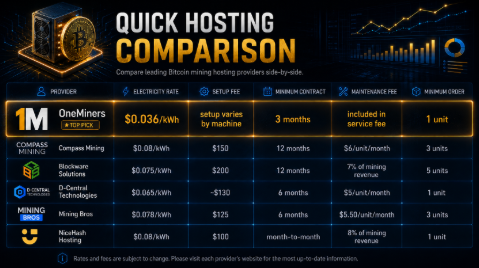
Bottom line: At $0.036/kWh, OneMiners prices electricity at roughly half the rate of every other provider on this list — even D-Central’s hydro-powered $0.065/kWh doesn’t come close. Combined with a 1-unit minimum order and a maintenance fee that’s simply folded into the service fee rather than billed separately, it’s the clearest price leader in this comparison, not just a competitive option. It’s also the only provider here offering Pay Later, letting customers start hosting before paying the full cost upfront — a payment option none of the other five brands compared here currently offer.
OneMiners: Pricing Breakdown
OneMiners’ headline number is what sets it apart: $0.036/kWh, roughly half the rate charged by every other provider in this comparison, including D-Central’s hydro-discounted $0.065/kWh. For a typical mid-size ASIC running 24/7, that gap alone can mean hundreds of dollars in savings per machine per month compared to the rest of the market.
Rather than a flat setup fee, OneMiners’ onboarding cost depends on the specific machine being hosted, with the exact figure shown at checkout — so the amount will vary based on which miner you’re deploying. Maintenance is handled the same way: instead of a separate monthly line item, it’s folded directly into the overall service fee shown at checkout, simplifying the bill down to one number rather than several add-on charges.
The minimum contract runs 3 months — shorter than the 6–12 month terms common among Compass Mining, Blockware Solutions, and Mining Bros, though not quite as flexible as NiceHash’s month-to-month option.
There’s also no minimum order size beyond a single unit, meaning a one-machine hobbyist gets the same rate as a large-scale deployment — most competitors reserve their best pricing for bulk orders.
The standout, though, is Pay Later — OneMiners lets customers begin hosting immediately and pay hosting costs later rather than requiring payment upfront. For beginners weighing the cost of getting started, this removes the biggest financial barrier that every other provider in this comparison still requires customers to clear on day one.
Why it’s the top pick on price: No competitor on this list comes close to OneMiners’ $0.036/kWh electricity rate, and the simplified billing (one service fee instead of separate setup and maintenance charges) makes the true cost easier to calculate upfront — a combination that makes it the strongest option on price by a clear margin.
Compass Mining: Pricing Breakdown
Compass Mining runs a hosting marketplace model, connecting customers with multiple third-party facilities rather than one company-owned site. Rates average around $0.08/kWh — more than double OneMiners’ rate — though this varies by which specific partner facility a machine lands in.
The $150 setup fee is standard across most placements, and the typical minimum contract runs 12 months, four times longer than OneMiners’ 3-month term. The $6/unit/month maintenance fee is on the higher end of the market, which partly reflects the overhead of coordinating across a multi-facility network. The 3-unit minimum order makes Compass a better fit for small-to-mid-size operations than solo hobbyists.
Blockware Solutions: Pricing Breakdown
Blockware Solutions typically bundles hosting with hardware sales, which shows up in its fee structure: the standalone $200 setup fee is commonly waived for customers who purchase their ASICs directly through Blockware. Hosting runs $0.075/kWh — roughly double OneMiners’ rate — with a 12-month minimum contract standard across most plans.
Rather than a flat maintenance fee, Blockware generally charges 7% of mining revenue — a model that scales with profitability but can cost more than a flat per-unit fee during high-revenue periods. The 5-unit minimum order reflects its focus on serious retail and small-institutional customers rather than single-machine miners.
D-Central Technologies: Pricing Breakdown
D-Central Technologies, based in Quebec, Canada, offers $0.065/kWh, a direct benefit of hydro-powered facilities in the region and the lowest rate among OneMiners’ competitors — though still nearly double OneMiners’ $0.036/kWh. The setup fee runs roughly $130 USD (CAD $175), and the minimum contract is 6 months, twice as long as OneMiners’ term.
Maintenance runs $5/unit/month, in line with the more affordable end of the market, and there’s no minimum order size — making D-Central a reasonable option for cost-conscious miners who can accommodate Canadian-based hosting and CAD billing, though it still trails OneMiners on headline price.
Mining Bros: Pricing Breakdown
Mining Bros prices hosting at $0.078/kWh, with a $125 setup fee and a 6-month minimum contract — a mid-market position on both price and commitment length, and more than double OneMiners’ electricity rate. The $5.50/unit/month maintenance fee sits just below the market midpoint, and the 3-unit minimum order targets small-scale operators rather than single-machine hobbyists.
NiceHash Hosting: Pricing Breakdown
NiceHash — best known for its hashpower marketplace — prices hosting at $0.08/kWh with a $100 setup fee, more than double OneMiners’ rate. Its standout feature on the pricing side is flexibility: NiceHash offers month-to-month contracts with no long-term commitment required, appealing to miners who want to test a facility before committing — the one area where it beats OneMiners’ 3-month minimum.
Rather than a flat maintenance charge, NiceHash typically applies an 8% revenue share — the highest percentage-based fee on this list, which is worth factoring in during high-revenue mining periods.
What Actually Affects Mining Hosting Prices?
Beyond the headline kWh rate, these factors explain most of the price variation between providers:
- Facility location: Regions with cheaper industrial power (parts of Texas, the Pacific Northwest, or hydro-rich Canadian provinces) generally offer lower base rates — this is part of why D-Central’s Quebec facilities undercut most of the other competitors, even though OneMiners still prices are lower overall.
- Cooling method: Immersion cooling facilities often charge a premium per kWh but can extend hardware lifespan and allow overclocking, which may offset the higher rate.
- Contract length: Longer commitments (12+ months) typically unlock lower per-kWh pricing versus month-to-month plans — which makes OneMiners‘ combination of a short 3-month term and the lowest rate on this list particularly notable.
- Hardware type: Newer, more power-efficient machines often qualify for better rates at facilities that prioritize efficient fleets.
- Order size: Bulk hosting (Compass, Blockware) typically unlocks better per-unit pricing than single-machine hosting, but comes with higher entry minimums.
Hidden Costs to Watch For
When comparing quoted rates, always confirm with the provider:
- Early termination or contract-break fees
- What insurance actually covers — theft, fire, hardware failure
- Shipping/logistics fees to get hardware to the facility
- Fees for firmware customization or overclocking/underclocking requests
- Downtime compensation policy — do you get credited for facility outages?
Final Verdict
On price, OneMiners is the clear leader in this comparison — its $0.036/kWh electricity rate is roughly half of every competitor’s, including D-Central’s hydro-powered $0.065/kWh, which is the next-lowest on the list. Combined with a 1-unit minimum order, a 3-month contract, and a simplified all-in service fee instead of separate setup and maintenance charges, OneMiners removes both the cost and complexity barriers that come with hosting elsewhere. NiceHash remains worth a look specifically for miners who want month-to-month flexibility over OneMiners’ 3-month term, and Compass Mining or Blockware Solutions may still suit large-scale, bulk-order operations — but on straightforward price, nothing here comes close to OneMiners’ rate.
Price is only one side of the equation. Once you have picked a host, the numbers that decide your actual return are uptime, hashrate, and how long the machine takes to pay for itself. We covered those in How Profitable Is Bitcoin Mining with OneMiners? Complete Guide.
Disclaimer
Cryptocurrency mining involves financial risk, including hardware depreciation, electricity market fluctuations, and network difficulty changes that affect profitability. Hosting rates and fees are subject to change; confirm current pricing directly with each provider before making a decision. This post is for informational purposes only and does not constitute financial advice.





Comment