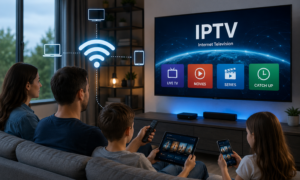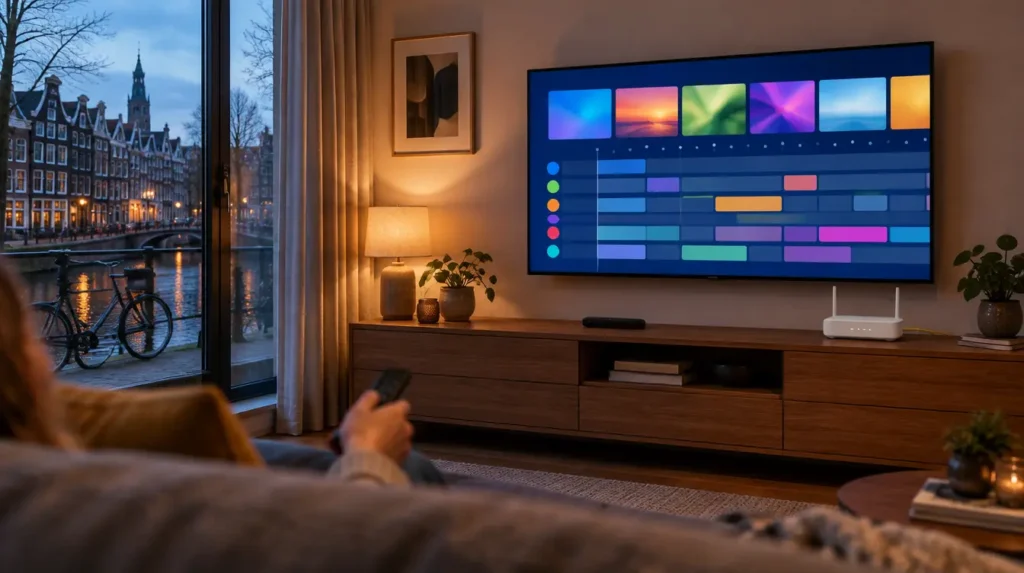
Television used to be an infrastructure business. Whoever owned the cable in the street or the transponder in orbit owned the customer. Over the past decade that link has loosened. The signal now travels over general-purpose broadband, and the television service has become one more application running on top of it. The industry term for this is IPTV, and the Netherlands is one of the clearest examples of what happens when a whole market makes the switch.
This article looks at the engineering that makes it work, the economics that follow from it, and what a buyer should weigh before signing up.
From broadcast to request
A broadcast network sends every channel to every home at once. An IP-based service does the opposite: it sends one stream to one device because that device asked for it.
Two delivery models sit under that description. Telecom operators often run managed networks, where live channels travel as multicast traffic inside the operator’s own infrastructure with reserved capacity. Independent services use the open internet, where each viewer receives an individual unicast stream. The first offers tighter control over quality; the second works on any connection, anywhere.
Both rely on the same idea for on-demand content. Video is cut into short segments of a few seconds each, and the player fetches them one after another over ordinary web protocols. The two dominant formats are HLS and MPEG-DASH.
Adaptive bitrate: the reason it rarely freezes
The feature that made internet television usable is adaptive bitrate streaming. Each programme is encoded several times at different quality levels, from a low-resolution version of under a megabit per second up to a 4K version of twenty or more. The player measures the connection continuously and picks the best version it can sustain for the next segment.
When someone else in the house starts a large download, the picture softens for a few seconds instead of stopping. When the line clears, quality climbs back. Viewers mostly never notice, which is the point.
Compression matters just as much. H.264 remains the universal baseline. HEVC roughly halves the bitrate for the same picture, and AV1 improves on that again, at the cost of more demanding decoding. Every step down in bitrate lowers the provider’s delivery bill and widens the range of connections that can carry a clean 4K image.
The delivery chain
Between the source and the screen there are four stages.
- Ingest. The provider receives channel feeds and on-demand files.
- Encoding and packaging. Each feed is compressed into the quality ladder and cut into segments.
- Distribution. A content delivery network copies those segments to servers close to viewers, so a household in Groningen is served from the Netherlands and not from another continent.
- Playback. An app on the television, stick, phone or set-top box requests segments, decodes them and draws the programme guide.
The weak point is usually the last few metres. A stream that is perfect at the network edge can still stutter over crowded Wi-Fi, which is why a wired connection to the main screen remains the most effective single improvement.
One trade-off is worth knowing about. Segmented streaming adds delay, so a live event can run anywhere from a few seconds to half a minute behind a traditional broadcast. Low-latency variants of the streaming formats are closing that gap, but anyone who follows live sport alongside a group chat will have met the problem.
Why the Dutch market moved early
The technical conditions in the Netherlands are close to ideal. Fast fixed broadband reaches the great majority of homes, fibre keeps expanding, and home connections are rarely capped. A stable HD stream needs around 10 Mbit/s, so the capacity is there with room to spare.
Behaviour followed capacity. Dutch viewers adopted catch-up viewing early, and many households now watch across a television, a tablet and a phone during the same evening. People who search for IPTV in Nederland are usually comparing exactly that: how many screens, for how long, at what total cost. Dutch-language overviews such as IPTV in Nederland organise packages along those lines.
The economics of the subscription
Moving delivery onto general broadband changes the cost structure. A provider no longer needs its own physical network to reach a customer, and it no longer needs to ship a dedicated box. The marginal cost of adding a subscriber falls to bandwidth and support.
That shows up in how the product is sold. The traditional model was a base bundle with paid extras layered on top and a contract measured in years. The newer model is a flat price for a fixed term, typically six, twelve or twenty-four months, scaled by the number of simultaneous screens. A typical IPTV kopen page sets those combinations side by side, which makes the real comparison a simple one: total price divided by months, for the number of screens the household needs.
For the buyer, three figures matter more than the advertised channel count:
- Simultaneous streams. The number of screens that can play at once, not the number of devices allowed to log in.
- Effective monthly cost. The total price divided by the term.
- Renewal behaviour. Whether the term ends by itself or renews automatically.
Licensing is part of the product
The delivery technology is neutral. Rights are not. A provider needs agreements covering the channels and programmes it distributes, and the cost of those rights is a large part of what any legitimate service charges.
That gives buyers a useful test. A price far below what licensed distribution could support, missing company details, payment only by cryptocurrency or private transfer, and no published terms are all reasons to look elsewhere. European courts have held that knowingly streaming from an unlicensed source can itself be unlawful, so the question is the customer’s as well as the seller’s. Asking a provider how its content is licensed is a reasonable step before paying.
What comes next
Three developments are worth watching. Lower-latency streaming will narrow the gap with broadcast for live events. More efficient codecs will keep cutting the bandwidth needed for high-resolution video. And as fibre coverage grows, the distinction between a managed operator network and the open internet will matter less to the viewer.
The direction is settled. Television is becoming software delivered over a general-purpose network, and the subscription is becoming a simple, time-limited contract. In a market with infrastructure as strong as the Dutch one, the technology is no longer the constraint. The quality of the provider, and the terms it offers, are what is left to compare.