
Hisense U7SG Review: A Big-Screen TV Built for Movies, Shows, Sports and Gaming at Home

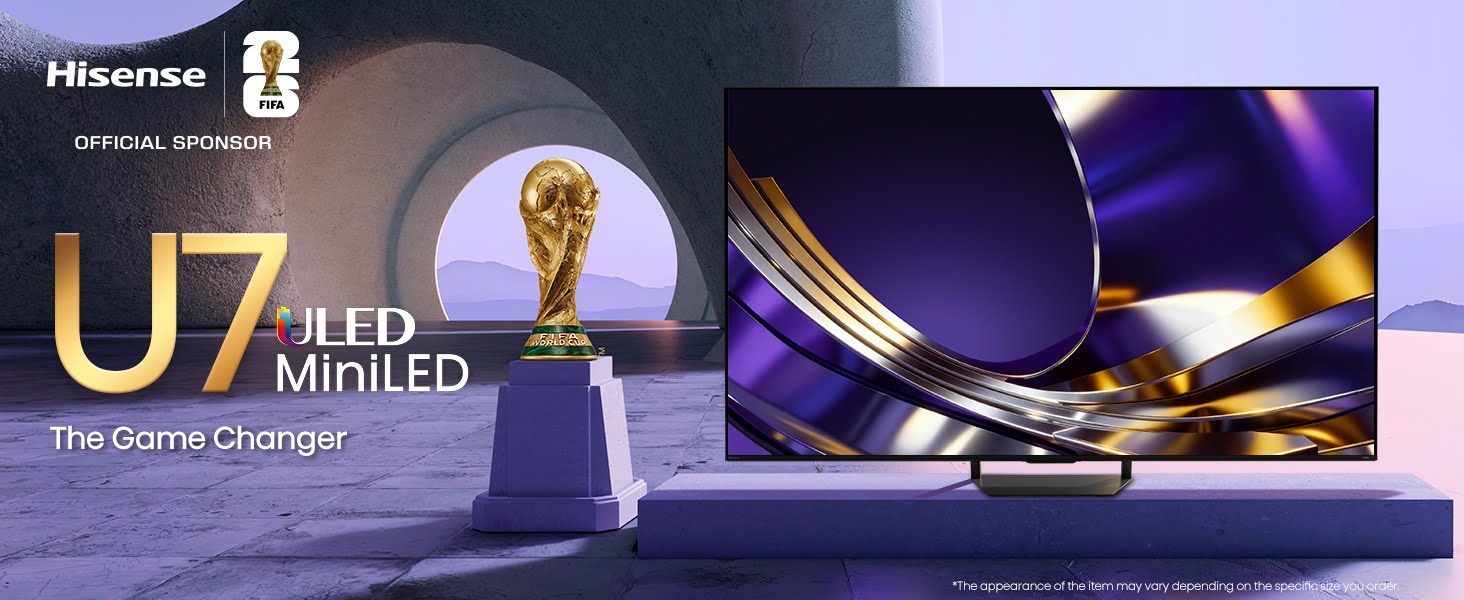
The modern television has a demanding job. It needs to handle cinematic films at night, live sport during the day, fast-paced gaming, streaming services and everyday television without requiring viewers to constantly adjust settings. For households investing in a large-screen TV, picture quality alone is no longer enough. Motion handling, brightness, reflections, colour accuracy, gaming performance, sound and smart features all matter.
The Hisense U7SG Smart Google TV is designed around precisely that kind of mixed use. Rather than concentrating on a single headline specification, the U7SG combines Hi-QLED MiniLED Pro display technology, a native 165Hz refresh rate, anti-reflection treatment, AI-assisted picture processing, high peak brightness, Pantone Validated colour and gaming features capable of supporting refresh rates of up to 330Hz VRR.
The result is a television designed to move comfortably between a bright-room sporting event, an evening film and a high-frame-rate gaming session.
According to Hisense’s U7 product brief, the U7 platform is positioned around speed and clarity, combining 165Hz motion, MiniLED brightness and intelligent AI processing for films, sport and next-generation gaming.
Hi-QLED MiniLED Pro: More Precise Control of Light
At the heart of the U7SG is Hi-QLED MiniLED Pro, and it is the logical place to begin when considering the television’s picture performance.
MiniLED technology uses thousands of considerably smaller backlights to provide more precise control over illumination across the screen. This matters because one of the perennial challenges for an LED television is displaying very bright and very dark elements simultaneously without compromising either.
The U7SG’s approach is designed to produce bright highlights while preserving convincing blacks and detail in darker areas. That can make a meaningful difference across different types of content. A night-time film can retain detail within shadows, while a daytime sporting event can remain bright and vibrant.
Hi-QLED technology adds an emphasis on a broad and accurate colour range, helping the screen reproduce vivid colours without relying simply on excessive saturation. Hisense describes the system as using thousands of MiniLED backlights for precise control alongside Hi-QLED technology for greater colour accuracy and intensity.
Native 165Hz Refresh Rate for Fast-Moving Content
Motion performance becomes increasingly important as screens get larger. Blur, judder and smeared frames that might be relatively unobtrusive on a small television can become much easier to notice when the picture occupies a substantial portion of your field of view.
The U7SG therefore incorporates a native 165Hz refresh rate.
This is particularly relevant to gaming, live sport and action-heavy entertainment. Football, motorsport and other rapidly moving broadcasts can benefit from smoother reproduction, while compatible games can take advantage of the television’s higher-refresh-rate capabilities.
The objective is straightforward: keep movement fluid and make fast action easier to follow. Hisense specifically positions the native 165Hz panel as a way of reducing blur, lag and smeared frames during high-speed content.
For households that use the same television for films, television programmes, sport and gaming, this versatility is arguably more useful than a display optimised primarily for one type of content.
Anti-Reflection and Glare-Free Viewing
A television’s laboratory specifications tell only part of the story. The room in which it is installed can have an equally important effect on the viewing experience.
Large windows, overhead lighting and afternoon sunlight can introduce distracting reflections, particularly on a large display. The U7SG addresses this with anti-reflection and glare-free screen technology.
Hisense uses an advanced dual-layer screen treatment intended to minimise reflections and glare more effectively than a conventional single-layer approach.
This is an important practical consideration for a television intended to operate as the centrepiece of a living room rather than exclusively in a dark home-cinema environment. A family might watch football on a bright Saturday afternoon and a film after dark on the same television. The display therefore needs to perform under substantially different ambient-light conditions.
Reducing visible reflections helps preserve clarity and allows viewers to concentrate on the content rather than what is being reflected back at them.
Hi-View AI Engine Pro Makes Picture Optimisation More Automatic
Artificial intelligence has become increasingly important in television processing, although its usefulness ultimately depends on whether it improves the viewing experience rather than simply adding another specification to the box.
The U7SG uses the Hi-View AI Engine Pro to analyse content and make real-time adjustments to picture characteristics including colour, contrast and detail.
The practical advantage is adaptability.
A dark cinematic drama presents a different processing challenge from a brightly lit football match, while an animated programme may require different treatment again. Instead of expecting the viewer to repeatedly navigate picture menus, the processor can optimise relevant characteristics as the content changes.
That should make the television particularly appealing to households in which several people use the same screen for very different purposes. Advanced users can still care about their preferred settings, but everyday viewers benefit when the television can perform much of the optimisation automatically.
Up to 3,000 Local Dimming Zones and Up to 3,000 Nits Peak Brightness
Brightness is important, but how a television controls that brightness is arguably just as significant.
Depending on screen size, the U7SG offers up to 3,000 local dimming zones and up to 3,000 nits of peak brightness.
Local dimming divides the backlight into independently controlled areas. Rather than illuminating the entire display uniformly, different parts of the picture can be brightened or darkened according to what is happening within the scene.
Imagine a bright object against a predominantly dark background. More precise lighting control can help the bright element retain its intensity while surrounding areas remain appropriately dark. Hisense says its precision lighting zones are designed to produce stronger contrast, sharper edges around bright objects and vivid highlights while maintaining detail in dark scenes.
High peak brightness is also particularly useful in well-lit rooms and for HDR material, where small but intense highlights can contribute substantially to perceived depth and realism.
Hi-QLED Colour with Pantone Validated Accuracy
Brightness and contrast need convincing colour reproduction to complete the picture.
The U7SG combines its Hi-QLED technology with Pantone Validated colour, providing an independent reference point for colour accuracy.
The benefit can be appreciated in ordinary content as much as carefully produced films. Team colours should look recognisable during sport; grass, landscapes and clothing benefit from natural tonal variation; skin tones need subtlety; and games increasingly contain richly detailed environments where colour is an important part of their visual design.
Hisense describes the technology as delivering natural, accurate colour for applications ranging from sports uniforms and grass textures to cinematic skin tones and gaming environments.
The important distinction is between colour that merely looks intense and colour that remains convincing. Pantone validation strengthens the U7SG’s emphasis on the latter.
AI Smooth Motion and Motion Rate 660
The native 165Hz panel is complemented by AI Smooth Motion and Motion Rate 660.
Here, AI-assisted processing analyses fast-moving sequences and helps create smoother transitions between frames. The intention is to reduce the blur and choppiness that can make rapid camera movements or quickly moving objects difficult to follow.
Hisense says the system intelligently fills in frames between fast-moving scenes to maintain a sharper, smoother picture across sport, action films and gaming.
This complements rather than replaces the native refresh rate. The underlying high-refresh-rate panel provides the foundation, while motion processing is intended to improve how different sources and types of content are presented.
For sports fans in particular, this combination is significant. Following a fast-moving ball, player or racing car across a large display places considerable demands on motion handling.
Game Booster 330 with Enhanced Game Bar
Gaming receives more than a token game mode on the U7SG.
Game Booster 330 with Enhanced Game Bar supports enhanced refresh rates of up to 330Hz VRR on compatible configurations and content, with the goal of delivering smoother motion and lower input lag. Hisense also provides an on-screen Game Bar through which players can monitor information including FPS, VRR and HDR and adjust relevant settings without leaving their game.
Variable Refresh Rate is especially useful because a game’s frame rate does not necessarily remain constant. Synchronising the display more closely with the source can contribute to a smoother and more responsive experience.
The Enhanced Game Bar is the more practical half of the equation. Rather than hiding gaming controls several layers deep in a conventional settings menu, it puts useful information and adjustments closer to the player.
That combination helps the U7SG serve as both a home-entertainment television and a serious gaming display rather than forcing buyers to choose between the two roles.
2.1.2 Multi-Channel Surround Sound Tuned by Devialet
A large picture is considerably less convincing when accompanied by thin audio, so Hisense has also paid attention to the U7SG’s sound system.
The television features a 2.1.2 multi-channel surround configuration tuned by Devialet, designed to create a fuller and more immersive sound field. Hisense’s brief describes the system as delivering sound from multiple directions so that dialogue, music and effects feel more closely integrated with the picture.
The inclusion of Dolby Atmos adds another dimension to compatible content by supporting a more spatial presentation of sound.
For viewers building a dedicated home-cinema system, separate audio equipment may still be desirable. But capable integrated audio makes the television considerably more useful straight out of the box, particularly for households that prefer a cleaner installation without multiple speakers around the room.
Google TV with Gemini Interactive AI
The U7SG’s intelligence extends beyond picture processing.
It runs Google TV with Gemini Interactive AI, turning content discovery into a more conversational experience. Instead of searching solely by programme title, viewers can describe what they want to watch and receive recommendations.
Hisense says Gemini can provide personalised recommendations across more than 10,000 apps, while also answering questions and presenting visual information covering areas such as sport, news, fitness, cooking and travel.
That addresses one of the less discussed problems with modern streaming: having enormous amounts of content available does not necessarily make it easier to decide what to watch.
Conversational discovery can potentially reduce the time spent moving between individual applications and browsing menus.
The U7SG also includes a Backlit Voice Remote Control, with illuminated keys and a Find My Remote function. Ambient-light sensing adjusts the key illumination according to the room conditions, a small but useful feature when switching between daytime viewing and a darkened room for films.
HDR, Dolby Vision and the Big-Screen Cinema Experience
The U7SG also supports a broader home-cinema proposition through HDR technologies including Dolby Vision, accompanied by Dolby Atmos audio and IMAX Enhanced capabilities.
Dolby Vision is designed to provide expanded brightness, contrast and colour information with compatible HDR material, while Dolby Atmos contributes to a more spatial audio experience.
IMAX Enhanced, meanwhile, is intended to bring aspects of the IMAX presentation experience into compatible home-entertainment content.
That combination is particularly relevant because the U7SG is available in large screen sizes. The range extends across 55-inch, 65-inch, 75-inch, 85-inch and 100-inch models, allowing buyers to select a size appropriate to their room and viewing distance rather than treating “big screen” as a single category.
Connectivity for Modern Streaming
A smart television increasingly depends on its network connection. High-resolution streaming, cloud-based services and connected gaming can all place considerable demands on home Wi-Fi.
The U7SG therefore includes Wi-Fi 6E, designed to support fast and stable wireless connectivity when paired with compatible networking equipment.
It may not be as visually impressive a specification as MiniLED brightness or a 165Hz panel, but connectivity is fundamental to the experience of a television increasingly built around streaming applications and online services.
Final Thoughts
The Hisense U7SG is best understood not through any single specification, but through how its technologies work together.
Hi-QLED MiniLED Pro provides the foundation for brightness, contrast and colour. A native 165Hz refresh rate and AI Smooth Motion address fast-moving entertainment. Anti-reflection treatment makes the screen better suited to real-world living rooms, while up to 3,000 local dimming zones and up to 3,000 nits of peak brightness strengthen its HDR and bright-room credentials. Pantone Validated colour adds an emphasis on accuracy, and Game Booster 330 extends the television’s capabilities for high-refresh-rate gaming.
The supporting features are equally relevant. The Hi-View AI Engine Pro automates picture optimisation, the 2.1.2-channel system tuned by Devialet strengthens integrated audio, and Google TV with Gemini introduces conversational discovery to a platform spanning thousands of applications.
For a household looking for one large television to move between films, streaming programmes, live sport and modern gaming, that breadth is the central proposition of the Hisense U7SG. Rather than requiring different equipment for different forms of entertainment, it is designed to make the living-room screen capable of adapting to whatever the household wants to watch or play next.






Comment