
The Shift to AI-Native CLM: How Enterprise Contract Intelligence Drives Strategic Value in 2026

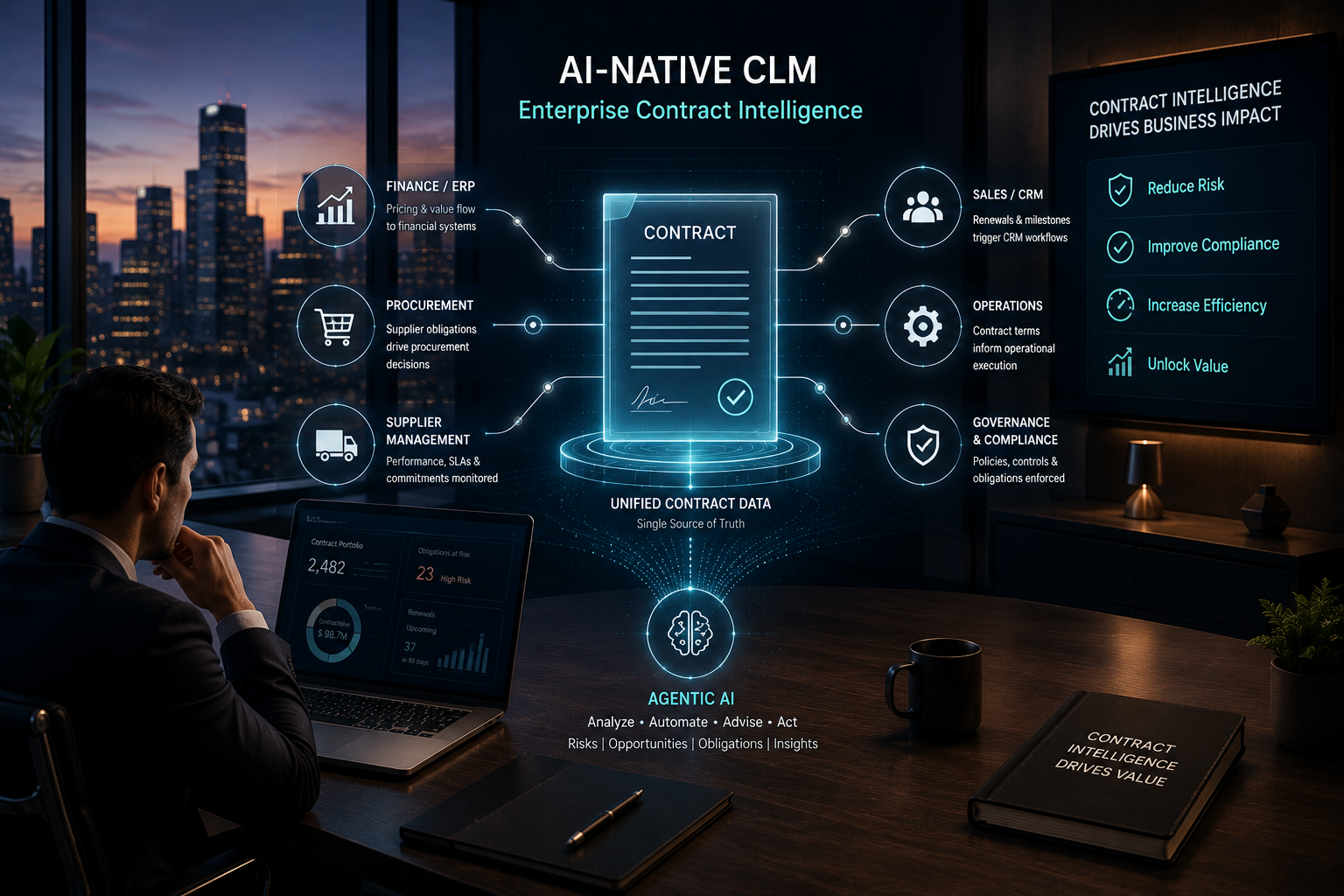
Enterprise contracts have evolved far beyond legal agreements. They define commercial commitments, supplier performance expectations, pricing structures, regulatory obligations, and revenue opportunities that influence business performance long after signature. Yet many organizations still manage contracts as static documents rather than dynamic sources of enterprise intelligence. The shift to AI-native Contract Lifecycle Management (CLM) is changing that paradigm. By combining structured contract data, agentic AI, enterprise integrations, and continuous analytics, AI-native platforms transform contracts into strategic assets that inform procurement, legal, finance, sales, and operations throughout the contract lifecycle. As enterprises accelerate AI adoption in 2026, the question is no longer whether contracts should be digitized – it is whether organizations can convert contract intelligence into measurable business outcomes.
Why This Happens Traditional CLM platforms were designed primarily to manage documents rather than generate business intelligence. Their core function was to support drafting, negotiation, execution, storage, and retrieval, with limited visibility into how contractual obligations affected operational and commercial performance after signature. Modern enterprises, however, require contracts to function as active data assets. Pricing commitments must influence finance systems. Supplier obligations should inform procurement decisions. Renewal terms need to trigger sales workflows. Compliance requirements must connect with governance processes. When contracts remain isolated from enterprise systems, organizations lose the ability to make informed, data-driven decisions across the business. The transition to AI-native CLM addresses this challenge by treating contracts as continuously evolving sources of structured intelligence rather than static legal documents.
Beyond Departmental Silos The challenge extends beyond simply sharing documents across departments. In many organizations, critical contract intelligence never reaches the business systems responsible for executing contractual commitments. Pricing obligations remain disconnected from ERP systems. Renewal milestones fail to trigger CRM workflows. Supplier commitments are separated from procurement operations, while compliance obligations remain isolated from governance processes. As a result, organizations struggle to operationalize the intelligence already contained within their contracts. AI-native CLM platforms address this fragmentation by creating a unified contract data layer that connects legal agreements with enterprise operations in real time.
Why It Persists Despite growing awareness of AI’s potential, many enterprises continue to rely on document-centric CLM models. The challenge is rarely a lack of technology. Instead, organizations face operational, architectural, and organizational barriers that slow transformation. Legacy contract repositories remain deeply embedded within enterprise environments, making large-scale modernization complex. Contract data often exists in inconsistent formats, limiting its usefulness for AI-driven analysis. At the same time, legal, procurement, finance, and sales teams frequently operate with different objectives and disconnected workflows, making enterprise-wide contract intelligence difficult to establish. The transition to AI-native CLM therefore requires more than deploying new software. It requires organizations to rethink contracts as operational data that supports continuous decision-making across the enterprise.
What Would Actually Fix It Unlocking strategic value from contracts requires a shift from document management to enterprise contract intelligence. Rather than simply storing agreements, AI-native CLM platforms continuously capture, structure, analyze, and operationalize contract data across the business.
Several capabilities enable this transformation:
Unified Contract Data: A centralized contract data model creates a single source of truth, allowing procurement, legal, finance, sales, and operations to work from consistent contractual intelligence. Enterprise Integrations: Native connections with ERP, CRM, procurement, supplier management, and governance platforms ensure contract intelligence flows directly into downstream business processes. Agentic AI and Intelligent Automation: AI agents can automate routine workflows, surface contractual risks, recommend negotiation strategies, and proactively monitor obligations throughout the contract lifecycle. Continuous Governance: Embedded audit trails, policy controls, and explainable AI help organizations maintain transparency, strengthen compliance, and build trust in AI-assisted decision-making.
Together, these capabilities transform contracts from static records into continuously available business intelligence that supports faster decisions and stronger commercial outcomes.
From Predictive Analytics to Autonomous Contract Intelligence Predictive analytics helped organizations anticipate contract risks. AI-native contract intelligence goes further by reasoning over contractual data, recommending actions, orchestrating workflows, and enabling autonomous execution across enterprise systems. Instead of simply identifying potential issues, AI can continuously monitor contractual performance, recommend corrective actions, surface commercial opportunities, and assist business users through conversational interfaces. This enables organizations to move beyond reactive contract management toward proactive contract intelligence that continuously creates business value. AI-native CLM platforms such as Sirion combine structured contract data, agentic AI, workflow automation, and enterprise integrations to transform contracts into continuously accessible business intelligence. Rather than limiting visibility to signed documents, organizations can monitor obligations, manage commercial risk, automate approvals, and generate real-time insights that support enterprise-wide decision-making throughout the contract lifecycle.
Conclusion The future of Contract Lifecycle Management is no longer defined by how efficiently organizations store contracts, but by how effectively they activate the intelligence those contracts contain. As enterprises continue their AI transformation in 2026, contracts are becoming strategic data assets that inform commercial decisions, strengthen governance, improve operational resilience, and accelerate business execution. Organizations that embrace AI-native CLM will be better positioned to move beyond document management and build connected, intelligence-driven contract operations that create measurable enterprise value throughout the contract lifecycle. In the AI-native enterprise, competitive advantage will increasingly depend not on how well organizations store contracts, but on how effectively they transform contract intelligence into business action.





Comment