An action research study of a mid-sized automotive components company found that structuring the S&OP process, a formal team, defined roles, and a scheduled demand review, cut average monthly inventory cost by 18.42% and lifted service level by three points within seven months. The meeting itself barely changed. What changed was what arrived at it.
Most organizations already run a monthly S&OP process. Few walk in with what the meeting actually needs to produce a decision. This guide will explain the four inputs that separate a decision meeting from a status update.
Input 1: One consensus number instead of three
The most common failure in a monthly review is walking in with sales, finance, and operations each holding a different demand figure. Research on S&OP team structure found that centralization of decision-making has a negative effect on performance, while information quality shared across the team is one of the strongest drivers of a functioning S&OP process. That research points toward building the consensus number ahead of the meeting: the room reviews a plan instead of assembling one.
Input 2: A supply plan constrained against real capacity
An unconstrained demand number is a wish list with a due date. The S&OP process only produces a workable plan when supply has already been checked against capacity, material, and lead time before the meeting starts, so the group is choosing between feasible options rather than discovering an infeasible one mid-discussion. Rough-cut capacity planning belongs upstream of the room rather than inside it.
Input 3: Pre-modeled trade-off scenarios
A trade-off raised for the first time in the meeting gets deferred, almost every time. “Let’s take it offline” is what happens when nobody has already modeled what a demand-led plan costs against a margin-led one. Bringing two or three scenarios into the room, each with its service, inventory, and cost implications already worked out, turns the executive session into a comparison of options instead of a debate built from scratch.
Input 4: A record of what the last cycle decided
Without a decision log, the same trade-off resurfaces month after month, because nobody can point to what was agreed or why it changed. A written record of commitments, owners, and outcomes from the previous cycle is what lets a monthly review build on the last one instead of repeating it. This is the input teams skip most often, because it costs nothing to skip and the bill only arrives two or three cycles later.
Why the inputs matter more than the meeting format
None of these four inputs require a longer meeting or a bigger team. They require the work to happen before the room fills rather than during it. The S&OP process described in most textbooks assumes this is already true; the gap between that assumption and most companies’ Monday-morning reality is exactly where reviews turn into status updates.
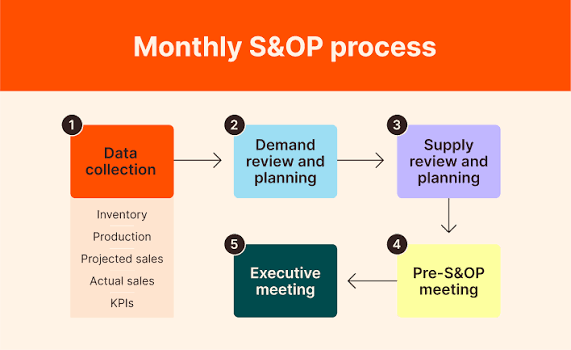
This is also the case for sales and operations planning software: it earns its place by producing these four inputs automatically, cycle after cycle, rather than depending on planners to assemble them by hand under a deadline. A sales and operations planning software platform that only reports the consensus number, without capturing how the group got there, leaves the same accountability gap a spreadsheet does. For the mechanics of the five-step monthly cycle itself, our S&OP process guide covers where each of these inputs is produced.
Frequently Asked Questions
What makes an S&OP process a decision meeting instead of a status update?
The meeting produces a decision when the four inputs, a consensus number, a constrained supply plan, modeled scenarios, and a decision log, already exist before the room fills. Without them, the meeting spends its time assembling information instead of acting on it.
Who is responsible for preparing these four inputs?
Demand planning owns the consensus number, supply planning owns the constrained plan, a smaller pre-S&OP group owns the scenarios, and whoever runs the cycle owns the decision log. Sales and operations planning software can hold all four in one place, but no single function can produce them alone.
Does sales and operations planning software replace the meeting?
No. Sales and operations planning software replaces the manual assembly work that currently eats the weeks before the meeting, so the room spends its time deciding rather than reconciling spreadsheets, and the decision log gets kept automatically instead of relying on someone remembering to write it down.
Closing
A monthly S&OP process earns its place on the calendar when it ends in a decision rather than when it simply happens. The four inputs above are what separate the two, and none of them depend on adding another meeting to the calendar.
Talk to our team to see how these four inputs show up, or don’t, in your current cycle.
Contact us to walk through your next S&OP cycle together.