Cross-border enterprises expanding across international jurisdictions face a frustrating reality: customer demand frequently outpaces payment acceptance. While performance marketing and product localization capture executive focus, checkout conversions routinely collapse between the customer’s payment submission and the acquiring bank’s settlement engine. For companies operating in specialized e-commerce, high-velocity subscription services, cross-border digital platforms, and complex services, payment decline codes are rarely technical errors. Instead, they represent structural friction between modern commerce and fragmented clearing rails.
Navigating these dynamics requires moving beyond off-the-shelf aggregators. Building a resilient revenue funnel demands a deep understanding of Bank Identification Number (BIN) routing, localized acquiring, and the specialized discipline of high-risk banking.
The Anatomy of the Cross-Border Authorization Deficit
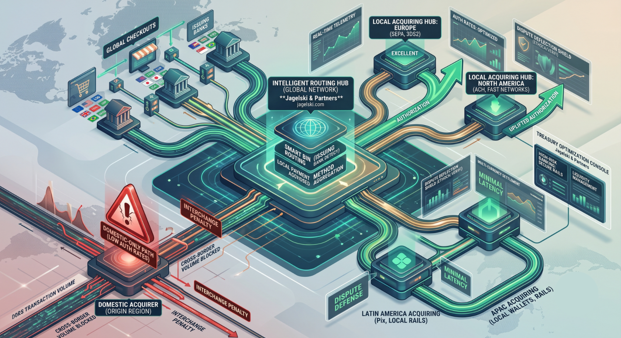
When an enterprise relies on a single merchant acquiring account in its home jurisdiction to process payments from global customers, it experiences an immediate authorization penalty. A typical domestic transaction within the European Economic Area or North America can achieve authorization rates above 90%. However, when a cardholder in Singapore, Australia, or Brazil attempts to transact through an acquiring bank located thousands of miles away, authorization rates frequently plummet to 65% or lower.
This performance drop is driven by automated risk rules enforced by the cardholder’s issuing bank:
- Out-of-Region Fraud Scoring: When an issuing bank detects a foreign acquiring location, its fraud scoring system automatically assigns an elevated risk weight to the transaction, suspecting card-not-present fraud or compromised credentials.
- Mismatched Currency Conversions: Dynamic Currency Conversion (DCC) and cross-border currency mismatch can trigger real-time cardholder velocity blocks or automatic declines from issuing systems that restrict foreign exchange exposure.
- 3D Secure Protocol Drop-Offs: Divergent regional implementations of strong customer authentication (such as varying regional mandates for 3DS2) cause unexpected authentication loops, resulting in elevated abandonment rates.
For mainstream retailers, these losses are painful; for companies operating in high-volume, non-standard sectors, they can be fatal. Unaddressed payment failures inflate customer acquisition costs, distort retention analytics, and drive payment processors to implement defensive reserves.
The Strategic Shift to Localized Acquiring and Smart BIN Routing
Enterprise treasury teams are actively replacing monolithic payment gateways with distributed acquiring frameworks. Under this model, businesses establish corporate entities and local merchant acquiring connections in key target territories.
By utilizing dynamic BIN routing, an enterprise evaluates the first six to eight digits of a card number in milliseconds at checkout. If the card was issued by a European bank, the transaction routes directly to a local European acquirer. If the card originates from a UK, Latin American, or North American issuer, the transaction directs to corresponding regional infrastructure.
The benefits of localized routing extend across the entire balance sheet:
- Authorization Uplift: Shifting cross-border volume to local clearing rails removes the geographic risk premium, routinely restoring approval rates by 10 to 25 percentage points.
- Interchange Optimization: Domestic transactions avoid expensive cross-border scheme fees and international interchange surcharges levied by Visa and Mastercard.
- Reduced Dispute Velocity: Local clearing enables clearer billing descriptors on cardholder statements, significantly reducing friendly fraud and confusion-driven chargebacks.
Beyond Credit Cards: The Expansion of Local Payment Networks
A common strategic mistake made by growing international businesses is assuming credit cards remain universal. In reality, consumer payment behavior is increasingly regionalized.
In several major markets, localized account-to-account (A2A) schemes, direct bank transfers, and domestic wallets account for more than half of all commercial transaction volume. Examples include Pix in Brazil, iDEAL (and the European Wero initiative) across key EU markets, and direct bank rails in the Nordics.
Integrating localized payment methods alongside traditional card acquiring reduces processor lock-in, bypasses interchange overhead, and eliminates traditional chargeback exposure entirely, as most bank-to-bank payment rails settle irrevocably. However, managing multi-currency treasury settlements from diverse payment schemes requires robust high-risk banking partners capable of aggregating and repatriating foreign exchange balances smoothly.
Navigating the Scheme Monitoring Thresholds
Higher processing volumes naturally generate dispute volume. Under active monitoring programs like the Visa Acquirer Monitoring Program (VAMP) and Mastercard’s dispute thresholds, maintaining control over operational ratios is an ongoing compliance imperative.
Exceeding established dispute thresholds (historically benchmarked around 0.9% to 1.0% dispute-to-transaction volume) triggers escalating fines from card schemes and exposes the enterprise to sudden processor termination. Once an acquiring institution faces penalties from card networks on behalf of an individual merchant, the merchant account is typically placed on rolling reserves or closed.
High-growth operators protect their merchant lines through proactive infrastructure:
- Pre-Chargeback Integration: Deploying automated alert networks (such as Ethoca and Verifi) that intercept consumer complaints before they escalate into formal chargebacks, issuing automated refunds to keep the formal ratio pristine.
- Fraud Scoring Calibration: Implementing device fingerprinting and behavioral velocity checks to stop automated card-testing attacks before transactions reach the acquiring switch.
- Volume Load Balancing: Distributing transaction volumes across multiple merchant identification numbers (MIDs) to prevent seasonal surges from distorting monthly risk metrics.
Unlocking Global Liquidity with Jagelski & Partners
Securing specialized cross-border merchant processing accounts and the underlying corporate banking facilities to settle funds is rarely straightforward. Traditional corporate banks often decline applications from non-standard business models out of compliance caution, while generic payment brokers routinely make empty promises about instant approvals.
This is where the boutique advisory practice at Jagelski & Partners sets the standard. Rather than subjecting enterprise clients to the reputational risk of unvetted, scattershot applications, the jagelski consultancy operates on an institutional matchmaking framework:
- Bespoke Portfolio Structuring: Analyzing operational models, processing track records, and corporate ownership to build institutional-grade compliance dossiers that address underwriting requirements in advance.
- Tier-1 Network Access: Directly introducing businesses to an extensive global network of vetted acquiring banks, electronic money institutions, and specialized corporate account providers across Europe, the UK, and international financial centers.
- End-to-End Treasury Infrastructure: Coordinating merchant processing facilities with segregated holding accounts, automated currency hedging rails, and international corporate banking partners.
By working with seasoned specialists who understand the mechanics of cross-border risk underwriting, enterprises replace operational vulnerability with institutional stability. To evaluate your payment processing architecture and access institutional corporate facilities tailored to your operating model, explore the advisory solutions at jagelski.com.