Most finance teams can tell you exactly what they spent on payroll last quarter. Ask them what they’re paying for their forty seventh SaaS subscription, and you’ll get a much longer pause.
That pause is expensive. The average midsized company now runs somewhere between 80 and 130 SaaS tools, and a large share of that spend renews automatically, on terms nobody renegotiates, tracked by nobody in particular. AI tools have only made this messier: teams are now stacking API credits, per seat AI assistants, and usage based model subscriptions on top of an already sprawling SaaS stack, often billed separately and reviewed by no one in particular. It’s not fraud, and it’s not laziness. It’s just that renewal management fell into the gap between procurement, IT, and finance, and none of the three ended up owning it.
Where the money actually leaks
The leak rarely shows up as one big mistake. It shows up as a hundred small ones, compounding quietly.
A team keeps 40 unused seats on a data analytics tool because nobody flagged that usage had dropped after a reorg. A contract auto renews at last year’s price plus an 8% “standard increase” that was never actually standard, just unchallenged. A vendor discount negotiated during a hard sales push two years ago quietly expires, and the account reverts to list price without anyone noticing until the invoice lands. An AI writing assistant purchased for one team during a pilot quietly renews company wide a year later, at ten times the original seat count.
Individually, each of these looks like a rounding error. Add them up across a full SaaS and AI stack, and companies routinely find that a fifth to a third of their software spend sits on renewals that were never actually reviewed, just paid.
Why this is a visibility problem, not a discipline problem
It’s tempting to frame this as a process failure, the kind where someone should have caught it. In practice, the problem is structural. Contract end dates live in a shared drive, or in someone’s inbox, or nowhere searchable at all. Usage data lives inside the tool itself, and rarely gets pulled before a renewal date rather than after. And the person who negotiated the original deal is often gone by the time it comes up for renewal, taking the context with them.
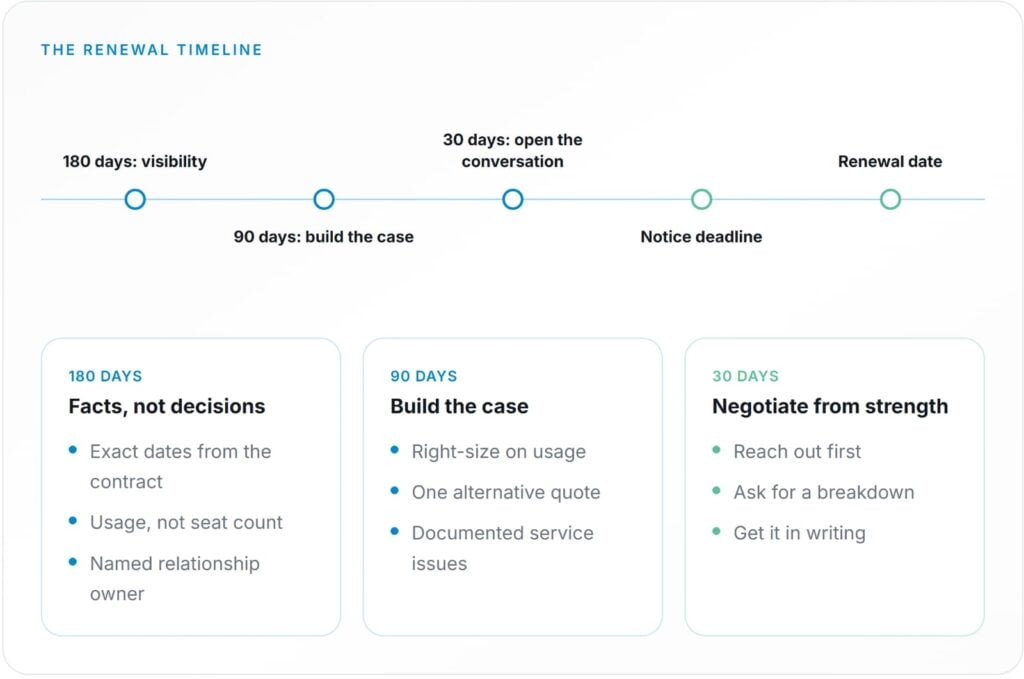
Finance ends up reactive by design. They see the renewal invoice, not the window beforehand, usually around three months, when there was actually leverage to negotiate, adjust seat counts, or walk away.
What better looks like in practice
The companies that get this right tend to do three unglamorous things well.
They track contract end dates and auto renewal clauses in one place that finance actually checks, not a spreadsheet that goes stale after the second update. They pull usage data before the renewal conversation, not during it, so “we have 100 licenses and use 60” is a known fact rather than a surprise raised mid negotiation. And they treat the two or three months before a renewal as an active negotiation window rather than an administrative formality, since vendors expect pushback at renewal far more than buyers realize, and most discounts simply go unclaimed because nobody asked.
This is exactly the gap that a newer category of tools, SaaS renewal and spend intelligence platforms like Venduris, has emerged to close. These platforms sit between procurement, IT, and finance, using usage data and AI driven anomaly detection to surface upcoming renewals, flag underused licenses across both traditional SaaS and the newer wave of AI subscriptions, and hand teams the negotiating leverage that usually gets lost in the handoff between departments. It’s a narrow problem compared to broader spend management, but a narrow problem that happens to sit on a lot of money.
The bigger picture
SaaS and AI spend are not going to shrink. They are among the few line items still growing steadily even as companies tighten budgets elsewhere. That makes renewal management less of a nice to have and more of a basic finance hygiene issue, similar in spirit to reconciling expense reports or auditing vendor contracts. The companies figuring this out now aren’t doing anything exotic. They are simply making sure someone, a person or a system, is actually looking at renewal timing and usage data before the date hits, instead of after the invoice does.
That shift alone tends to be where the missing fifth to a third of the budget goes.