
The Pre-Launch Community Audit Every Web3 Marketing Agency Should Run Before Investors Show Up


There is a moment in almost every Web3 fundraising conversation that founders never see coming. The investor nods at the tokenomics slide, then quietly opens a second browser tab — Discord, Telegram, X. What they find in the next four minutes often decides the outcome more conclusively than anything in the deck.
This is the cognitive gap behind most failed token raises: founders believe their community signals strength, while investors are reading data that tells a different story. The best Web3 marketing agency closes this gap before it costs a project its funding round. The tool that closes it is a structured pre-launch community audit.
Why Investors See What Founders Don’t
Investors apply forensic community analysis before formal due diligence begins — and founders rarely know the criteria being used.
The standard founder narrative: 18,000 Discord members, 12,000 Telegram subscribers, growing fast. The investor narrative: a group with 10,000 members but fewer than 20 messages a day is dead weight. A group with 800 members and 150-plus daily messages is where deals happen.
That gap — between audience size and community vitality — is exactly what investors are diagnosing. A 5,000-member group of genuinely engaged holders is worth more than 50,000 airdrop hunters who will sell at the first sign of price pressure. A 2025 analysis of 23 token launches valued above $50 million found that over 90% saw post-listing price declines, with 75% losing more than 60% of their value within four weeks — not because of weak technology, but because of misalignment between launch strategy and what the market actually values.
The pre-launch community audit is the intervention that closes this gap before investors find it themselves.
What Investors Actually Audit (And How to Get There First)
A professional community audit examines three signal layers that determine whether a community can sustain a token post-launch.
Signal Layer 1: Engagement Architecture
The first check any investor or Web3 marketing agency runs is engagement rate normalized against member count. The meaningful ratio is Daily Active Members (DAM) to total community size. Healthy pre-launch communities show a DAM ratio above 3–5%; anything below 1% across Discord and Telegram indicates a passive audience that will not convert to holders.
Key audit checkpoints:
- Reply chain depth — are members responding to each other, or is it one-way broadcast?
- Admin activity cadence — stale pinned content older than four weeks signals low operational investment
- Bot ratio — inflated usernames deflate the credibility of every other metric
- AMA participation rate — the share of members who actually attend and ask questions is one of the most reliable proxies for genuine conviction
Signal Layer 2: Community Is Truly Connected to Product Metrics
Real community strength shows up in product behavior, not follower counts. A pre-launch audit by a competent Web3 marketing agency maps community activity against available product signals — testnet interactions, whitelist wallet connections, quest completions on Galxe or Layer3 — and looks for correlation. When the two move together, the community is real. When they diverge, the audit flags a Sybil vulnerability.
Investors have seen this play out at scale. When Arbitrum ran its $1 billion ARB airdrop, independent researchers identified Sybil accounts and same-entity addresses accounting for nearly 70% of airdropped tokens. A Discord that cannot be connected to any product interaction looks structurally fragile to anyone who remembers that.
Signal Layer 3: Narrative Coherence Across Platforms
Discord builds long-term loyalty, Telegram accelerates participation, X generates awareness. An audit checks whether the narrative across all three is coordinated and escalating, or reads like three disconnected broadcasts. Fragmented messaging is a signal experienced investors read as operational immaturity.
The 5-Point Community Audit Scorecard
A structured pre-launch audit by the best Web3 marketing agency for your vertical should produce a score across five dimensions. The table below illustrates what healthy versus at-risk readings look like for a typical pre-launch Web3 project:
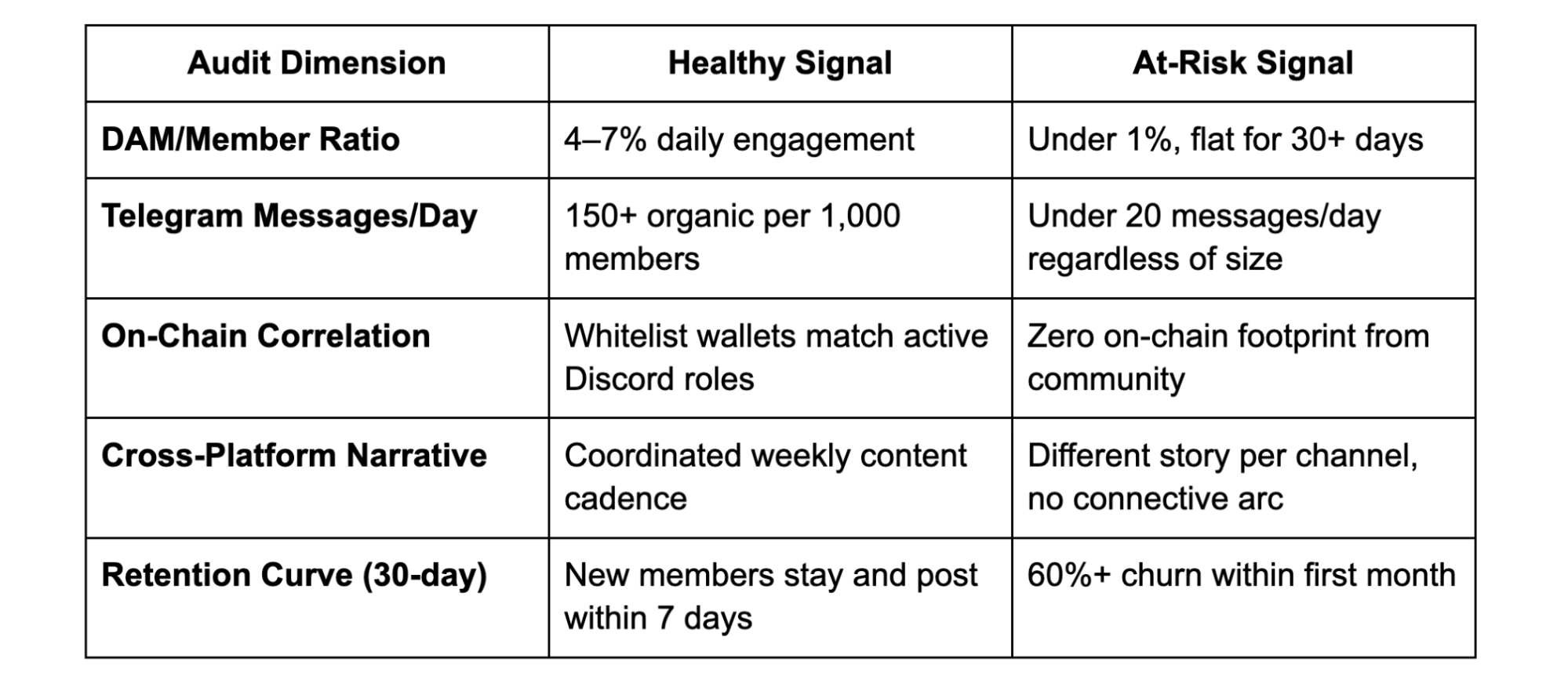
Protocols lacking a retention architecture see 60% or more churn inside 90 days, according to 2025 CoinGecko Labs research — a finding that makes the retention curve dimension of the audit the single most predictive factor for post-launch holder stability.
How the Audit Changes the Investment Conversation
Walking into a pitch with audit-grade community data shifts the founder from defensive to credible before the first question is asked.
When a founder presents community analytics rather than raw follower counts, the investor’s silent forensic check is preempted. They are no longer discovering problems — they are reviewing a team that already found and addressed them.
Investors in 2026 treat community engagement as evidence of real demand: active users, recurring participation, token holder involvement. The audit converts subjective community narrative into the objective language institutional capital speaks.
ICODA, a full-service Web3 marketing agency with 650+ clients across DeFi, GameFi, and token sales since 2017, builds this audit infrastructure specifically to surface these signals before investor meetings — with results including community scaling from zero to active audiences and measurable AI visibility gains in ChatGPT and Google AI Overviews.
The Five Most Common Failures the Audit Exposes
Most pre-launch communities contain at least two of the following. Each is fixable with four to eight weeks of lead time — and catastrophic if an investor finds it first.
- Ghost server syndrome. Member count says 35,000. Last organic message: eleven weeks ago. The Discord is a number, not a community.
- Airdrop farming contamination. Quest campaigns generated 8,000 new Telegram members with zero interest in the protocol. Retention collapses to zero within 30 days of the campaign ending.
- Cross-platform fragmentation. X pitches institutional utility. Discord is meme culture. Telegram mods answer with outdated whitepaper text. Three audiences, three stories, no identity.
- No feedback loop. Community sentiment has nowhere to go — so it festers in side channels and erupts publicly during market stress.
- Admin absence. Stale pinned messages and weeks of silence from moderators signal leadership disengagement to anyone who looks.
Each failure has a remediation path. The audit surfaces the issue; the plan — built by an experienced Web3 marketing agency — defines what to fix and when.
What a Best-in-Class Audit Delivers
The output is not a report. It is an investor-ready brief. The best Web3 marketing agency for pre-launch work delivers:
- A community health score across all five audit dimensions
- A red-flag register with severity classifications (critical / moderate / cosmetic)
- A 30-60-90 day remediation roadmap by platform
- An analysis linking community behavior to product interaction data
- A narrative coherence review across Discord, Telegram, and X
- A benchmark against comparable projects at the same stage
ICODA’s methodology covers community positioning, competitive architecture review, and AI visibility assessment — ensuring the project’s narrative surfaces in both traditional search and AI-generated responses, the channels institutional researchers now rely on.
Run Your Audit Before Investors Run Their Own
A strong community is a tangible asset that directly impacts valuation. Founders who act on this early present their community as evidence of execution — not a number to defend.
The four-minute investor check can become your strongest asset, if you run it first.
→ Request your free community audit from ICODA and get a full diagnostic of community health, on-chain correlation, and narrative coherence before any investor runs the same analysis on their terms.







Comment