Ahmedabad: The way businesses manage their workforce is evolving as organisations grow, digitise their operations and face increasingly complex employee administration requirements. Processes such as attendance and payroll, which have traditionally been handled as separate administrative functions, are increasingly being viewed as connected components of workforce management. For growing businesses, this is creating a stronger need for technology that can bring related HR processes into a more structured and manageable workflow.
The changing role of technology in workforce management is part of a broader shift in how businesses approach internal operations. Digital tools are increasingly being adopted across different functions, and HR is becoming an important part of this transformation. As employee numbers increase, businesses need processes that can handle larger volumes of workforce information while remaining practical for HR and administrative teams to manage.
Attendance and payroll are particularly relevant to this evolution because of their operational connection. Attendance information can form an important input into payroll processing, making coordination between the two functions essential. When businesses manage these activities through disconnected processes, teams may need to repeatedly transfer, verify and reconcile information before completing payroll.
Integrated HR technology offers a different approach. By connecting related workforce processes, businesses can create a more continuous flow of information and reduce the administrative friction associated with managing separate systems. The objective is not simply to digitise individual tasks, but to make the overall workforce management process more connected.
This becomes increasingly important as businesses scale. A workforce management process that works for a smaller team may become more difficult to maintain when employee numbers rise. More employees mean more attendance records, greater payroll-related information and increased administrative coordination. Without scalable systems, routine workforce processes can place additional pressure on HR and business teams.
For growing businesses, therefore, scalability is becoming an important consideration in HR technology. Organisations need systems and processes that can evolve alongside their workforce. An integrated approach can provide a more structured foundation for managing connected functions and help businesses approach workforce administration as an ongoing process rather than a series of isolated tasks.
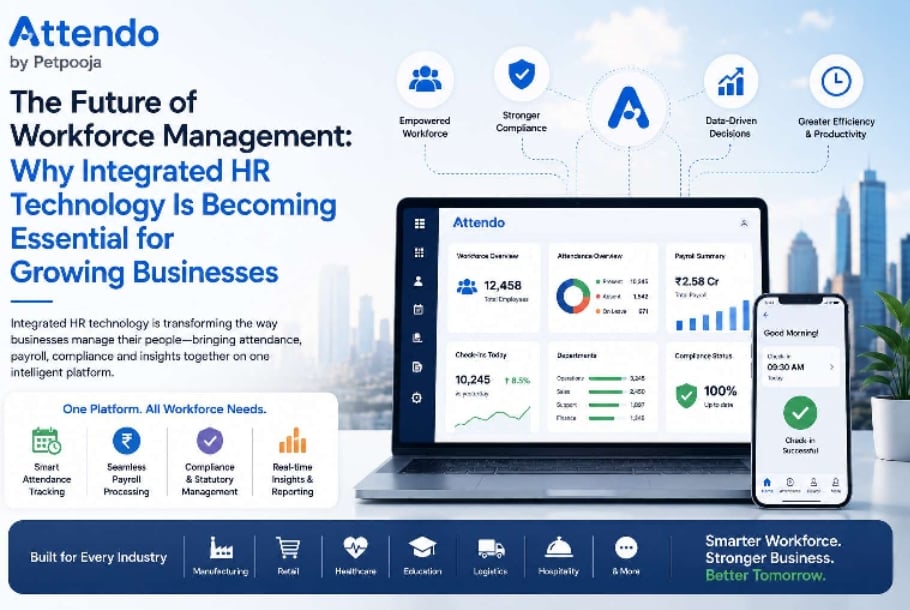
This broader evolution provides the context for the transition of Petpooja Payroll to Attendo. The new identity reflects the platform’s move beyond a F&B industry toward a broader workforce management positioning for every industry centred on attendance, payroll and related workforce processes. The campaign objective is to establish Attendo as a credible attendance-to-payroll and workforce management platform.
The emergence of Attendo also reflects the changing conversation around HR technology. The platform is not being positioned only around payroll processing for restaurants but around the relationship between attendance and payroll within workforce management for broader industry. This provides a broader context for businesses evaluating how technology can support their growing workforce requirements.
For HR teams, integrated technology can potentially simplify the movement of information between connected processes. Instead of maintaining separate workflows and relying on repeated manual coordination, businesses can work toward creating a more unified approach to workforce administration.
The importance of this approach extends beyond efficiency. As businesses grow, their internal processes need to become increasingly structured. Workforce management is a recurring operational requirement, and the ability to manage it consistently can become more important as organisations increase their employee strength.
Attendo’s communication strategy reflects this broader market direction. Its planned communication journey moves from the initial rebranding announcement into brand and industry narrative, product positioning and leadership communication. The objective is to build sustained visibility around workforce technology rather than limiting communication to the launch itself.
The product positioning further focuses on how integrated attendance and payroll can simplify workforce management for growing businesses. This approach places the platform within a wider industry conversation around workforce digitisation while keeping the communication focused on the practical requirements of businesses.
For India’s growing businesses, the future of workforce management is therefore likely to be shaped by how effectively technology can connect related HR processes. As organisations expand, managing workforce information through fragmented systems can become increasingly complex. Integrated technology like Attendo that provides hardware along with software can scale with the business easily in a growing market.
The transition from Petpooja Payroll to Attendo represents one such move toward a broader workforce management identity. By placing attendance, payroll and workforce management within a single narrative, Attendo is looking to address the changing technology requirements of businesses as they grow.
As HR technology continues to evolve, the focus is increasingly moving beyond individual functions toward connected workforce ecosystems. For growing businesses, that shift can make integrated HR technology an increasingly important part of building scalable, organised and manageable workforce operations.