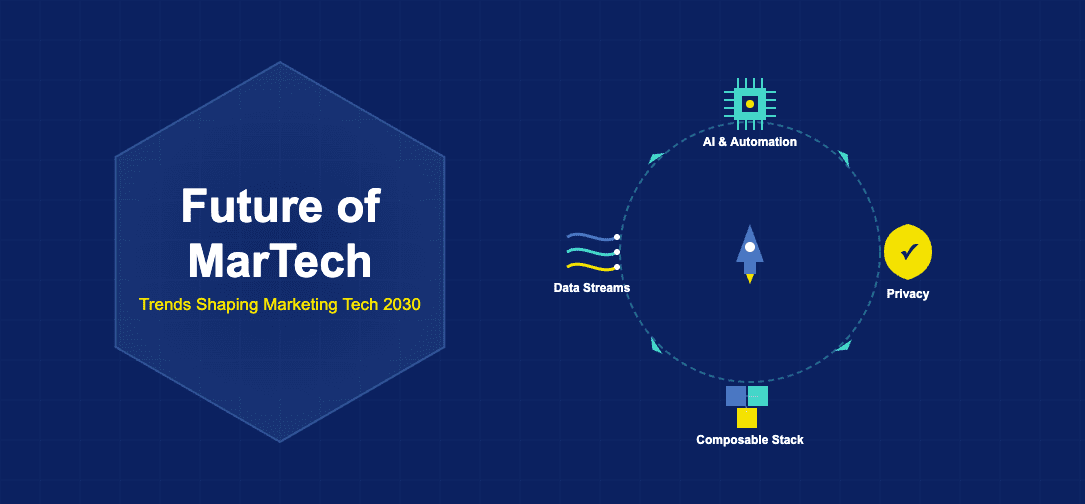
The marketing technology landscape is undergoing one of its most significant transformations since the category’s inception. The convergence of artificial intelligence, privacy regulation, and shifting consumer expectations is fundamentally reshaping how marketers build technology infrastructure and operate their functions. The global MarTech market is projected to reach $702 billion by 2030, up from $344 billion in 2025, representing more than 100 percent growth over five years. However, this explosive growth masks significant disruption and consolidation occurring within the MarTech ecosystem. Legacy point solutions are being displaced by composable platforms, third-party data is being replaced by first-party data strategies, and generative AI is automating functions that previously required specialist expertise. For marketing leaders and technology professionals, understanding the trends shaping MarTech through 2030 is essential for making strategic investments that build durable competitive advantages rather than temporary tactical capabilities that will quickly become obsolete.
Artificial intelligence and particularly generative AI represent the most disruptive forces reshaping MarTech. Generative AI models trained on massive datasets of human-written text, images, and code have demonstrated remarkable capabilities in content generation, from long-form articles to social media copy to product descriptions. This capability is being rapidly integrated into MarTech platforms: copywriting tools that generate email subject lines and ad copy at scale, content creation platforms that generate articles and blog posts, video creation tools that generate video scripts and even video content, and design platforms that generate visual creative. Beyond content generation, AI is increasingly being applied to strategic marketing functions. Predictive analytics models now predict customer churn risk, lifetime value, next purchase probability, and propensity for specific product categories with remarkable accuracy. Machine learning models optimise digital advertising in real time, adjusting bids and creative based on performance feedback. AI-powered personalisation engines deliver increasingly sophisticated one-to-one customisation at scale. The organisations that master generative AI capabilities will gain substantial productivity advantages: the ability to create personalised content for thousands of customer segments, the ability to optimise campaigns in real time with minimal human intervention, and the ability to generate hypotheses about customer behaviour that would be impractical to test manually.
The death of third-party cookies represents another fundamental MarTech inflection point. For two decades, cookies placed by advertising networks and data brokers allowed marketers to track individuals across the web, build audience segments, and target advertising based on behavioural history outside of publishers’ sites. This infrastructure enabled the rise of programmatic advertising, real-time bidding, and audience targeting at scale. However, privacy concerns, regulatory action, and browser changes are eliminating third-party cookies. Google’s Chrome browser, which accounts for approximately 65 percent of web traffic, is phasing out third-party cookies entirely. Safari and Firefox already block them. Privacy regulations including GDPR and CCPA have constrained the collection and use of personal data. The industry’s response is a shift toward first-party data strategies where marketers collect data directly from their own customers through interactions with owned properties. Email, website, app, and CRM data become the foundation for targeting and personalisation. This shift is actually positive for many direct-to-consumer brands because first-party data is proprietary and creates competitive moats. However, it is disruptive for performance marketers and agencies that relied on third-party data and audience sophistication for differentiation.
Composable MarTech and Headless Architecture
The evolution toward composable MarTech and headless architectures represents a fundamental shift in how marketing technology infrastructure is organised. Historically, marketing organisations attempted to standardise on single integrated platforms: a marketing automation platform would handle email, landing pages, and lead scoring, a CRM system would manage customer data, a data warehouse would handle analytics, and so forth. This monolithic approach offered the benefit of integrated data and processes, but the cost of inflexibility: if a marketing team needed a capability that the core platform didn’t provide, integrating a best-of-breed solution required significant custom engineering. Composable MarTech inverts this approach: rather than starting with a single integrated platform, organisations assemble best-of-breed solutions across different layers of the MarTech stack, using APIs and data integration tools to create seamless data flow across systems. A marketing technology stack might include Salesforce for CRM, Snowflake for data warehousing, dbt for transformation, HubSpot for marketing automation, Segment for data collection, Hightouch for reverse ETL, and Looker for analytics. These systems work together through APIs and integrations to create an integrated technology ecosystem that is more flexible and easier to upgrade than a monolithic platform would be.
Headless architecture, a concept from ecommerce, is increasingly being applied to MarTech. A headless approach separates the content or decision logic layer from the presentation layer. Rather than a marketing automation platform controlling how content is delivered across all channels, a headless approach would have centralised content and decision logic accessible via APIs to any presentation channel. An email platform, a website personalisation engine, a mobile app, and a social media management platform could all call the same APIs to retrieve personalised content and recommendations, ensuring consistency whilst allowing each channel to optimise presentation for its specific format. Headless approaches enable more sophisticated omnichannel experiences because decisions about which content to show a customer can be made once and then applied consistently across all touchpoints. However, headless approaches require significant engineering investment and operating discipline to manage the complex integrations.
Convergence of AdTech and MarTech, Predictive and Prescriptive Analytics
The historical separation between AdTech, the technology used for programmatic advertising, and MarTech, the technology used for customer relationship management and marketing automation, is increasingly blurring. As first-party data becomes more valuable and identity solutions less viable, advertisers are looking to activate customer data from their CRM systems directly for paid media. Conversely, insights from ad performance feed back into marketing automation and personalisation systems. Platforms like Salesforce, which owns both the largest CRM system in the world and major advertising and media properties, are uniquely positioned to unify AdTech and MarTech. This convergence has significant implications: marketing budgets that were historically split between customer data platforms, email systems, and ad networks may increasingly consolidate to fewer integrated platforms. Marketers will have more sophisticated capabilities to activate customer data across both owned channels and paid media, but they will depend on fewer vendors.
The sophistication of analytics in MarTech continues to advance from descriptive analytics (what happened) toward prescriptive analytics (what should we do). Descriptive analytics describes what happened in the past: how many customers purchased, what was the average order value, which channels drove the most revenue. Predictive analytics uses historical patterns to forecast what will happen: which customers are most likely to churn, which leads are most likely to convert, which marketing messages will resonate with which audiences. Prescriptive analytics takes prediction further: given what we know about customers and the outcomes we want to achieve, what is the optimal action to take with each customer. Prescriptive analytics might recommend specific product recommendations for each customer, specific email send times to maximise opens, or specific ad creative to show to each audience segment. As machine learning models become more sophisticated and integrated into marketing platforms, prescriptive analytics capabilities will become increasingly central to how marketing operates.
Emerging Channels and Privacy-First Marketing
New channels for marketing continue to emerge, driven by changing consumer behaviour and technological advancement. Augmented reality and virtual reality are increasingly being used for product visualisation, try-on experiences, and immersive brand experiences. Voice commerce through smart speakers and voice assistants is creating a new channel for product discovery and purchase that requires different optimisation approaches than visual commerce. Conversational commerce through chatbots and messaging platforms is enabling real-time customer service and sales assistance. The metaverse, depending on its ultimate adoption, could represent a new platform for branded experiences, events, and commerce. For most organisations, these emerging channels represent experimentation opportunities rather than core budget allocation, but pioneering brands experimenting with these channels are discovering insights about customer expectations and preferences that inform their broader marketing strategies.
Privacy-first marketing represents a fundamental mindset shift for the industry. Rather than starting with the assumption that marketers have access to detailed behavioural tracking and third-party enrichment data, privacy-first approaches acknowledge privacy constraints and build marketing strategies within those constraints. Privacy-first personalisation relies on first-party data, contextual signals, and aggregated insights rather than individual-level tracking. Contextual advertising targets based on page content and search context rather than individual browsing history. These approaches actually perform better than many anticipated because they align with consumer expectations and reduce privacy friction. Privacy-first marketing also delivers strategic benefits: reduced dependence on third-party vendors, reduced compliance risk, and customer relationships grounded in explicit first-party data collection rather than opaque tracking.
| Era | Dominant Technology | Primary Capability | Marketing Focus |
|---|---|---|---|
| Email Era (2000-2010) | Email service providers, simple CRM | Mass email communication and list segmentation | Building subscriber lists, email frequency management |
| Web Analytics Era (2010-2015) | Google Analytics, marketing automation platforms | Website behaviour tracking, lead scoring, campaign attribution | Lead generation, funnel optimisation, multi-touch attribution |
| Programmatic Advertising Era (2015-2020) | Ad exchanges, DSPs, identity platforms, data marketplaces | Real-time bidding, audience targeting, cross-device tracking | Audience segmentation, brand awareness at scale, retargeting |
| Privacy-First AI Era (2020-2030) | First-party data platforms, generative AI, composable architecture | Personalisation without tracking, content generation, prescriptive analytics | Owned audience building, AI-generated personalisation, customer lifetime value |
| Trend | Current State | Expected Evolution | Impact Level |
|---|---|---|---|
| Generative AI in Marketing | Early adoption in copywriting and content generation, experimentation stage | Mainstream use for personalised content, real-time optimisation, strategic insights | Transformational: reshapes marketing productivity and skill requirements |
| Privacy-First Marketing | Transition phase, cookie deprecation in progress, first-party data strategies emerging | Dominant model with contextual and consent-based targeting replacing third-party tracking | Critical: fundamentally changes audience targeting and personalisation approaches |
| Composable MarTech | Adopted by sophisticated organisations, still minority practice | Becomes standard architecture for growth-stage and enterprise organisations | High: defines how organisations build sustainable marketing technology stacks |
| Emerging Channels | Experimentation stage, limited mainstream adoption, AR/VR and voice growing | Mainstream adoption for suitable use cases, metaverse platforms materialise | Moderate to High: creates new customer touchpoints but not majority of spend |
| First-Party Data Strategies | Building phase, organisations investing in owned data infrastructure | Becomes competitive necessity, data moats created by first-party data ownership | Critical: determines whether organisations can operate independently from third-party vendors |
The future of marketing technology through 2030 belongs to organisations that embrace these shifts strategically whilst building robust foundations for privacy-first, data-driven marketing. The most successful marketing organisations will be those that invest in first-party data infrastructure, that experiment thoughtfully with generative AI and emerging channels, that adopt composable architecture for flexibility, and that treat privacy not as a constraint but as an opportunity to build customer relationships grounded in transparency and consent. The MarTech vendors that will thrive are those that anticipate these shifts and build products aligned with privacy-first, AI-powered, composable architecture paradigms. For marketing leaders, the time to begin these transitions is now, as the window for capturing competitive advantage before these approaches become table stakes is rapidly closing. The organisations that are building these capabilities today will be substantially ahead of those that attempt to make the transition after it becomes clearly necessary.
Related reading: Customer Data Platforms in 2026: Architecture, Integration and the Competitive Landscape
Data from Statista’s digital market outlook shows that global digital spending continues to grow at double-digit rates, with mobile channels accounting for an increasingly dominant share of total transactions.
PwC’s analysis of financial services trends through 2025 highlights the convergence of technology and media as a defining dynamic, with data-driven personalisation becoming the primary competitive differentiator.
For more coverage on related topics, explore our dedicated section on technology insights.