By 張耐德, Tainan, Taiwan · Reviewed Oct 6, 2026
Disclosure: I’m not affiliated with OpenFate and have no business relationship with the company. I wasn’t paid, I didn’t receive free credits, and this post contains no affiliate links. I researched and drafted this review with help from an AI assistant, using the public sources listed at the end, and I reviewed and approved the final text.
The short verdict
OpenFate’s central design choice is sound in principle: a dedicated engine calculates the chart, and AI explains it afterward. The site publishes its calculation settings, its test cases, and the source code of its calendar engine, so parts of its claims can be checked instead of taken on trust. In three published example charts recalculated by hand for this review, the four pillars matched.
Before paying, check the privacy settings, since three are on by default. Treat the on-site ratings as figures published by OpenFate itself, not independently verified ones.
How this review was done
This review is based on OpenFate’s public documentation, its published test data, and the full sample report it publishes. I didn’t buy credits or generate a personal paid report, so the paid experience isn’t covered first-hand here.
| Question | Evidence used | Status |
| Does the chart math hold up? | Three published OpenFate
examples, recalculated by hand with standard sexagenary rules |
Done for these three
cases only |
| Is the engine open and testable? | Public GitHub repositories,
published test cases, and replay script |
Reviewed; replay not run |
OpenFate.ai Review (2026)
| Question | Evidence used | Status |
| What does an AI report look like? | The full sample report OpenFate publishes in English and
Traditional Chinese |
Reviewed |
| Privacy, payments,
refunds |
Privacy Policy and Terms of Service (both dated 2 August 2026) | Reviewed |
| Prices | OpenFate’s published price list (dated 13 August 2026) | Reviewed; check live
prices before buying |
| How should the on-site reviews be read? | Homepage review section, Terms §4, Privacy Policy §8 | Reviewed |
| Paid features used first hand | — | Not tested |
What is OpenFate?
OpenFate.ai is a multilingual astrology and Chinese metaphysics platform operated from the United States; its terms are governed by New York law. It covers six chart systems: Bazi (Four Pillars), Zi Wei Dou Shu, Western astrology, Vedic astrology, Human Design, and Japanese Sukuyo.
On top of the charts, it offers:
Compatibility readings in five of those systems, plus a combined view Six oracle tools: Tarot, Lenormand, Meihua Yishu, Liuyao, Qimen Dunjia, and Guanyin temple lots
A Huangli almanac and a daily fortune page
A birth-time calibration tool
The site is available in English, Simplified Chinese, Traditional Chinese, Japanese, and Korean. Its terms describe the service as cultural content for reflection and entertainment, not prediction or professional advice.
How it works: calculate first, explain second
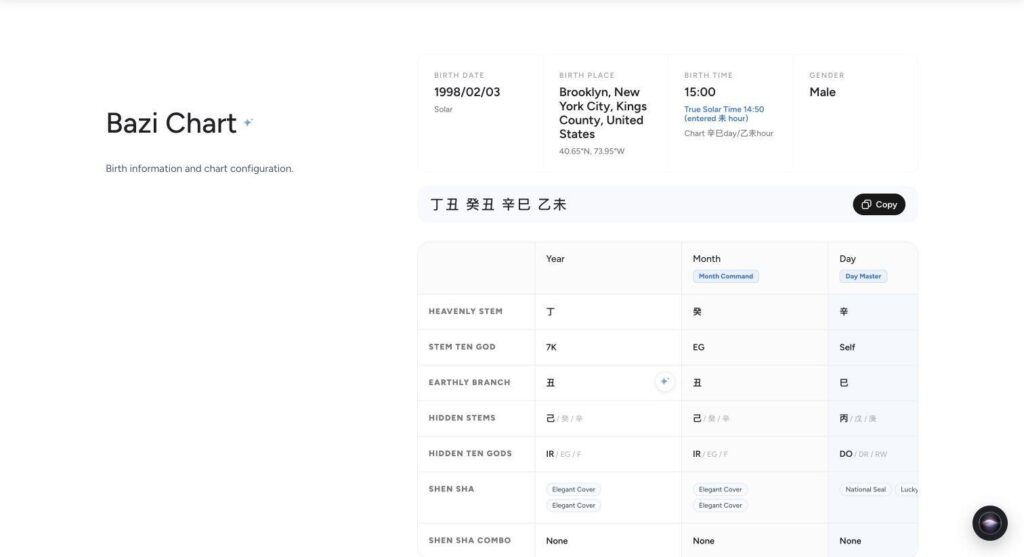
A Bazi chart depends on exact calendar math: solar-term boundaries, true solar time, historical time zones and daylight saving, and whether the day changes at 11 pm or midnight. A small error in any of these can shift the hour or day pillar, and every interpretation built on it.
OpenFate assigns this math to a dedicated engine instead of asking the language model to work it out. The AI receives the finished chart and explains it. This design is meant to reduce calculation errors; it doesn’t rule out bugs in the engine itself.
Completed reports are saved as frozen snapshots, so later updates don’t rewrite them. The free Bazi chart displays the settings it used, which makes differences from other apps easier to trace.
Spot-check:three published examples
OpenFate publishes a complete sample report built on a synthetic (made-up) birth: 17 April 1990, 08:26, Taipei, female, with true solar time on and a 23:00 day boundary. Its engine gives 庚午 · 庚辰 · 壬子 · 甲辰. Recalculated by hand:
Year: 17 April is after Li Chun (early February), so 1990 counts as a 庚午 year. Month: the date falls between Qingming (earlyApril) and Lixia (early May), so it is the 辰 month. In a 庚 year, that month is 庚辰.
Day: counting from a standard reference date (1 January 2000 is a 戊午 day) gives 壬子. Hour: Taipei is about 1.5° east of the UTC+8 meridian, so true solar time runs about six minutes ahead of the clock. That gives roughly 08:32, inside the 辰 hour (07:00–09:00). For a 壬 day, that hour is 甲辰.
Two of OpenFate’s annotated boundary examples were also recalculated:
15 June 2024, 23:45, longitude 112°E. This date is a 庚戌 day. The 23:00 rule therefore gives the next day’s pillar, 辛亥, and the midnight rule keeps 庚戌, as published. 4 February 2024, 16:26. Li Chun 2024 fell at about 16:27 Beijing time, so this moment still belongs to the 癸卯 year and 乙丑 month, as published.
What this shows, and what it doesn’t. The pillars match for these three cases. That doesn’t show the whole engine is error-free:
A dedicated engine can still contain bugs, especially around historical time zones or births right at a boundary.
OpenFate.ai Review (2026)
OpenFate chose which examples to publish.
OpenFate states it hasn’t published a same-settings accuracy comparison against other products.
Its 150-time-zone benchmark data is private.
OpenFate also reports that its open-source calendar engine passed 178 tests and that its eight published replay cases all match. Anyone can rerun them with the published script; that replay wasn’t run for this review. The methodology page also records a correction: a hidden-stem mismatch reported on GitHub was fixed and added as a regression test.
This checks calendar math only. It says nothing about whether Bazi interpretation describes real lives.
The sample AI report, read critically
The sample report for that synthetic chart is published in full in English and Traditional Chinese, labeled as a recorded generation rather than a customer testimonial. It covers ten themes, from chart structure and talents through career, relationships, wellbeing, and ten annual readings.
What it does well:
It ties statements to specific chart features, such as a clash between the year and day branches.
Health content is framed as areas to observe, not claims that symptoms exist. Timing windows are described as pressures, not guaranteed events.
The advice is concrete: set a decision deadline, put agreements in writing, schedule recovery after demanding work.
Where it’s weaker:
It is very long.
Much of the advice would suit almost any busy professional, a common weakness of personality readings.
Some sections reach far even when hedged, such as later-life wealth into the 2060s and suggested places to live. The Traditional Chinese version names Taipei, Yilan, Hualien, and Hsinchu as environment references. That’s localized, but best taken lightly.
Your own report may differ from this published sample.
What stands out
Stated limits. The methodology pages call themselves first-party disclosure, not an independent audit. They state that a reproducible chart doesn’t validate a metaphysical tradition, and that AI explanations can be incomplete or overconfident. Checkable components. The calendar engine is open source under the MIT license, with published test cases and a replay script. The methodology page also explains how to investigate a mismatch: compare the pillars first, then change one setting at a time. A public correction record. A reported calculation error was fixed and locked in with a regression test.
No single combined score. The multi-system tools keep each system’s evidence separate instead of merging everything into one match percentage.
A free entry point. The raw chart calculators work without an account, and each account gets one free AI oracle reading.
Whatto watch outfor
On-site ratings are published by OpenFate itself. The homepage shows a 4.8 average from 1,200+ reviews and claims 60,000+ users; these figures aren’t verified by an independent platform. Under the Terms, eligible signed-in feedback may be edited for clarity and safety, translated, and published with a masked identifier, and publication is on by default. That is a permission in the terms, not evidence that any specific review was changed. Still, self-published ratings carry less weight than reviews on an independent platform.
Some evidence is self-declared. The project owner’s human-review statement doesn’t record which rules or charts were reviewed, and the time-zone benchmark fixtures are private. OpenFate discloses both points, but they remain first-party claims.
Privacy defaults. Birth date, time, and place are personal data. OpenFate says it doesn’t sell personal information, and you can delete readings or your whole account from Settings. Three settings are on by default:
AI Memory, which stores facts you mention in chats to personalize later answers Marketing email
Public publication of your feedback
Prompts and chart data may be sent to third-partyAI providers, and data may be processed in the US. Review Settings after signing up. The service is for users 18 and over.
Pricing and credits. OpenFate’s published price list (USD, dated 13 August 2026):
| Option | Price (USD) |
| 250 one-time credits | $6.99 |
| 500 one-time credits | $11.99 |
| 1,000 one-time credits | $19.99 |
| Pro (200 daily credits) | $26.99/month or $259.10/year |
| Pro Max (400 daily credits, unlimited oracle AI readings) | $49.99/month or $479.90/year |
A full report or compatibility report costs 65 credits, roughly $1.30–$1.82 on one-time packs. A follow-up question costs 10 credits, roughly $0.20–$0.28. One-time credits don’t expire. Daily Fortune and the standalone three-system Combined Reading need a Pro plan. Prices may appear in local currency and can change, so check the live pricing page before buying.
Subscriptions renew until cancelled, with access to the end of the paid period. Refund requests must be made within 7 days and are limited to cases such as unused credits, duplicate charges, or failed access. Used credits and completed reports are generally non-refundable.
A short track record. Third-party directory listings date the platform’s appearance to 2026.
It’s still metaphysics. A correctly calculated chart is only that. Whether Bazi or astrology describes your life is a separate question, and OpenFate doesn’t claim to settle it.
A tip for readers inTaiwan
If your hour pillar differs between apps, compare the settings first. Taiwan’s clock time is set for 120°E, while most of the island sits slightly east of that, so longitude alone puts local solar time roughly 1 to 7 minutes ahead of the clock. The time of year can shift it by up to about 15 minutes in either direction.
Taiwan also observed daylight saving time in several years between 1945 and 1979, so older birth times may need an adjustment. These details matter mainly for births near the edge of a two-hour block.
Who it’s for
OpenFate suits people who are curious about Bazi, Zi Wei, or astrology, want readings in plain language, and want to see the calculation settings behind their chart. Developers may also be interested, since the Bazi engine can be connected to AI agents through MCP.
It isn’t suitable for anyone seeking guaranteed predictions, or for basing medical, legal, or major financial decisions on a reading.
FAQ
Is OpenFate free? The raw chart calculators are free and work without an account, and each account gets one free AI oracle reading. AI reports and follow-up chat use credits or a paid plan.
How much does an OpenFate report cost? A full report uses 65 credits, roughly $1.30– $1.82 on one-time packs at the prices published in August 2026. Check the live pricing page for current prices in your currency.
Is OpenFate’s Bazi calculation accurate? In the three published examples recalculated for this review, the pillars matched. OpenFate publishes its conventions and test cases, but there’s no independent head-to-head benchmark, so this isn’t proof that the whole engine is error-free.
Is OpenFate legit? It publishes a privacy policy, terms of service, refund rules, and a support email ([email protected]), and it open-sources its Bazi calendar engine. Its user numbers and ratings are self-reported.
Why is my OpenFate chart different from another app? Usually it’s settings: true solar time, the day-boundary rule (11 pm vs. midnight), time zone, daylight saving, or lunar leap months. Compare the four pillars first, then change one setting at a time.
Does OpenFate sell my data? Its privacy policy says no. Data may still be shared with service providers, including AI model providers, and the memory and feedback publication settings are on by default.
Sources
Information checked 6 October 2026. Features, prices, and policies may change. OpenFate homepage
BaZi calculation methodology, sample report and test data
Calculation and AI validation overview
Published synthetic test cases
Published product summary and price list
Open-source calendar engine
Open-source Bazi MCP
Privacy policy
Terms of service
Live pricing
About OpenFate
Page 8 of 8