
MiniMax H3 Triggered a 10 Percent Stock Surge — Inside the Open-Weight Strategy Reshaping AI Video Economics

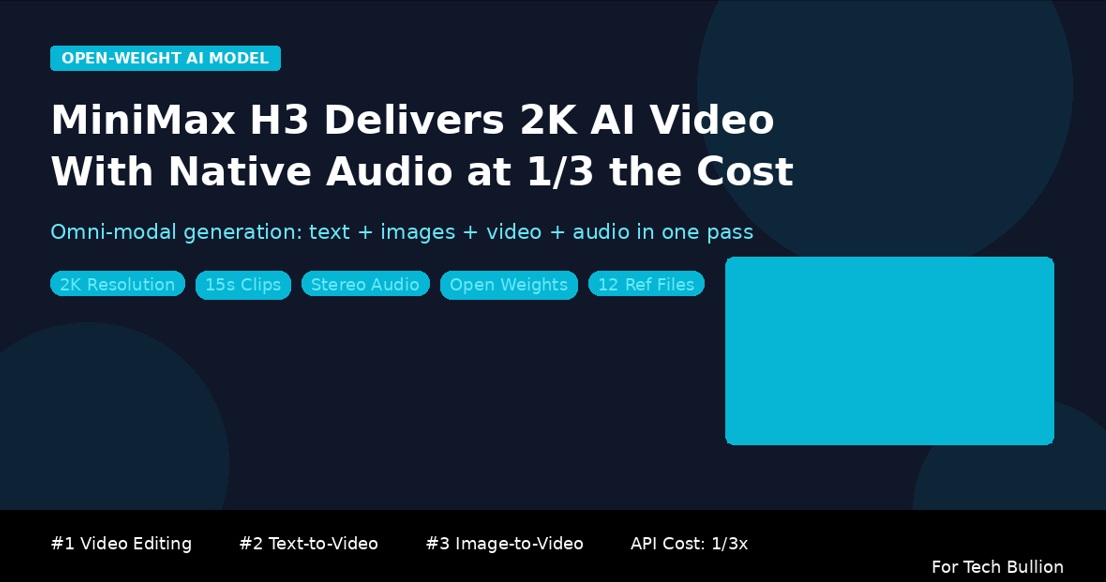
When MiniMax Group Inc. (0100.HK) announced the open-source release of its H3 video generation model on August 3, 2026, the market responded immediately. Shares surged over 10 percent on the Hong Kong Stock Exchange, closing at HKD $249.40. The rally was not a reaction to a revenue announcement or a partnership deal — it was a response to a strategic decision about how to compete in the AI video generation market.
MiniMax chose to publish the weights of a model that independently ranks first globally in video editing, second in text-to-video, and third in image-to-video. The model generates 2K video with native stereo audio at roughly one-third the per-second cost of closed-source competitors from OpenAI and Google. And then MiniMax made it available for anyone to download and deploy.
The stock movement tells a story about what the market values in AI in 2026: not walled gardens, but ecosystem positioning. MiniMax is betting that owning the open standard in AI video is more valuable than protecting a proprietary advantage that competitors will eventually match.
The Pricing Strategy That Changes Market Dynamics
To understand why the market reacted, start with the economics. AI video generation pricing in 2026 follows a clear hierarchy. OpenAI’s Sora 2 Pro charges $0.30 per second at 720p and $0.70 per second at 1080p. Google’s Veo 3.1 starts at approximately $0.05 per second on the Lite tier but scales steeply for production-quality output. Runway Gen-4.5, Kling 3.0, and other players occupy various points on the cost-quality curve.
H3 undercuts the entire field. At 2K resolution — higher than Sora 2’s 1080p ceiling — H3’s per-second API price is less than one-third of what mainstream closed-source models charge. At 768p, it is less than half the price of competitors’ 720p output.
This is not a loss-leader strategy. MiniMax designed H3’s architecture for computational efficiency from the ground up. The model’s H3-VAE uses 16× spatial compression and 4× temporal compression across 24 latent channels, and its Contextual Omni Representation system compresses approximately 100,000 tokens of input material to roughly 4,000 tokens. These architectural efficiencies translate directly into lower inference costs, which MiniMax passes through as lower API pricing.
For commercial buyers — advertising agencies, e-commerce platforms, media companies, marketing teams — the pricing difference compounds at scale. A marketing operation generating 500 ten-second ad variants per month faces a cost difference measured in thousands of dollars between H3 and closed-source alternatives. Detailed tier-by-tier pricing and enterprise feature breakdowns are available on the minimax h3 pricing page.
Why Open Weights Drive Enterprise Adoption
The decision to release H3’s weights on Hugging Face is the most strategically significant aspect of the launch, and it is the factor the market is pricing in.
In the LLM space, the pattern is well-established: open-weight models like Llama and Mistral captured enterprise adoption faster than their benchmark performance alone would predict, because enterprises value deployment flexibility, customization, and reduced vendor lock-in. Open weights mean the model can run on private infrastructure, be fine-tuned on proprietary data, and be integrated into existing technology stacks without API dependency.
AI video has not had its open-weight moment — until H3. Previous open-weight video models were academic exercises: interesting architectures with output quality that fell well short of closed-source production standards. H3 is the first open-weight video model that competes at the frontier across multiple benchmark categories. For enterprise buyers evaluating AI video infrastructure, this creates a new option that did not exist before.
The release includes two task-specific checkpoints (H3-Base for 768p generation and H3-Regenerate-2K for upscaling), each bundled with the Omni Transformer, processor, tokenizer, text encoder, Visual VAE, and Audio VAE. The BF16 base model requires approximately 134 GiB of weights, putting local deployment within reach of enterprise GPU clusters and cloud deployments.
For a comprehensive overview of H3’s capabilities and enterprise adoption paths, minimax h3 provides structured resources including feature documentation and generation examples.
The Technical Moat Behind the Pricing
H3’s cost advantage is not a temporary promotional discount — it is embedded in the architecture. Four subsystems contribute to the efficiency:
Contextual Omni Representation (H3-Context-IR) preprocesses multi-modal inputs (up to nine images, three video clips, three audio files) by modeling the relationships between all context sources and the target output, then compresses the representation by approximately 25:1. This dramatically reduces the token count that the generation model must process.
H3-VAE achieves aggressive spatial (16×) and temporal (4×) compression in latent space, reducing the computational cost per frame of generated video compared to less compressed architectures.
H3-Omni Transformer processes all modalities — text, image, video, audio — as a unified packed sequence with Rotary Position Embedding, avoiding the overhead of separate specialized models for each modality.
In-Context Regeneration handles upscaling from 768p to 2K as a second-stage process that operates on the compressed representation rather than the raw pixel output, which is computationally cheaper than super-resolution approaches that work in pixel space.
The result: H3 generates 15-second clips at 2K resolution and 24 fps with 32 kHz stereo audio across six aspect ratios, at inference costs that allow aggressive API pricing while maintaining margin. This is not a race to the bottom — it is a structural cost advantage.
Market Positioning in the AI Video Landscape
The AI video generation market in mid-2026 is dominated by Chinese models on the quality leaderboards. On the Artificial Analysis Video Arena, the top positions in text-to-video-with-audio are held by Chinese companies — ByteDance, MiniMax, Kuaishou, and Alibaba all rank ahead of Western alternatives. OpenAI’s Sora, once the most anticipated AI video product, is being sunset as a standalone offering and folded into ChatGPT.
H3’s positioning within this landscape is distinctive. Unlike ByteDance’s Seedance (closed-source, no weight release) or Kuaishou’s Kling (closed-source), MiniMax chose the open-weight path. This differentiates H3 in the enterprise market where deployment flexibility is a purchasing criterion, and it creates ecosystem lock-in of a different kind — developers who build on H3’s open weights have incentives to stay within the MiniMax ecosystem for complementary models (language, speech, music) and infrastructure.
The competitive risk is that Google and ByteDance can invest more in compute and data than MiniMax. Veo 3.1 still produces the most cinematically polished individual frames. Seedance 2.5 competes on a broader set of generation modes. But neither has matched H3’s combination of open weights, multi-modal input (including audio as a first-class input), and aggressive pricing.
Revenue Model and Monetization Paths
MiniMax’s revenue from H3 flows through three channels:
API consumption — The primary revenue driver. Per-second pricing at scale, with volume discounts implied by the tiered pricing structure.
Subscription plans — Individual and team plans ranging from $21/month (Starter, 180 credits) to $90/month (Premium, 1,300 credits with batch processing and priority queue). These provide predictable recurring revenue from prosumer and SMB segments.
Ecosystem monetization — H3 is designed to interoperate with MiniMax’s M-series LLMs, Speech 2.8, and Music 3.0. Developers who adopt H3 for video generation have a natural upsell path to MiniMax’s text, speech, and music APIs for end-to-end content production pipelines.
The open-weight release is the acquisition engine for all three channels. Developers who experiment with H3 locally often migrate to the hosted API for production workloads (the full 2K pipeline requires API access for the Context-IR preprocessing stage). Enterprise teams that evaluate the open weights for compliance and customization feasibility become API customers once they confirm the model meets their quality and latency requirements.
Risks and Limitations
The licensing terms require careful review. The MiniMax H3 Community License is not a permissive open-source license, and some analysts have flagged potential territorial restrictions. Commercial adopters need legal review before deploying.
The model’s prompting ecosystem is immature compared to competitors that have been in the market longer. Veo 3.1 benefits from months of community-developed prompt engineering, while H3’s ecosystem is weeks old.
Longer clips (15 seconds) can exhibit character drift and background inconsistency. And the H3-Context-IR preprocessing system — the component that handles multi-reference input compression — is not included in the weight release, creating partial API dependency for the full 2K workflow.
Company Fundamentals
MiniMax was founded in 2021 by Yan Junjie, formerly a deputy director at SenseTime. The company is headquartered in Beijing and listed on the Hong Kong Stock Exchange. The product portfolio spans video generation (H3), large language models (M-series, latest M2.7), text-to-speech (Speech 2.8, 30+ languages), and music generation (Music 3.0).
H3 is the third generation of MiniMax’s video model line, following Hailuo 01 (foundational architecture) and Hailuo 02 (efficiency improvements). The model positions MiniMax in the intersection of the open-weight AI movement and the commercial content creation market — a space where no other company currently offers a comparable combination of performance, openness, and pricing.
Investment Thesis
The 10 percent stock rally following the H3 release reflects a market thesis that goes beyond the model itself: MiniMax is building the default open-weight infrastructure layer for AI video generation, the same way Meta’s Llama became the default open-weight infrastructure for LLM deployment. If that thesis holds, the API consumption revenue from H3 is the beginning of a platform business, not a product business. The stock market appears to be pricing that distinction.
Whether MiniMax can defend this position against better-funded competitors remains the central risk. But the first-mover advantage in open-weight AI video, combined with structural cost advantages and a multi-product ecosystem, gives MiniMax a strategic position that is easier to build from than to replicate.







Comment