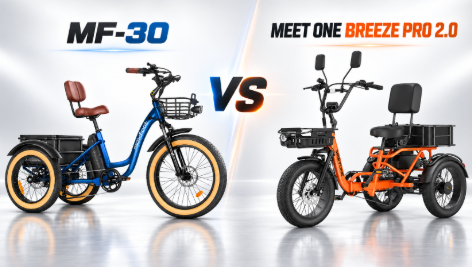
Choosing between the MaxFoot MF-30 and Meet One Breeze Pro 2.0 is not simply a matter of comparing two 750W electric trikes. Their rated motor figures are the same, and both use 48V 20Ah batteries, but the two machines take very different approaches to performance. The Breeze Pro 2.0 puts more emphasis on suspension, a semi-recumbent riding position, and a high payload rating. The MF-30 focuses on stronger peak output, a higher-current controller, a much lighter aluminum-alloy frame, larger wheels, and a lower purchase price.
For riders who want the best combination of usable power, manageable weight, all-terrain wheel sizing, and value, the MF-30 makes the more convincing case.
Core Specifications at a Glance
The published specifications below show where the two trikes differ before the detailed analysis.
| Specification | MaxFoot MF-30 | Meet One Breeze Pro 2.0 |
|---|---|---|
| Rated motor | 750W rear-drive brushless | 750W brushless |
| Peak power | 1,400W | 1,200W |
| Torque | 85Nm | 90Nm |
| Controller | 25A waterproof | 20A |
| Standard battery | 48V 20Ah Samsung | 48V 20Ah LG |
| Frame | 6061 front / 7A19 rear aluminum alloy | Carbon steel |
| Net weight | 90 lb | 127.9 lb |
| Tires | 24 x 4 in front / 20 x 4 in rear | 18 x 4 in, all three |
| Suspension | 50mm front fork | Front fork + dual rear shocks |
| Brakes | Three 180mm mechanical discs | Three 180mm hydraulic discs |
| Pedal-assist sensor | Speed sensor | Torque sensor |
| Max load | 350 lb trike rating | 450 lb |
| Current listed price | $1,699 | $1,799 |
Power: the same rating does not mean the same output
Both trikes are advertised with 750W brushless motors. That number matters, but it does not tell the whole story. MaxFoot rates the MF-30 at 1,400W peak power, compared with 1,200W for the Breeze Pro 2.0. That gives the MF-30 roughly 17 percent more published peak output.
The controller specifications reinforce that advantage. MaxFoot lists a 25A waterproof controller, while Meet One lists a 20A controller. A controller governs how much current can be delivered to the motor. Real-world performance still depends on rider weight, battery charge, temperature, surface, and programming, but the MF-30 has the stronger electrical specifications on paper. That matters when accelerating from a stop, carrying cargo, or asking the motor for short bursts of help on an incline.
Meet One claims 90Nm of torque, slightly above the MF-30’s 85Nm. The five-newton-meter difference is worth acknowledging, but it should be viewed alongside peak wattage and controller capacity. The Breeze Pro 2.0 has the higher published torque number; the MF-30 has the higher peak-power and current figures. Riders prioritizing overall power headroom have a solid reason to prefer the MaxFoot.
A 37.9-pound difference changes daily ownership
Weight is one of the clearest distinctions. MaxFoot lists the MF-30 at 90 pounds net. Meet One lists the Breeze Pro 2.0 at 127.9 pounds net. The MF-30 is therefore 37.9 pounds lighter, or about 30 percent lighter when measured against the Breeze’s weight. Put another way, the Meet One is about 42 percent heavier than the MaxFoot.
That difference affects more than a specifications table. A lighter trike is generally easier to maneuver by hand, reposition in a garage, roll through a gate, and handle when the battery is removed or depleted. Neither model is a lightweight conventional bicycle, and most owners will not lift either one casually. Still, nearly 38 pounds is substantial for anyone with limited strength or storage space.
The frame materials help explain the gap. MaxFoot specifies 6061 aluminum alloy at the front and 7A19 aluminum alloy at the rear. Meet One specifies a carbon-steel frame. Steel can be strong and is not automatically inferior, but the Breeze pays a major weight penalty. For riders who want capability without unnecessary bulk, the MF-30’s aluminum construction is a meaningful advantage.
Larger wheels for mixed surfaces
The MF-30 uses a 24 x 4-inch front tire and 20 x 4-inch rear tires. The Breeze Pro 2.0 uses 18 x 4-inch tires at all three positions. Both provide fat-tire traction and cushioning, but their behavior will differ.
Larger-diameter wheels generally roll over cracks, shallow ruts, and small obstacles more easily. The MF-30’s 24-inch front wheel is especially useful because the leading wheel encounters an obstacle first. Its 20-inch rear wheels are also larger than the Breeze’s 18-inch setup. Smaller wheels can contribute to a lower center of gravity and a compact package, so Meet One’s design has a purpose. However, riders expecting broken pavement, gravel paths, park trails, or rough shoulders may find the MaxFoot’s larger wheel format more versatile.
Comfort and capacity: where Meet One answers back
The Breeze Pro 2.0 deserves credit for its full-suspension design, including rear shocks, and its semi-recumbent layout. Riders with pronounced back or joint sensitivity may value those features. It also carries a published 450-pound maximum load, compared with the MF-30’s 350-pound trike payload rating. For a rider whose weight and cargo require the higher figure, that specification may decide the purchase.
The MF-30 uses a 50mm suspension fork but no rear suspension. Its larger fat tires and thick saddle still contribute to comfort, while avoiding the added hardware and weight of rear shocks. This is a classic tradeoff: the Meet One offers more suspension and capacity, while the MaxFoot is much lighter and uses larger wheels.
Brakes and sensors are preferences, not automatic victories
Meet One fits 180mm hydraulic brakes, while MaxFoot lists three 180mm disc brakes with cable-operated controls. Hydraulic systems can deliver a light lever feel and strong modulation. Mechanical disc systems are simpler, easier for many owners or ordinary bike shops to adjust, and avoid hydraulic fluid, bleeding, and hose-related service. Both require wear items such as pads, and neither is maintenance-free. The right choice depends on whether the buyer values hydraulic feel or straightforward serviceability.
The same balanced view applies to pedal assist. Meet One uses a torque sensor, which responds to how hard the rider presses on the pedals. MaxFoot uses a speed sensor, which can provide more consistent assistance once pedaling is detected. Riders seeking a bicycle-like, effort-sensitive response may prefer torque sensing. Riders who want predictable motor support without having to push hard may prefer the MF-30’s approach.
Battery and value
Both standard configurations use 48V 20Ah batteries. MaxFoot specifies Samsung cells and advertises up to 85-plus miles in its lowest assist setting. Meet One specifies LG cells and advertises a broad 40-to-100-mile range, with results dependent on conditions and configuration. Range claims are not directly comparable test results, so buyers should expect terrain, assist level, throttle use, weather, load, and tire pressure to have a large effect.
At the time of comparison, the MF-30 is listed at $1,699 and the Breeze Pro 2.0 at $1,799. The $100 difference is not enormous, but it favors the trike that already has the higher peak-power rating, higher-current controller, lighter aluminum frame, and larger wheels.
Verdict
The Breeze Pro 2.0 is the better fit for a rider who specifically needs its 450-pound rating, rear suspension, semi-recumbent seating, or hydraulic brake feel. Those are legitimate strengths. Yet the MF-30 offers the more balanced package for a wider range of buyers. It combines 1,400W peak power, a 25A controller, a 90-pound aluminum-alloy chassis, larger 24/20-inch wheels, and a lower price.
That combination is difficult to dismiss. When power, everyday handling, mixed-surface capability, and value all matter, the MaxFoot MF-30 is the stronger overall choice.
Sources
MaxFoot MF-30 official product page
Meet One Breeze Pro 2.0 official product page