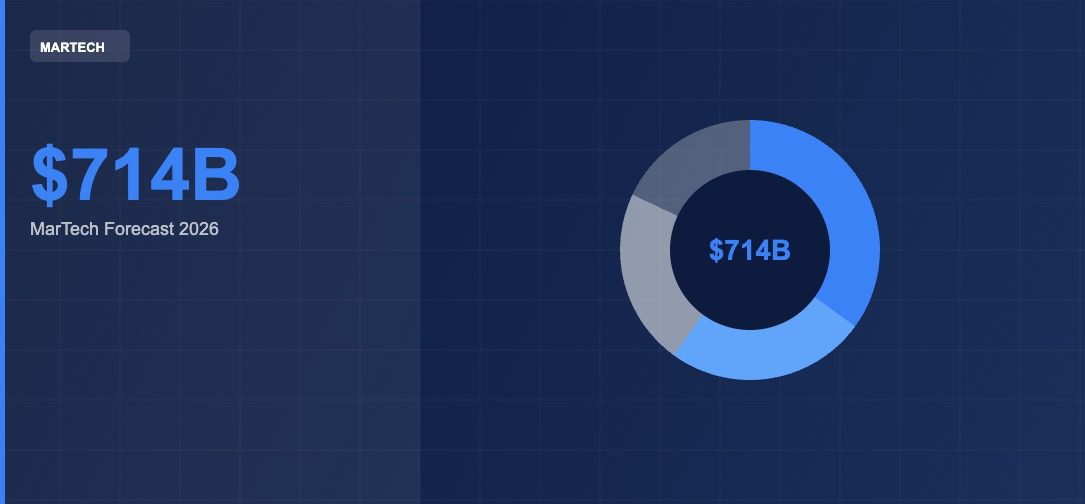
Marketing technology is one of those industries where the numbers seem to keep outpacing expectations. Each year, analysts revise their forecasts upward. Each year, enterprise budgets flow toward platforms that promise better targeting, deeper personalisation, and more measurable returns. And each year, the market delivers. The global MarTech market reached approximately $589.14 billion in 2025, according to Grand View Research, and is projected to reach $714.56 billion in 2026. That is not a modest increment. It is an addition of more than $125 billion in a single year, a pace of expansion that demands explanation and attention.
Understanding why this forecast is credible requires looking beyond the headline number. The forces driving MarTech’s growth are structural, not cyclical. They reflect permanent changes in how businesses compete, how consumers expect to be engaged, and how technology is transforming the entire discipline of marketing from the inside out.
The 2026 milestone is not simply a market growing larger. It is a market growing more capable, more central to business strategy, and more embedded in everything an organisation does to attract and retain customers.
Why the $714 Billion Forecast Reflects a Structural Shift in Marketing Investment
The compound annual growth rate for the global MarTech market between 2025 and 2034 is projected at approximately 19.9 percent, according to Grand View Research. At that pace, the step from $589 billion to $714 billion in a single year is consistent with the trajectory. But the more interesting question is what is sustaining that rate.
Marketing technology budgets are no longer discretionary. Across most major industries, the ability to find, engage, and retain customers at scale without marketing technology has become practically impossible. E-commerce, financial services, healthcare, and professional services have all crossed a threshold where digital-first customer engagement is the expectation, not the exception. The platforms that enable that engagement are now as essential to operations as ERP or finance software.
Approximately 80 percent of marketing technology decision-makers expect their MarTech budgets to increase over the next three to five years, according to McKinsey research published in 2024. When four out of five decision-makers expect to spend more, the forecast of continued double-digit growth is not optimistic speculation. It is the aggregated intention of the people who control the budgets.
Artificial Intelligence Is the Primary Engine Behind the 2026 Growth Projection
No single force is doing more to accelerate MarTech investment than artificial intelligence. What has changed in the last two years is not just the availability of AI tools but the specific and demonstrable value they are delivering inside marketing functions. Campaigns that previously took weeks to build and deploy can now be assembled in hours. Audience segments that required teams of analysts can be defined and activated by a single platform in real time. The economic case for AI-powered MarTech has moved from theoretical to evidenced.
McKinsey’s Global Institute estimated that marketing and sales represent the business function with the highest potential value from generative AI, identifying between $0.8 trillion and $1.2 trillion in annual value creation across industries, according to its 2023 report The Economic Potential of Generative AI. That estimate encompasses efficiency savings, revenue growth from improved personalisation, and faster campaign delivery at scale.
The platforms driving this investment are well established and accelerating. Salesforce launched its Agentforce product in late 2024, introducing AI agents capable of autonomously managing campaign creation, audience segmentation, and customer service interactions. In earnings commentary shortly after the launch, Salesforce CEO Marc Benioff reported signing more than 1,000 Agentforce deals within weeks of launch. Adobe’s Firefly generative AI models surpassed 6.5 billion generated images by early 2024, according to an Adobe press release, with the capability embedded throughout Experience Cloud for enterprise marketers. HubSpot’s Breeze AI suite, introduced in 2024, brought autonomous agents to content creation, social media management, and CRM prospecting for its base of more than 230,000 customers worldwide, according to HubSpot’s 2024 investor relations filings.
These are not experiments. They are production-grade products generating revenue at scale, and their adoption is a direct driver of the $714 billion projection for 2026.
North America and Asia-Pacific Are Growing From Different Starting Points
Geography matters in understanding how the 2026 forecast distributes across markets. North America accounts for more than 35.8 percent of the global MarTech market, according to Grand View Research, a share that reflects the region’s concentration of platform vendors, its scale of digital advertising spend, and the depth of enterprise investment in customer experience technology.
The United States remains the centre of gravity for MarTech innovation. The largest platforms, the most significant venture capital activity, and the highest concentration of enterprise buyers are all concentrated here. But dominance in a growing market is not the same as exclusivity. The $714 billion figure for 2026 reflects growth happening simultaneously across multiple regions, each adding to the total from a different base.
Asia-Pacific is the fastest-growing region in the MarTech market, according to Grand View Research, with countries including India, Indonesia, and Vietnam expanding their digital economies rapidly. India has produced globally recognised platforms including MoEngage and CleverTap, both of which have grown into international businesses. Indonesia and Southeast Asia more broadly are generating significant demand for mobile-first marketing platforms as smartphone penetration drives new digital consumer behaviour. This regional growth is additive to the global total, not redistributive, which is what gives the 2026 number its credibility.
Europe is growing more deliberately, shaped by its regulatory environment. Investment in consent management, first-party data infrastructure, and privacy-compliant personalisation tools continues to accelerate as organisations build the data foundations that the GDPR era requires.
The MarTech Ecosystem Has Expanded to Over 15,000 Products to Meet Rising Demand
The breadth of the MarTech market is as significant as its size. Scott Brinker, VP of Platform Ecosystem at HubSpot and founder of chiefmartec.com, has tracked the marketing technology landscape since 2011, when he catalogued approximately 150 solutions. His 2024 edition documented over 14,000 products globally, a more than 100-fold increase in just over a decade. That ecosystem breadth is both a reflection of demand and a source of continued investment.
Each category within the MarTech stack is a market in its own right. Customer relationship management software, which sits at the core of most MarTech investments, is itself a substantial multi-billion-dollar market in its own right, according to Grand View Research’s CRM market analysis. Marketing automation, customer data platforms, analytics and attribution, content management, social media management, and search marketing technology each represent significant and growing opportunities within the broader category.
The expansion to $714 billion in 2026 will be built on investments across all of these subcategories simultaneously. Organisations are not simply upgrading a single platform. They are building integrated stacks where data flows between tools, campaigns execute across channels, and measurement happens in real time. That kind of architecture requires investment in multiple layers, which is precisely why the growth rate is sustained even as the market grows larger.
Customer Data Platforms Are Defining How Organisations Approach the 2026 Landscape
One of the fastest-growing subcategories in the entire MarTech ecosystem is the customer data platform. CDPs allow organisations to collect, unify, and activate their own customer data directly, creating a single coherent view of each customer that can be used to personalise experiences across every channel. The CDP Institute has tracked consistent year-on-year revenue growth for CDP vendors as organisations invest in the first-party data infrastructure that the current privacy landscape demands.
The shift toward first-party data strategies has been driven by changes in the mobile and browser environments. Apple’s App Tracking Transparency framework, introduced in iOS 14.5, requires applications to request user permission before tracking activity across other apps and websites. Google has continued its work toward limiting third-party cookie support in Chrome. These changes have redirected investment toward the kinds of deep, direct customer relationships that CDPs are designed to support.
The organisations building strong first-party data foundations now are not simply responding to regulatory change. They are building durable competitive advantages. The brands that understand their customers directly, communicate with genuine relevance, and earn sustained consent are the ones that will extract the most value from every additional MarTech investment they make. As the market approaches $714 billion, the CDP category is among the most consequential places that investment is going.
What Reaching $714 Billion Means for Organisations Planning Their Next Investment
The journey from $589 billion to $714 billion in a single year will not be evenly distributed. Some organisations will make the investments that position them ahead of their competitors. Others will watch the opportunity pass while waiting for perfect certainty. The pattern of who captures the value in a rapidly expanding market tends to repeat itself.
The organisations that extract the most from a growing MarTech market share certain characteristics. They connect their technology investments directly to revenue outcomes, not just operational metrics. They treat data strategy and marketing technology strategy as inseparable. They build the talent and internal capability to maximise what the platforms they invest in can actually do. And they move quickly enough to generate learning before competitors do.
McKinsey research from 2024 identified leading marketing organisations as those that treat personalisation not as a campaign feature but as a systematic business capability, built on integrated data, real-time decisioning, and continuous measurement. The $714 billion forecast for 2026 is not just a market size figure. It is an indicator of how much investment will flow into building exactly those capabilities across tens of thousands of organisations around the world. This growth sits alongside the broader digital advertising ecosystem, where the global AdTech market is forecast to reach $3.23 trillion by 2034, according to industry projections.
The Path to $714 Billion Is an Invitation to Build More Effectively
The 2026 MarTech forecast is not a ceiling. It is a waypoint. The same Grand View Research projections that identify $714.56 billion for 2026 point to a market exceeding $1.27 trillion by 2031 and reaching further beyond that through the following decade. The industry is not slowing down. It is accelerating, compounding its capabilities as AI becomes more sophisticated, as data infrastructure matures, and as organisations across every sector recognise that technology-driven marketing is not an option but a requirement.
The specific number of $714 billion matters because it represents a genuine and measurable commitment by businesses globally to the proposition that marketing technology creates value. That commitment shows no sign of weakening. The AI tools being deployed today are delivering results that justify further investment. The regional markets expanding fastest are still early in their adoption curves. And the gap between what the best organisations can do with their MarTech stack and what the average organisation can do is wide enough that the appetite for improvement will sustain investment for years to come.
For every business thinking about where to allocate its technology budget in the years ahead, the direction of this market is not ambiguous. The question is not whether marketing technology will continue to grow. The question is whether your organisation will be among those leading the growth or watching it happen.