A professional product decision starts long before a carton reaches the treatment room. It starts with a precise question: what, exactly, is being purchased, and what evidence supports the way it will be described? That question matters especially for products marketed for localized fat reduction, where attractive packaging and familiar ingredients can make very different formulations appear interchangeable.
Lipo Vela is one such product that deserves a careful, document-led review. A useful assessment separates the commercial listing, the supplied label, the manufacturer or brand owner’s information, and the evidence for a particular clinical use. None of those documents can replace all the others. A product photograph may help identify the presentation, while a current local label establishes information that a photograph cannot reliably supply.
This guide is written for professional buyers and readers comparing aesthetic product information. It covers product identification, evidence quality, purchasing questions, receiving checks, and sensible ways to discuss uncertainty. It is not an injection protocol or a recommendation that this product is suitable for a particular person. Clinical suitability and lawful use require a qualified professional working within the rules of the relevant market.
Start with the exact commercial presentation
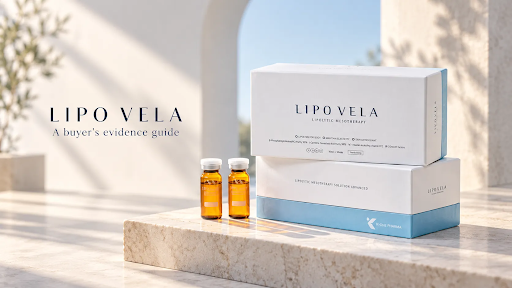
The Lipo Vela listing identifies a presentation sold as ten 10 mL vials. The accompanying image shows white and pale blue packaging with amber-colored liquid in clear vials. Treat those details as a starting point for a quotation, not as independent confirmation of the contents of every shipment. Ask the seller to confirm the exact stock available, including the version, outer-pack quantity, and individual container labeling.
HJ Corporations publishes product information under the Lipo Vela name and also presents a separately named Lipo Vela V product. The existence of a related name makes version control particularly important. A purchasing record should reproduce the full name on the offered pack instead of shortening every related item to “Lipo.” A seller’s assurance that two versions are “the same” needs documentary support before it affects a purchase. [1]
The visible packaging also contains company branding. Branding alone does not establish which organization is the legal manufacturer, exporter, distributor, or registration holder. Those roles may belong to different entities. Ask for the relevant legal names and match them against the supplied documents. If the invoice names one company and the label names another, the relationship should be explained rather than treated as automatically suspicious or automatically acceptable.
Understand what the ingredient description can establish
The brand’s public description discusses phosphatidylcholine, commonly abbreviated PPC, alongside other ingredients including deoxycholate, L-carnitine, and riboflavin. This identifies the product’s marketing context. It does not, by itself, establish a complete quantitative formulation, a validated treatment protocol, or a predictable result for an individual patient. Exact ingredient amounts and relevant specifications should come from the current product documentation. [1]
An ingredient can have a plausible biological action without proving that a finished formulation delivers a particular clinical outcome. Concentration, formulation, stability, route of administration, patient selection, and the outcome being measured all matter. A paper about a substance cannot simply be attached to every product that mentions that substance. The closer the research matches the actual product and intended use, the more informative it becomes.
The distinction between PPC and deoxycholic acid also deserves attention. These names should not be used as though they identify the same chemical or the same finished medicine. A product containing several substances is not established as equivalent to a separately approved single-active formulation merely because one ingredient appears in both. Procurement teams should avoid equivalence statements unless the relevant evidence and authorization actually support them.
Color is even less informative. A yellow or amber appearance may be visually characteristic of an advertised presentation, but it cannot authenticate the formulation, quantify an ingredient, or confirm sterility. It is reasonable to compare appearance with the manufacturer’s acceptance information. It is not reasonable to turn a matching color into a quality certificate.
Separate three different kinds of evidence
A clear review distinguishes identification evidence, quality evidence, and clinical evidence. Identification evidence answers whether the offered item matches the intended product. Quality evidence concerns the supplied batch and its documented manufacture, release, storage, and distribution. Clinical evidence addresses the benefits and harms of a defined use in people. A strong file needs the relevant parts of all three.
| Question | Most useful evidence | What does not answer it |
| Is this the requested version | Current label and exact product identifier | A similar product photograph |
| What is in the supplied product | Official formulation and labeling | A copied ingredient paragraph |
| Can this batch be traced | Batch records and linked commercial documents | A generic certificate without scope |
| Is a claimed benefit supported | Research matching product and use | Ingredient theory alone |
| Is the proposed use permitted locally | Relevant current local documentation | Availability on an international website |
This separation makes supplier conversations more productive. Instead of asking whether a product is “good,” ask which document answers a particular unresolved question. A sales representative may be able to supply packaging photographs immediately while needing additional time to obtain a formal statement from the responsible company. Record the difference between a supplied answer, a pending request, and a claim that remains unsupported.
Put regulatory statements in their proper context
The US Food and Drug Administration warns about unapproved fat-dissolving injections and states that Kybella and a generic deoxycholic acid injection product are the only FDA-approved drugs for improvement in the appearance of moderate-to-severe fullness associated with submental fat in adults. That statement does not confer approval on Lipo Vela or establish that another formulation is interchangeable with those approved products. It is a US regulatory reference, not a description of every country’s rules. [2]
For a professional buyer, the practical lesson is to identify the relevant jurisdiction before evaluating an approval claim. A certificate issued for one market may not settle the question in another. Likewise, a document about a manufacturing facility may not authorize a particular product, indication, or route. Record the country, product name, responsible entity, scope, and validity of each document being relied upon.
Avoid vague language such as “internationally approved.” It is too broad to be useful unless accompanied by precise details. If a supplier mentions a registration number, ask which database contains it and what the entry actually covers. A searchable number is useful only when the database entry matches the specific product and the intended commercial activity.
Compare options without implying equivalence
Readers often compare marketed lipolytic products, approved prescription medicines, and non-invasive body-contouring devices in the same search session. These are different categories. They may involve different mechanisms, eligibility criteria, professional responsibilities, and evidence requirements. A purchasing comparison should not flatten those differences into a price-per-session chart.
| Category | Sensible comparison question | Important limit |
| A marketed multi-ingredient product | What exact formulation and local status are documented | Marketing language does not establish an approved indication |
| An approved prescription medicine | Does its authorized indication match the clinical question | Approval is specific to the product and jurisdiction |
| A non-invasive device procedure | Which device and treatment area were evaluated | Device evidence does not validate an injectable product |
| General weight-management care | Is the concern localized contour or broader health | A cosmetic product is not a weight-management plan |
This framework also helps explain why a lower unit price cannot answer the clinical question. Two products can have similar packaging volumes while serving different purposes or lacking comparable evidence. A meaningful comparison begins with eligibility and documentation. Price becomes relevant only after the items have passed the appropriate checks.
For consumers, a consultation should clarify the actual concern, the available approaches, and the limits of each option. Persistent uncertainty about the product being proposed is a reason to request more information. A responsible professional should be able to name the product and explain the basis for recommending it without relying on a social-media slogan.
Build a useful pre-purchase document request
An efficient request is specific enough that the supplier can answer it without guessing. Include the full product name, presentation, destination country, quantity requested, and whether substitutions are acceptable. Then request current photographs of the offered stock, the applicable label and instructions, batch and expiry information, and the documents supporting the supplier’s role in the transaction.
Ask for photographs of all relevant panels, not just the front of the carton. The back and side panels may contain information missing from the promotional image. Where individual containers carry batch or expiry details, ask how those details relate to the outer carton. Do not assume that a photograph taken for a previous order represents the stock reserved for a new one.
Documentation should be readable at normal viewing size. A blurred screenshot of a certificate is difficult to evaluate and can conceal an expired date or a different product name. Request the complete document, including annexes when they define the covered products. If a document has been translated, retain the original and identify who supplied the translation.
Finally, agree on the process for discrepancies before dispatch. Define who should be contacted, which photographs are needed, and whether goods must remain unopened while the issue is reviewed. A clear process is more useful than a general promise that the seller will “take care of everything.”
Read certificates according to their actual scope
A certificate of analysis, a quality-management certificate, and an authorization letter serve different purposes. A batch certificate may report specified tests for one batch. A quality-management certificate concerns a defined organization and scope. An authorization letter may establish a commercial relationship for a particular period or territory. None should be treated as a universal substitute for the others.
For a batch document, compare the product name, batch identifier, date, issuing organization, and any stated acceptance criteria. If a report lists test results without a method or specification, ask how those results were assessed. Buyers do not need to pretend to be laboratory specialists; they do need to know when a qualified quality reviewer should evaluate a technical document.
For an authorization claim, use contact information obtained independently from the relevant organization when confirmation is necessary. An email address printed on a forwarded letter is not, by itself, an independent verification channel. Document the response and the precise relationship confirmed. Verification should support the specific transaction rather than create a misleading general endorsement of the seller.
Compare the total cost of an acceptable order
The useful commercial metric is the cost of stock that can be accepted and lawfully used as intended. Start with the quoted goods price, then add freight, import-related costs, and internal handling expenses. Separate known costs from estimates. Do not present a preliminary landed-cost figure as a guaranteed final amount.
A hypothetical comparison illustrates the point. Supplier A offers ten cartons at a lower headline price but provides no confirmed expiry window. Supplier B costs more but documents the available batch, remaining shelf life, and discrepancy procedure. The correct next step is to resolve A’s missing information, not automatically choose A or B. Incomplete offers are not yet comparable offers.
Avoid calculating “treatments per carton” from the advertised vial volume. That calculation would require a justified clinical protocol, patient-specific decisions, and the product’s applicable instructions. Purchasing staff can calculate cartons, sealed containers, and nominal stock volume. They should not convert inventory arithmetic into a treatment recommendation.
Inventory planning should also account for realistic demand. A discount on a larger order can become expensive if the stock expires before appropriate use. Set a minimum acceptable remaining shelf life in the purchase agreement and align it with expected turnover. A smaller, well-documented order may be commercially preferable to an oversized purchase that creates avoidable pressure to use inventory.
Prepare for receiving before the shipment arrives
Choose a receiving location and responsible staff member before dispatch. The person accepting the parcel should know which records must be retained and where uncertain stock will be held. Delivery to an unattended reception area can create a gap between courier handover and documented receipt, especially when the shipment requires specified storage conditions.
At receipt, compare the shipment against the purchase order and packing list. Record the number of cartons, the product version, the visible condition of the outer packaging, and the batch and expiry details available without compromising the product. Photograph damage or discrepancies before rearranging the contents. Preserve relevant shipping records and any monitoring information supplied with the shipment.
Use the actual product instructions to determine storage requirements. Do not assume that every aesthetic product belongs in a refrigerator or that cold packaging proves correct handling. If a temperature excursion is suspected, set the stock aside under the applicable conditions and seek a documented disposition from the responsible party. Appearance alone cannot establish that an excursion was harmless.
An acceptance record should end with a clear status: accepted, awaiting review, or rejected. “Probably fine” is not a useful inventory category. The record should identify who made the decision and the evidence supporting it, so another staff member can understand the outcome later.
Create traceability that survives a staff change
A practical inventory record connects the product, batch, supplier, receipt date, storage location, and subsequent disposition. The system can be simple, but it must be consistent. An elaborate spreadsheet that nobody updates is less useful than a small set of fields completed for every delivery.
Retain original invoices and relevant communications with the batch record. If an order contains multiple batches, record them separately instead of assigning one batch number to the entire delivery. When stock moves between sites, preserve the connection between the original receipt and the new location. Internal transfers should not erase provenance.
The World Health Organization distinguishes substandard medical products from falsified ones. That distinction is useful because a genuine product can still present a quality problem, while deliberate misrepresentation raises a different issue. An intact-looking carton does not eliminate either concern. A traceable record helps the organization investigate what happened without jumping prematurely to a conclusion. [3]
Communicate about benefits without overstating them
Educational content should distinguish what the product is marketed to do from what the reviewed evidence establishes. Wording such as “marketed for localized contouring” is different from promising a measurable reduction after a fixed number of visits. Specific outcome claims need appropriately matched evidence, including the relevant population, assessment method, and follow-up period.
Before-and-after images also need context. Lighting, posture, timing, weight changes, and other interventions can influence appearance. Without a documented method, a photograph is an illustration rather than a reliable estimate of treatment effect. Do not turn selected images into a prediction for every reader.
For a professional website, publish only claims the clinical and regulatory teams can support. Keep procurement information separate from patient eligibility decisions. Readers benefit from precise statements about packaging, documentation, and evidence limits; they do not benefit from invented certainty. Clear limits can improve credibility because they show exactly where the available information ends.
A practical review meeting agenda
Before adding a new product to inventory, hold a short review involving purchasing, the responsible clinical professional, and whoever oversees quality or compliance. Purchasing should present the exact offer and supplier documents. The clinical reviewer should address the intended use and supporting evidence. The quality reviewer should identify unresolved handling, traceability, or documentation questions.
End the meeting with named actions. For example, one person may request the current instructions, another may confirm the applicable local status, and a third may revise the purchase specification. Set a date for review rather than allowing unresolved questions to disappear into an email thread. Record whether the product is approved for purchase, pending evidence, or unsuitable for the proposed purpose.
This process need not be bureaucratic. Its value is that it prevents a commercial deadline from silently becoming the deciding factor in a clinical product decision. A concise written conclusion also helps the next buyer understand why an item was accepted or declined.
A worked example of an incomplete offer
Imagine that a buyer receives a quotation for ten cartons of Lipo Vela. The price and delivery estimate are clear, but the attached photograph shows only the front of a box. The quotation does not identify the available batch, remaining shelf life, or whether the offered item is the same version previously reviewed. This is an incomplete offer, even if the seller has supplied other products successfully.
The buyer first sends a short clarification request with three separate questions: which exact version is available, which batch will be allocated, and which current product documents apply? Keeping the questions separate helps the seller route them correctly. A warehouse contact may confirm the stock, while a technical contact may need to obtain the instructions from the responsible organization.
Suppose the seller then offers Lipo Vela V because the requested version is temporarily unavailable. The buyer should record this as a new proposal. The original review cannot simply be relabeled. The responsible team needs to establish whether the alternative formulation, presentation, and evidence answer the same professional need. Until that review is complete, the order remains pending rather than automatically approved or rejected.
Once the exact offer is confirmed, the buyer compares the remaining shelf life with expected appropriate demand and agrees on the receiving criteria. The purchase order reproduces the full product name and excludes unapproved substitutions. The receiving team receives a copy of the confirmed specification before dispatch, allowing it to compare the delivery with the actual agreement.
This hypothetical example shows why a few precise questions can be more useful than a long general assurance of quality. The questions create a chain from product selection to quotation, allocation, and receipt. They also give both parties an opportunity to correct an ambiguity before it becomes a shipping problem. No clinical conclusion is drawn from the commercial process; the product’s proposed use still requires its own qualified review.
The same record can support the next order. Staff can reuse the confirmed identity fields while updating the batch, expiry, price, and shipping details. Reuse should reduce repetitive administration without carrying old stock information forward as though it were current.
Frequently asked questions
Does a ten vial presentation establish the formulation
No. Pack size describes the commercial presentation. It does not establish ingredient concentrations, release specifications, clinical performance, or local authorization. Confirm those points through the relevant current documents. Even when the count and nominal volume match an online listing, the batch and version still need to be checked against the actual stock supplied.
Can research on an ingredient prove that Lipo Vela works
Ingredient research can explain why a formulation is being investigated or marketed, but it cannot automatically establish the finished product’s effectiveness. Look for a match between the researched product, formulation, intended use, participant group, and outcome. Where that match is absent, describe the evidence as indirect rather than presenting it as product-specific proof.
Is a familiar carton enough to confirm authenticity
No. Packaging appearance is one part of identification, and legitimate packaging can also change over time. Combine photographs with batch information, linked purchasing records, and confirmation through an appropriate independent channel when needed. Avoid both extremes: treating every small visual difference as proof of falsification or treating a convincing image as proof of authenticity.
Should every shipment include ice packs
Shipping conditions should follow the applicable product requirements and a suitable transport plan. Adding ice packs without understanding those requirements can create its own handling problems. Ask how the seller maintains the specified conditions and what evidence is available for the shipment. A cold parcel and a compliant shipment are not necessarily the same thing.
What if the supplier cannot provide the requested documents
Clarify whether the document is unavailable, inapplicable, or still being obtained. Some requests may need to be directed to the manufacturer or another responsible entity. Keep the purchase pending when an essential question remains unanswered. A professional explanation of a document’s scope is more useful than repeated reassurance without supporting information.
Is this a product for self administration
This guide does not support self-administration. Decisions about any injectable aesthetic product require appropriately qualified clinical assessment, relevant authorization, and suitable facilities. An online product page is not a substitute for those safeguards. Readers considering a procedure should ask the treating professional to explain the exact product, alternatives, expected limitations, and follow-up arrangements.
Take the next step with a precise request
When approaching an aesthetic products supplier, send a defined request for the exact Lipo Vela presentation, current stock photographs, batch and expiry information, applicable labeling, and the documents relevant to your destination market. Ask for a complete quotation only after the product identity is clear. This keeps the conversation focused on verifiable details rather than broad promises.
A useful purchasing decision should leave a readable trail: what was offered, which evidence was reviewed, what remained uncertain, and why the order was accepted or declined. That trail is the practical foundation of responsible sourcing. It protects the buyer from avoidable ambiguity and supports more accurate conversations with the professionals and patients who ultimately depend on the decision.
References
[1] HJ Corporations. Lipo Vela. Official product information. Accessed September 2026.
[2] US Food and Drug Administration. FDA Approves Additional Information in Labeling for Kybella (Deoxycholic Acid) Injection Warning of Adverse Reactions Associated with Unapproved Use. September 15, 2026.
[3] World Health Organization. Substandard and falsified medical products. December 2024.
Product presentation was cross-checked against the FillersFairy Lipo Vela listing. Commercial listings identify the offer; they are not independent clinical evidence. The purchasing examples and review workflow in this article are illustrative editorial tools, not reported clinical study results.