
How to Test Forex Strategies With Virtual Money

Broker disclosures do not lie. Since 2018, ESMA has required CFD providers marketing to EU retail clients to include a standardized risk warning in their marketing communications — one that states the provider’s own percentage of losing retail accounts. That figure runs between 70% and 85% across major CFD platforms.
In the U.S., the CFTC’s customer advisory on Forex states that most OTC forex customers lose money once all costs are factored in — with two-thirds of accounts at registered dealers losing money over a measured one-year period
The traders who make it past year two tend to share one habit — they tested strategies with virtual money long before they put real capital at risk. A Forex simulator won’t guarantee profits, but it will show you whether a system has any statistical footing before that system costs you anything real.
How Demo Accounts Work
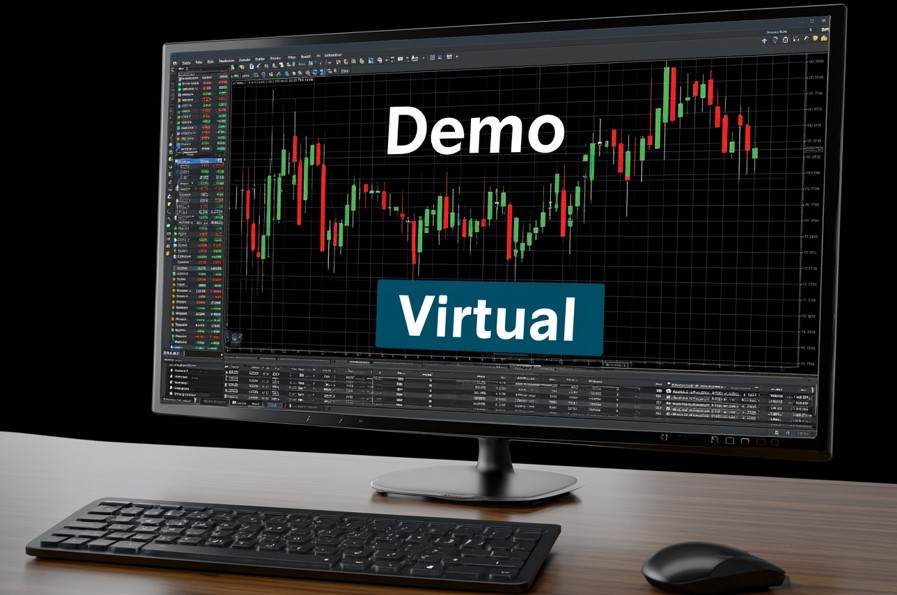
Demo trading runs on live price feeds and mirrors the mechanics of a real account — order types, margin calculations, position sizing — but the balance is simulated. You get fills at real market prices without any money changing hands.
The practice predates digital platforms by decades. Before broker demo accounts existed, traders logged hypothetical entries and exits on paper at the end of each session, then reviewed results weekly.
The logic was simple: documented evidence of a repeatable edge beats guesswork. That habit transferred directly into the modern era, which is why Forex paper trading and demo trading are used interchangeably today. The platform changed; the method didn’t.
Backtesting vs. Forward Testing
Strategy testing happens in two stages, and each one answers a different question.
Backtesting: Does the Logic Hold on Historical Data?
Backtesting applies your strategy rules — entry signals, stop-loss placement, take-profit targets — to historical price data. You run those rules across a past period and measure what would have happened: win rate, average gain per trade, maximum drawdown.
The main risk here is overfitting. A strategy tweaked until it looks profitable on the exact data set you tested it on tends to fall apart on new data. Changing one variable — stop-loss distance, time frame, session filter — often produces a completely different result.
A backtest that survives multiple data periods and minor rule variations is far more credible than one optimized on a single stretch of price history. The National Futures Association notes that historical performance is not necessarily indicative of future results — a standard disclaimer that applies directly to every backtest you will ever run.
Forward Testing: Does It Hold in Live Conditions?
A confirmed backtest moves to a Forex simulator next. Forward testing runs the same rules on price action as it unfolds in real time, which means the strategy faces current spreads, real session behavior, and live news events rather than clean historical data.
This step catches the gap between “worked in the past” and “works now.” Markets change character — volatility regimes shift, correlations break down, liquidity patterns adjust around major macro events. A strategy tested only on historical data skips all of that.
Setting Up the Demo Correctly
A virtual trading account puts the same paper-trading process inside a live platform — same charts, same order panel, same data feed — with a simulated balance in place of real capital. Opening one takes a few minutes at any regulated broker, but the setup choices made at this stage directly affect how useful the data will be.
- Set a realistic balance. Use the amount you actually plan to deposit, not a default $100,000 figure. Drawdown percentages and position sizes calculated on an inflated balance mean nothing when you go live with $3,000.
- Check the demo expiry window. Most broker demo accounts expire between 30 and 90 days of inactivity. If the test needs eight to ten weeks, confirm the account won’t cut out mid-test, or find out whether the broker allows renewal.
- Lock in the same pairs and sessions. A strategy tested on EUR/USD during the London session will not produce comparable results if you switch to exotic pairs during the Asian session on a live account. Test what you intend to trade.
- Keep a trade journal. The platform logs fills; it does not log your reasoning. Write down what triggered each entry, what the original plan was, and what the outcome was. The journal is where patterns actually show up.
Run a minimum of 50 trades on any single strategy before drawing conclusions. Ten trades can look like a solid track record by pure chance; fifty gives you a sample that actually means something.
Where Structured Guidance Closes the Gap
Demo access solves the capital risk problem. It doesn’t solve the feedback problem. Traders who open a Forex simulator without a framework for what to measure often log weeks of screen time without understanding why results are inconsistent.
The trading simulator at WR Trading is a browser-based tool that pulls live market data across forex, stocks, indices, and commodities. No account, no installation, no broker needed. Students in the mentorship program use it to put classroom concepts — chart reading, risk management, psychology, strategy — into practice against real prices.
Traders work through a defined curriculum that connects Forex paper trading practice to specific execution topics — position sizing, risk management, and strategy — in a structured sequence rather than self-directed guesswork.
Simulation plus structured feedback closes the most common gap in demo trading: practicing without clear standards for what good execution actually looks like.
Metrics Worth Tracking
| Metric | What It Shows | Benchmark |
| Profit Factor | Gross profit ÷ gross loss | Above 1.5 |
| Win Rate | Trades closed in profit | Read alongside reward-risk |
| Max Drawdown | Largest peak-to-trough drop | Must fit your live risk tolerance |
| Reward-Risk Ratio | Avg winner ÷ avg loser | 1.5:1 minimum |
| Sharpe Ratio | Return adjusted for volatility | Above 1.0 |
A 70% win rate with a 0.5:1 reward-risk ratio loses money. A 38% win rate with a 2.5:1 ratio is profitable. Win rate alone tells you almost nothing — the ratio it sits alongside determines whether the math works over time.
Track all five metrics across at least 50 trades on your Forex paper trading account. That’s the minimum before the numbers mean anything.
What Demo Doesn’t Replicate
A demo account is an accurate mechanical environment, but it still cannot cover all of the live trading aspects:
- Slippage: Demo fills are clean. On a live account during a central bank announcement, a CPI release, or a major jobs report, stop-loss orders can fill several pips away from the set price,
- Spreads: Demo spreads are often compressed. Real spreads widen sharply during volatility and around major news releases.
- Psychology: Mechanical habits carry over from demo; emotional discipline doesn’t — it builds only from actual exposure to real consequences.
Treat these gaps as data points, not arguments against demo trading. A strategy that struggles on demo has no chance live. One with a documented edge on demo at least starts from honest ground.
When the Data Says Go Live
Move from Forex paper trading to a funded account when five conditions are met:
- At least 50 trades logged following the same rules throughout, no mid-test modifications.
- Profit factor above 1.3 across the sample.
- Maximum drawdown stayed inside a loss limit you’d accept on real capital.
- Written risk plan in place: position size per trade, daily loss cap, conditions to stop for the day.
- No strategy changes made to improve the look of the results.
If any point is unmet, the demo period extends.
The Actual Point of Virtual Testing
A Forex simulator is not a confidence-building exercise. It is an evidence-collection tool. The goal is a documented sample of trades that tells you, with reasonable statistical weight, whether a strategy has an edge in current market conditions.
Traders who use demo time that way — structured tests, honest records, no resets after losing streaks — arrive at a live account with something most retail traders skip entirely: a baseline grounded in data rather than feeling.






Comment