Database reliability sits at the core of almost every modern application. When the data layer produces incorrect results, the impact reaches every feature that depends on it. SQL automation testing addresses this by replacing manual database checks with repeatable, scripted validation that runs consistently across every build. Tools like aqua cloud help QA teams manage and track automated SQL tests alongside the rest of their testing workflow, and a dedicated SQL insert query generator can accelerate test data preparation significantly.
What Is SQL Automation Testing?
SQL automation testing is the practice of using scripts and tools to validate database behavior automatically, without manual intervention on each test run. Rather than a tester querying the database by hand after every deployment, automated tests execute predefined SQL statements and compare the results against expected values.
SQL testing at this level covers a wide range of validations. These include checking that data inserts, updates, and deletes produce the correct outcomes, verifying that stored procedures return accurate results, and confirming that data migrations preserve integrity across environments. SQL automation sits alongside functional and API testing in a mature QA pipeline, focused specifically on what happens below the application surface.
Benefits of SQL Automation Testing
Teams that invest in SQL automation testing see consistent advantages across the development cycle:
- Faster feedbackmeans database defects surface during the build pipeline rather than in production.
- Repeatabilityensures the same validations run identically across every environment, removing human variability from database checks.
- Broader coveragelets a tester validate hundreds of data scenarios that would be impractical to check manually on each release.
- Regression protectioncatches cases where a schema change or new query breaks existing SQL testing behavior.
- Audit trailgives QA teams documented evidence that database validations were performed, which matters in regulated industries.
- Reduced manual effortfrees testers to focus on exploratory and business-logic testing rather than repetitive data checks.
Prerequisites for SQL Automation Testing
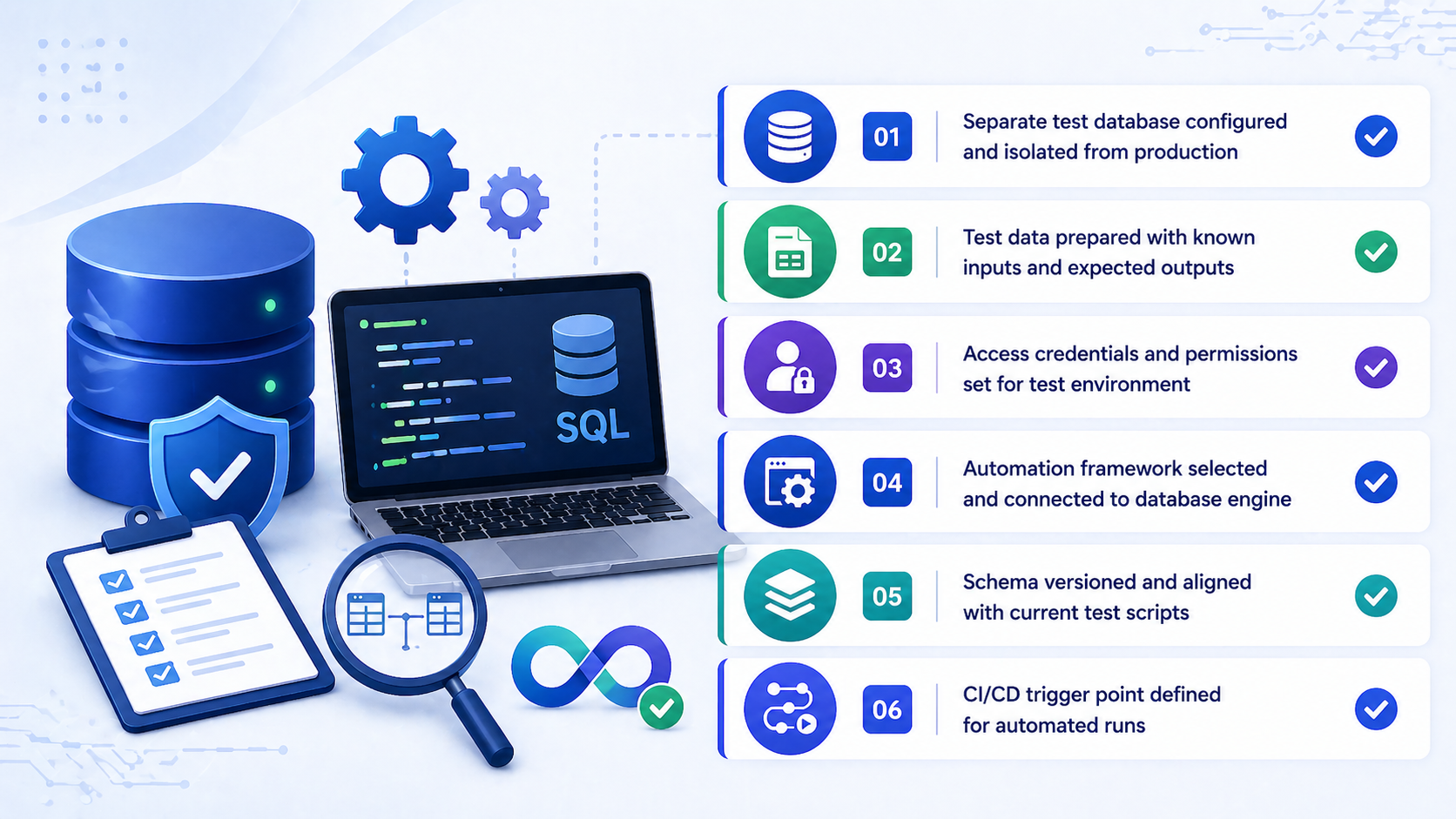
Before SQL automation can run effectively, several conditions need to be in place:
- A stable test database that is separate from production and can be reset between test runs.
- Defined test data with known inputs and expected outputs for each validation scenario.
- Access credentials configured for the test environment, with appropriate read and write permissions.
- A chosen automation framework compatible with the database engine in use, such as pytest with a database plugin for PostgreSQL, or a dedicated tool for SQL Server.
- Version-controlled schema so that SQL testing scripts stay in sync with the current database structure.
- A CI/CD integration point where SQL automation tests can be triggered automatically on each build or deployment.
Skipping any of these steps creates gaps that undermine the reliability of the entire SQL automation effort.
Steps to Perform SQL Automation Testing
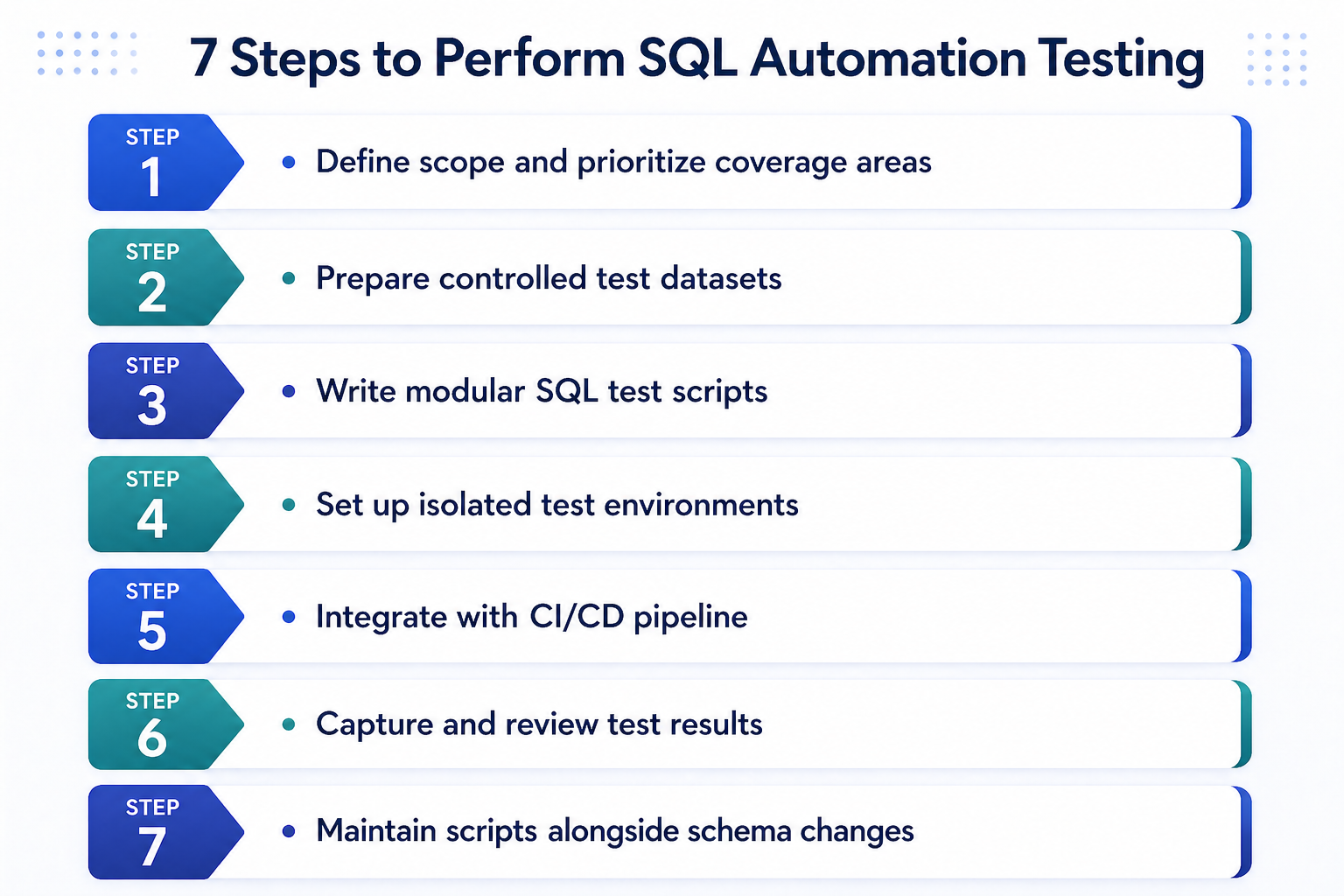
SQL automation testing follows a structured sequence that any QA team can apply regardless of the database platform:
- Define the scopeby identifying which database operations, stored procedures, and data flows need automated coverage. Prioritize areas with the highest business impact or the most frequent changes.
- Prepare test databy creating controlled datasets with known values. Each test case needs a predictable starting state so that result comparisons are meaningful.
- Write test scriptsthat execute SQL statements against the test database and assert expected outcomes. Scripts should be modular, targeting one behavior per test.
- Set up the test environmentwith isolated database instances that can be seeded and torn down cleanly between runs.
- Integrate with the CI/CD pipelineso that SQL automation runs automatically on each deployment. A tester should be able to trigger the full SQL testing suite from a single pipeline step.
- Capture and review resultsusing a reporting layer that flags failures with enough detail to identify the root cause quickly.
- Maintain scripts alongside schema changesto prevent test drift, where SQL automation checks pass because they are testing outdated structures rather than current behavior.
Challenges in SQL Automation Testing
SQL automation introduces specific challenges that teams need to plan for from the start:
- Test data managementis one of the hardest problems in SQL testing. Realistic datasets are complex to generate, and tests that share data can interfere with each other if isolation is not enforced.
- Schema drifthappens when database structures change without corresponding updates to SQL automation scripts, causing false passes or irrelevant failures.
- Environment inconsistencybetween development, staging, and production databases leads to tests that pass in one environment and fail in another.
- Stored procedure complexitymakes some database logic difficult to test in isolation, particularly when procedures depend on multiple tables or external calls.
- Performance at scalebecomes a concern when the SQL testing suite grows and long-running queries slow down the CI/CD pipeline.
- Permissions and access controlacross environments add configuration overhead that QA teams frequently underestimate during initial setup.
Best Practices
 1.Enforce test isolation
Each SQL automation test should create its own data, execute against it, and clean up afterward. Tests that rely on leftover state from previous runs produce inconsistent results that erode confidence in the entire suite over time.
2.Version-control test scripts alongside application code
When a migration alters a table structure, the corresponding SQL testing scripts should be updated in the same commit. This prevents the gradual drift that makes automated suites unreliable and keeps QA coverage accurate as the schema evolves.
3.Layer tests by complexity
Simple data validation checks should run first and fast. Stored procedure tests and multi-table scenarios come afterward. This structure means a tester can identify failures at the simplest possible level before more complex SQL automation tests consume pipeline time.
4.Write precise assertions
A test that checks whether a query returns any rows is far weaker than one that verifies the returned rows match exact expected values. Precision in assertions is what makes SQL testing genuinely protective rather than superficially green.
5.Automate test data generation
Manually maintaining datasets does not scale. How to automate SQL testing sustainably depends on having a repeatable way to generate and seed test data, so that the suite stays usable as the database grows in complexity.
Conclusion
SQL automation testing gives QA teams reliable, repeatable coverage of the database layer without the overhead of manual validation on every release. When set up with proper test isolation, version-controlled scripts, and CI/CD integration, SQL automation catches data defects early and keeps them from reaching production. The investment pays back quickly on any project where SQL testing is central to how the application behaves.