Choosing an AI knowledge base system for private deployment is not the same as choosing a general SaaS chatbot. The decision touches infrastructure, data security, document governance, model routing, permission design, integration, operations, and long-term ownership. A system that looks good in a simple web demo may not be suitable for a controlled enterprise environment. A system that can be installed privately may still be difficult to maintain if it lacks clear administration tools, retrieval visibility, or upgrade practices.
Private deployment usually enters the conversation because the enterprise wants stronger control. Internal documents may be confidential. Customer data may require strict separation. The assistant may need to run inside an intranet or connect to systems that are not exposed publicly. Security teams may ask where prompts, embeddings, retrieval logs, uploaded files, and model responses are stored. Business leaders may ask whether the assistant can support real workflows rather than only answer questions. These are reasonable questions, but they need a structured evaluation process.
This article provides a practical framework for selecting a private AI knowledge base system. It focuses on the areas that matter after the demo: deployment architecture, knowledge management, retrieval quality, permissions, citations, workflow integration, operations, and adoption. A platform such as FastGPT should be evaluated through these concrete criteria, not only through the fluency of the first generated answer.
Define the Deployment Boundary First
The first selection question is where the system actually runs. “Private deployment” can mean different things. It may mean the application runs on the company’s own servers while model calls still go to an external provider. It may mean documents and vector storage stay inside a private cloud, but some inference services are external. It may mean the entire stack, including embedding models and large language models, runs inside an intranet. These options have different cost, risk, and maintenance implications.
Before comparing products, define the required boundary. Which components must stay inside the private environment? Uploaded documents? Parsed text? Embeddings? Vector indexes? User prompts? Retrieved context? Conversation logs? Workflow execution logs? Model calls? Backups? If the organization cannot answer these questions, it may choose a deployment model that sounds secure but does not meet the real compliance need.
The boundary should also include network access. Will the system run fully offline? Can it access external model APIs? Can it connect to internal OA, CRM, HR, helpdesk, or database systems? Does it need single sign-on? Does it need to serve external customers or only internal employees? The answers will narrow the vendor list quickly and prevent late-stage architecture surprises.
Evaluate Knowledge Base Management, Not Just Chat
An AI knowledge base system is only useful if it can manage knowledge well. In private deployment, this becomes even more important because the enterprise will usually own more of the operational process. The system should help administrators upload documents, organize knowledge bases, update content, remove outdated material, inspect retrieval behavior, and maintain different knowledge domains over time.
Look closely at document handling. Does the system support the file types your teams actually use? Can it process long documents, tables, mixed-language content, and structured policies? Can administrators manage versions and identify outdated files? Can business teams maintain knowledge without asking engineers to edit code? A private deployment that requires technical intervention for every document change will slow adoption.
The selection team should test real documents, not sample PDFs. Use support manuals, HR policies, implementation notes, process guides, sales materials, and technical documents from the actual business. Then ask real questions from employees or customers. This will reveal whether the knowledge management layer is strong enough for production.
Test Retrieval Quality with Real Questions
Retrieval quality is the heart of an AI knowledge base. A private deployment can protect data, but it cannot guarantee good answers if retrieval is weak. The system must find the correct evidence before the model can generate a trustworthy response. This requires more than basic vector search. Enterprise use cases may need metadata filters, reranking, keyword matching, semantic matching, document segmentation, and control over how many sources are used.
Create a test set before procurement. Include common questions, ambiguous questions, version-specific questions, policy exception questions, and questions that should not be answered from available knowledge. For each question, define the expected source document and acceptable answer boundary. Then test whether the system retrieves the right content and whether the answer stays grounded in that content.
Do not rely only on answer fluency. A fluent answer may hide poor retrieval. Ask reviewers to inspect the retrieved sources. Did the system find the right section? Did it miss an important exception? Did it mix old and new documents? Did it answer when it should have refused? The best private deployment choice is not the system that sounds most confident. It is the system that can be inspected and improved when retrieval fails.
Require Citations and Reviewability
Enterprise users need to verify important answers. A customer service agent may need to confirm a product explanation before sending it to a customer. HR may need to point employees to the correct policy. IT may need to validate security procedures. Legal, finance, and compliance teams may require an audit trail. Citations and reviewability are therefore core selection criteria, not optional interface features.
The system should preserve source metadata during ingestion and show useful references in the answer experience. A vague citation to a document name may not be enough for long policies or manuals. Users often need section-level or passage-level traceability. Administrators need retrieval logs so they can understand why the assistant produced a bad answer. Without this visibility, private deployment may create a secure but opaque system.
Reviewability also supports continuous improvement. When a user reports a wrong answer, the team should be able to inspect the question, retrieved knowledge, cited sources, and final response. Then they can decide whether to update the document, adjust retrieval settings, improve prompts, add metadata, or change escalation behavior. A system that cannot support this loop will become harder to trust as usage grows.
Design Permissions Around Business Roles
Permission design is one of the main reasons companies choose private deployment, but it is often under-specified. The system should support the way the organization actually separates knowledge and responsibilities. A simple administrator-user split is rarely enough. Enterprises may need permissions by department, role, region, customer, project, document type, or application.
Start by mapping knowledge domains. Which content is public? Which is internal? Which is confidential? Which is customer-specific? Which is restricted to HR, finance, legal, security, or management? Then map user groups. Which employees can query each knowledge base? Who can upload documents? Who can publish an assistant? Who can connect tools? Who can inspect logs? Who can change prompts and workflows?
The selection team should test permission behavior directly. Can a user retrieve content from a knowledge base they should not access? Can an assistant accidentally mix restricted and unrestricted knowledge? Are logs visible to the right administrators only? Can tool actions be limited by role? A private deployment without strong permission design may reduce external risk while increasing internal exposure.
Check Model and Embedding Flexibility
Private deployment decisions often depend on model strategy. Some companies are comfortable using external large language model APIs if documents and logs are controlled. Others require local models for all inference. Some want to choose different models for different use cases: a stronger model for complex reasoning, a faster model for simple Q&A, a local embedding model for sensitive documents, or a specialized reranker for retrieval quality.
The AI knowledge base system should support the model choices the organization needs. It should make clear which data is sent to which model, how prompts are constructed, how retrieved context is handled, and how model configurations are managed. If local models are required, evaluate latency, hardware requirements, answer quality, and maintenance workload. Local deployment can increase control, but it may also require more infrastructure expertise.
Embedding choices also matter. Embeddings influence retrieval behavior, especially across languages, technical terms, and domain-specific phrases. If the company has Chinese and English documents, product terminology, abbreviations, or industry language, retrieval should be tested with realistic queries. Model flexibility is not about collecting options. It is about matching the knowledge base to the company’s language, risk, and performance needs.
Evaluate Workflow and Integration Capabilities
A private AI knowledge base should not be limited to answering “what does this document say?” Many enterprise use cases require the assistant to guide work. It may help employees prepare OA requests, draft customer replies, summarize tickets, classify problems, generate proposal text, or route cases to the right team. This requires workflow design and sometimes integration with existing systems.
When evaluating platforms, ask how the system connects knowledge to workflow. Can it ask follow-up questions? Can it produce structured outputs? Can it call approved tools or APIs? Can it require human confirmation before actions? Can it handle errors gracefully? Can different workflows be built for different departments? These capabilities determine whether the assistant becomes a daily work tool or stays a separate Q&A interface.
Integration should be approached with caution. The AI knowledge base should not casually replace OA, ERP, CRM, HRIS, finance, or helpdesk systems. Those systems should remain systems of record. The assistant should guide users, prepare information, and connect to approved workflows. For private deployment, integration also requires network planning, credential management, audit logs, and permission controls.
Plan for Operations and Upgrades
Private deployment gives the enterprise more control, but it also gives the enterprise more responsibility. Before choosing a system, ask who will operate it after launch. Who monitors availability? Who handles backups? Who applies updates? Who troubleshoots slow retrieval? Who reviews logs? Who manages model changes? Who responds when users report bad answers? Who owns each knowledge domain?
A good private deployment system should make operations visible and manageable. Administrators should be able to see usage, inspect failures, update knowledge, manage applications, and coordinate with business owners. The system should have a realistic upgrade path. If every update requires heavy custom work, the organization may fall behind on security fixes and product improvements. If logs are insufficient, troubleshooting will be slow.
Operations should also include cost control. Even in private deployment, model inference, embeddings, storage, compute, and administrator time have costs. Usage can grow quickly after adoption. The team should monitor token usage, model latency, document growth, and workflow volume. A private AI knowledge base should be treated as a production system, not a one-time installation.
Run a Pilot Before Making a Broad Commitment
The best way to choose a private AI knowledge base system is to run a focused pilot. Pick one use case with real business value and clear knowledge ownership. Customer service Q&A, HR policy assistance, OA process guidance, sales enablement, or internal IT support are common starting points. Prepare real documents and a realistic question set. Define success metrics before testing.
During the pilot, evaluate both technical and operational fit. Can business users maintain content? Does retrieval work on real questions? Are citations useful? Are permissions reliable? Does the deployment model satisfy security requirements? Can administrators inspect logs and improve answers? Does the assistant save time in the actual workflow? If the pilot only tests prepared demo questions, it will not reveal the problems that matter after rollout.
A pilot should also identify expansion conditions. What quality level is required before adding more departments? Which issues must be fixed before tool integration? What ownership model is needed? Which workflows are too risky for automation? These decisions help the company scale responsibly.
Applying the Checklist to FastGPT
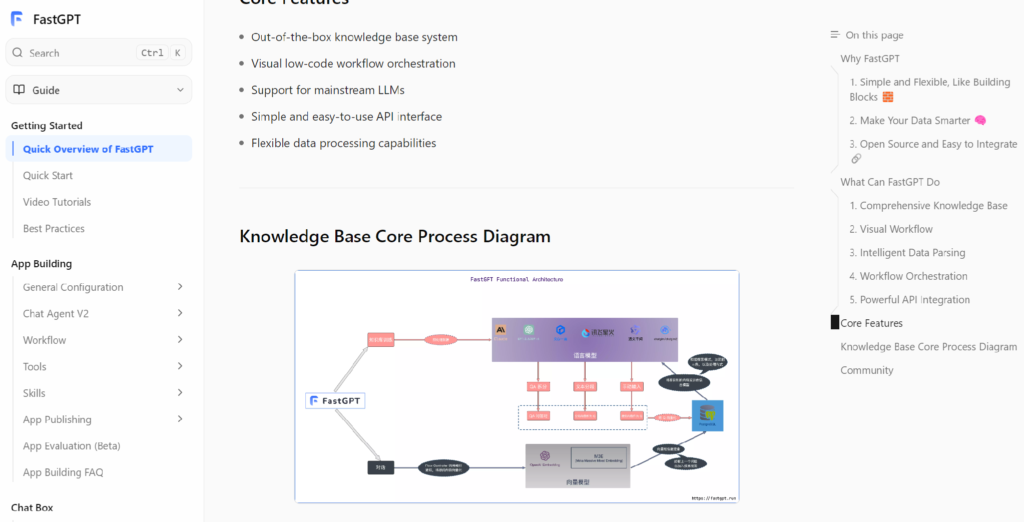
FastGPT’s official documentation is a useful starting point for teams evaluating knowledge-based AI applications. During selection, the team should map FastGPT against the same checklist: deployment boundary, knowledge management, retrieval quality, citations, permissions, model configuration, workflow design, integration needs, operations, and pilot results. The goal is not to accept or reject a platform based on a single feature. The goal is to understand whether it can support the company’s actual operating requirements.
The evaluation should involve multiple stakeholders. IT should review deployment and operations. Security should review data boundaries and permissions. Business teams should test answer usefulness and content maintenance. AI or engineering teams should test retrieval, model behavior, and integration. Executives should look for measurable business value. This shared evaluation prevents the project from becoming either a purely technical installation or a purely business-led demo.
FastGPT may be a strong fit when the company wants to turn enterprise documents into maintained AI applications and connect knowledge to workflows without building every layer from scratch. The final decision should still be based on evidence from the pilot. Private deployment is serious infrastructure. It deserves serious testing.
Final Takeaway
Choosing an AI knowledge base system for private deployment requires more than asking whether the product can be self-hosted. The company must define its data boundary, test real documents, evaluate retrieval and citations, design permissions, plan model routing, check workflow capabilities, and prepare for operations. A private system that is hard to maintain will not create lasting value. A secure deployment with weak knowledge governance will still produce weak answers.
The best choice is the system that matches the company’s risk profile, business workflow, and operating capacity. Start with a specific use case. Test it with real users and real documents. Measure answer quality and business impact. Then expand only when the knowledge base is reliable, the permission model is clear, and the team knows how to maintain it. Private deployment can be a powerful option, but it should be selected as part of a practical enterprise AI strategy, not as a checkbox.