
NVIDIA AI is coming to Lovense’s next-generation Solace device

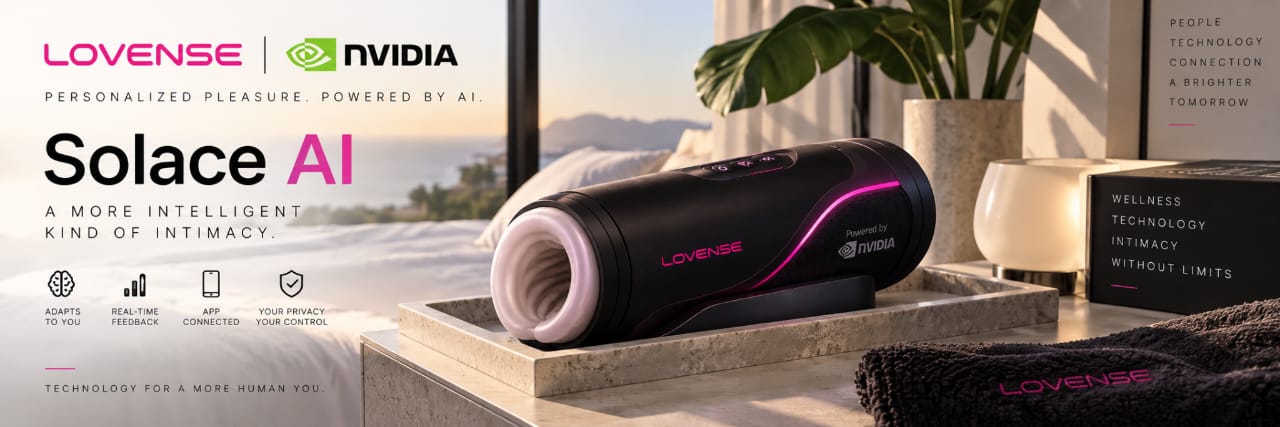
Lovense is taking its connected male wellness technology a step further with Solace AI, a new device that uses NVIDIA edge computing to personalize its response in real time.
Lovense is expanding its use of artificial intelligence with Solace AI, a new male pleasure device that combines the company’s motorized technology with NVIDIA’s Jetson edge-computing platform.
The device represents the next generation of Lovense’s existing Solace lineup, adding onboard AI processing and a collection of sensors designed to let the hardware respond dynamically to its user.
Rather than relying entirely on preset patterns, Solace AI analyzes information from pressure and motion sensors while the device is operating. An onboard AI model can then modify speed, stroke depth and rhythm based on that feedback.
The result, according to Lovense, is a system that can adapt continuously instead of simply executing a sequence of predetermined commands.
“We wanted to move beyond a device that simply does what it’s told,” a Lovense spokesperson said. “The goal with Solace AI is to create something capable of recognizing patterns in how it’s being used and adapting the experience in real time.”
NVIDIA brings AI processing onto the device
A major part of that system comes from NVIDIA Jetson, the company’s computing platform for running AI models directly on embedded hardware.
Jetson technology is commonly associated with robotics, autonomous machines and other edge-computing applications where sensor information needs to be processed quickly.
Lovense is applying the same principle to intimate technology.
Instead of sending every sensor reading to cloud infrastructure for processing, Solace AI can perform much of its adaptive processing locally. That reduces latency between detecting a change and adjusting the device.
The company says local processing was also an important consideration when designing the product’s privacy architecture.
Users will be able to disable adaptive learning, erase stored personalization profiles and use conventional manual controls instead.
Building on Solace Pro
Solace AI follows Lovense’s existing Solace Pro, an automatic male pleasure device that already combines motorized movement with connected software.
Lovense’s current ecosystem includes Bluetooth connectivity, remote partner control and interactive synchronization through the Lovense Remote app.
The company has also developed AI Sync technology capable of translating compatible interactive video and livestream content into synchronized device movement.
Solace AI adds another layer to that system.
Instead of simply receiving an instruction telling the hardware how to move, the new device can evaluate sensor feedback at the same time and modify that movement based on an individual’s learned preferences.
That could mean two Solace AI devices responding differently to the same piece of interactive content.
“Synchronization gives the device context about what’s happening digitally,” the Lovense spokesperson said. “Adaptive AI gives it context about the person using it.”
Learning individual preferences
Lovense says Solace AI can gradually build a profile around combinations of speed, rhythm and stroke depth preferred by an individual user.
Those patterns can then influence future sessions.
The company describes the system as optional personalization rather than autonomous control. Users retain access to traditional settings through the Lovense Remote app and can manually change intensity or movement at any point.
Remote partner control will also remain part of the platform.
The difference is what happens between those commands.
Sensors inside Solace AI continually provide information to its onboard processing system, allowing the device to make smaller adjustments without requiring the user to repeatedly change settings.
A different kind of edge-AI device
NVIDIA has been pushing AI beyond traditional computers and data centers through its Jetson platform.
The technology allows manufacturers to place significant AI processing capabilities directly inside machines that interact with the physical world.
That approach has become increasingly important in robotics because a machine sometimes needs to interpret sensor information and react immediately rather than waiting for a cloud server.
Solace AI applies the same basic architecture to consumer intimate hardware.
It also illustrates how increasingly compact AI systems could eventually appear in categories of electronics that historically relied on comparatively simple microcontrollers and predetermined software.
For Lovense, the transition follows a progression already underway across its products — from manually controlled devices to connected hardware, interactive synchronization and now locally processed adaptive AI.
The company expects limited production of Solace AI to begin in 2027, followed by wider availability.
A final retail price has not been announced. Lovense says the new device will be positioned above Solace Pro in its male product range.
The existing Lovense Remote ecosystem will remain central to the product, providing manual controls, partner connectivity and access to compatible interactive experiences.
Solace AI simply adds something new to that equation: hardware capable of learning from what happens after the user presses play.
Media Contact
Lovense Communications
Global Media Relations
Lovense
Hong Kong
Media inquiries: [email protected]
Product: Solace AI






Comment