
How Proptech and Data Are Rewriting Construction Cost Estimation in South Africa

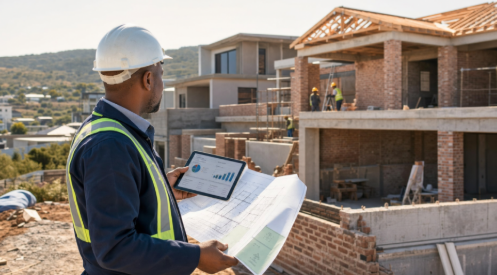
For decades, construction cost estimation has run on a mix of experience, instinct and Excel. A quantity surveyor’s gut feel, a spreadsheet inherited from the last project, an allowance pencilled in because nobody had better information at the time — that has been the industry standard, and the industry has paid for it. Estimation error is not a rounding problem. It shows up later as budget overruns, contract disputes and projects that stall halfway through because the numbers never matched reality. A wave of proptech and data tooling is now attacking that weak point directly, replacing single-point guesses with factor-based, data-driven ranges that update as market conditions do. What is notable is where this shift is easiest to see in action: not only in the mature markets of the US and Europe, but in emerging markets, where the gap between old-style estimating and new data infrastructure is widest — and therefore most visible.
Why cost estimation was the industry’s weak link
The traditional estimating process depends heavily on one person’s judgement at a point in time. An experienced estimator applies unit rates that may be months or years out of date, adjusts them by feel for the specific job, and hands over a number that often omits scope items a homeowner or developer only discovers once work is underway. There are established methods for doing this more rigorously — analogous estimating, parametric estimating, unit-cost estimating and detailed (bottom-up) estimating are the four broadly recognised approaches, and cost engineers still lean on shortcuts like the 0.6 rule to scale known costs across similar projects. But even the better methods are only as good as the inputs behind them. The real levers that move a build’s cost are consistent everywhere: size, location, material specification, design complexity, and labour, which typically accounts for a quarter to a third of total project cost. When those inputs are stale or generalised, the estimate is a guess wearing a spreadsheet’s clothing.
What “data-driven estimation” actually changes
The mechanical shift is straightforward but consequential: instead of one estimator producing one number from memory, a data-driven model produces a range built from live regional inputs — provincial or regional labour rates, material costs, escalation indices, and finish-level factors — and refreshes that range as market conditions move. This is different from digitising an old spreadsheet into software; a static digital tool still ages the moment its rates are entered. The newer approach treats cost estimation as a continuously updated data product, drawing on construction input price indices. Statistics South Africa domain-level reference for producer/consumer price index data –> — the producer and consumer price data that tracks material and labour cost movement over time — as its backbone. For developers and procurement teams, the payoff is faster front-end budgeting: a realistic range appears before a single quote is requested, which means conversations with contractors start from an informed position rather than an open question.
A concrete example: factor-based estimation in an emerging market
South Africa offers a useful, concrete illustration of this trend rather than an abstract one. One example is a data-driven South African building-cost platform that lets a visitor generate an indicative cost range in under a minute by entering basic project details, then draws on published per-square-metre and house-size cost data segmented by building type and province — the front-end data layer that sits before a homeowner or developer ever requests a formal builder quote. Its published ranges show how wide the spread can be even within one country: residential construction sits anywhere from roughly R5,000 to R20,000 per square metre depending on specification, and a 100 m² house correlates to a budget of roughly R600,000 at the basic end, up to R2,400,000 at the premium end, depending on finish level. Design complexity is priced too — in the Western Cape, irregular building shapes are indicated to add roughly 6% to 20% to cost because of higher perimeter-to-floor-area ratios and increased setting-out work. None of these are quotes or guarantees; they are indicative, factor-based ranges, generated from provincial labour, material, escalation and finish-level inputs, that exist to inform a buyer before they compare actual builder quotes — precisely the kind of front-end data layer the broader trend is built on.
Addressing the anxiety: will this replace estimators?
Any conversation about data and automation in a skilled profession eventually arrives at the same question: does the technology replace the professional? For construction estimating, the honest answer is that it augments rather than replaces. A data-driven range narrows the starting point and removes a large amount of manual drudgery — pulling historic rates, cross-checking indices, building a first-pass model from scratch — but it does not interpret a site’s specific constraints, negotiate scope with a contractor, or catch the judgement calls that only come from professional experience. The quantity surveyor or estimator’s role shifts from generating the first number to interpreting and refining a data-generated one. That is a meaningful change in workflow, not a redundancy notice. It is also worth noting that concerns about rising costs remain well founded regardless of the tooling used: labour and material inflation continue to push construction costs upward in most markets, and no estimating model — however data-rich — removes that underlying pressure. What better data does is make the pressure visible earlier, when it is still cheaper to plan around.
What this signals for the industry
The broader signal here is not that emerging markets are catching up to a developed-market playbook — it is that they are writing a different one. Where mature markets are largely retrofitting data layers onto decades-old enterprise estimating software built for large contractors, a market like South Africa is building cost transparency directly into consumer-facing platforms from the outset, with no legacy system to work around — echoing the productivity gap McKinsey has documented across the construction sector more broadly. That has real implications beyond convenience. It shifts negotiating power slightly toward buyers, who arrive at builder conversations already holding a realistic, regionally grounded number instead of an open question. It pushes procurement toward evidence rather than habit. And it suggests the next phase of proptech competition in construction will not be decided by interface polish, but by data currency — whose labour rates, material indices and provincial escalation factors are refreshed regularly rather than left to age quietly in a spreadsheet. Cost estimation, long treated as construction’s least glamorous back-office task, is quietly becoming one of the clearest test cases for what data-driven property technology can actually deliver.







Comment