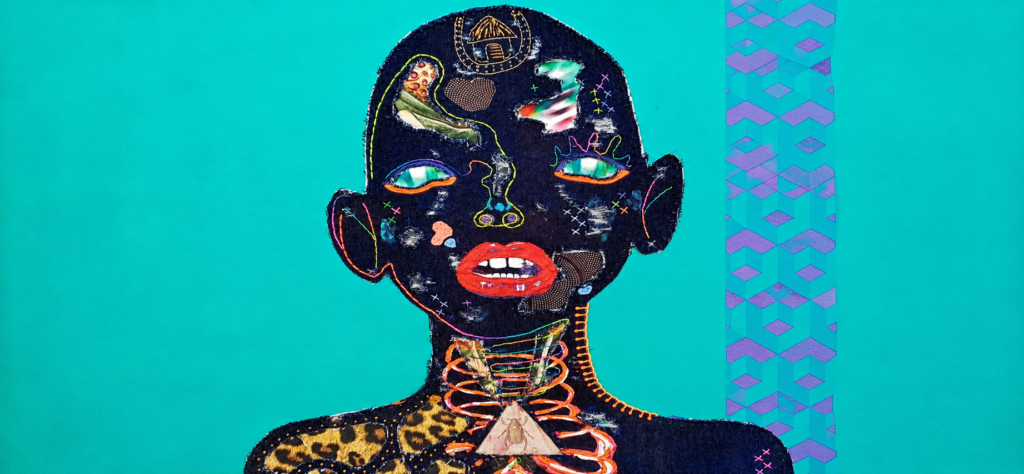
Contemporary art is often judged by what appears on the wall, yet the deeper story is usually found in the material, the hand, and the memory behind the work. For Mzamo Mlambo, art begins before the gallery. It begins in Osindisweni, a small mission in KwaZulu-Natal, where childhood creativity was shaped by rural surroundings, cultural traditions, and the simple act of drawing with sticks on the ground. That early relationship with mark-making still informs the way he approaches art today.
Mzamo is building his practice from Durban, South Africa, as a contemporary African artist working with textile-based storytelling, geometry, repetition, and hand-stitched detail. His work does not treat African heritage as decoration. It uses heritage as structure. Through fabric, stitch, abstraction, and illusion, he explores memory, identity, craftsmanship, and the tension between tradition and modernity.
This matters because the global art market is paying closer attention to African contemporary art, but visibility alone is not enough. The stronger question is which artists are creating work with a clear visual language and cultural depth. Mzamo’s practice sits within that conversation. His work draws from traditional African textile knowledge while translating it into contemporary African art that can speak to local and international audiences.
The discipline behind his work is central to its meaning. Every hand-stitched detail carries time, patience, and physical labour. In a culture where images are produced and consumed quickly, textile-based art forces a different pace. It asks the viewer to consider the process as part of the final artwork. For Mzamo, the act of making becomes a way to preserve memory while creating something new.
His visual language is shaped by geometry and repetition. These patterns are not only aesthetic choices. They create rhythm, movement, and depth, often producing the feeling of a three-dimensional illusion. This combination of structure and emotion allows his work to sit between craft, design, and fine art without being reduced to any one category.
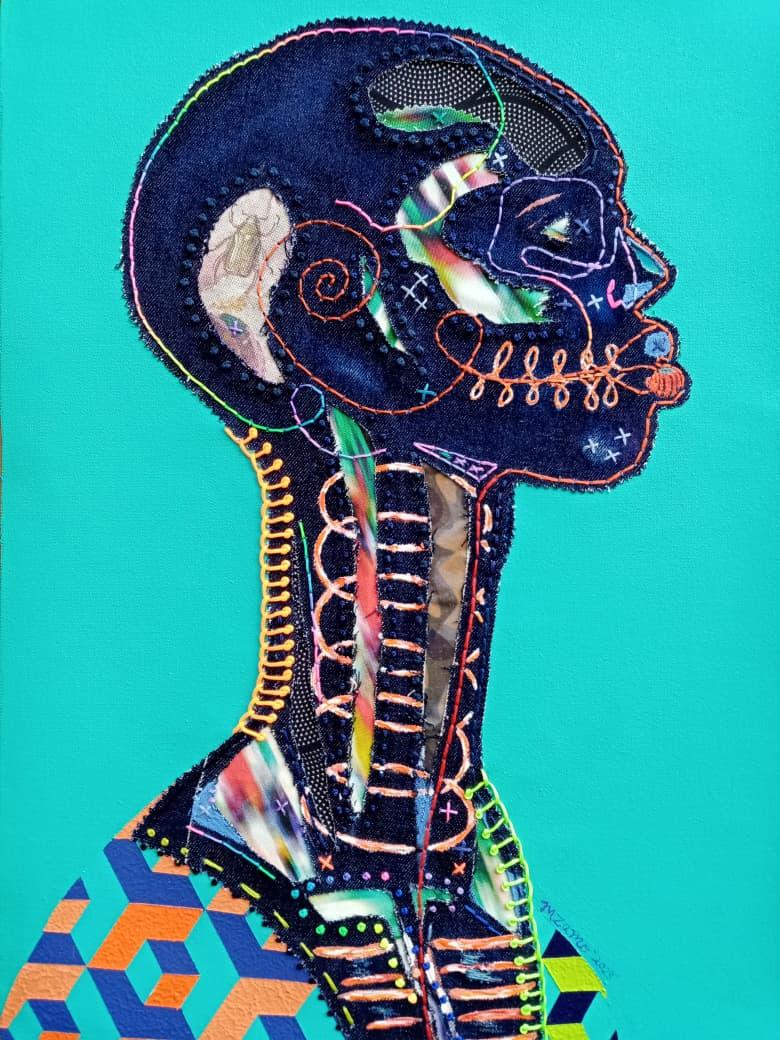
Ghost Machine (2023), hand embroidery and mixed media on canvas, 60 × 40 cm.
Mzamo’s path has also been shaped by persistence. Establishing himself as a professional artist with limited resources and limited access required more than talent. It required experimentation, collaboration, and the gradual development of a distinct voice. His involvement with the Amasosha Art Movement and Rebirth Art Project Space has helped place his work within South Africa’s contemporary art ecosystem while giving him space to refine his practice.
One of his meaningful works, Spirit of Nyame, reflects the direction of his evolving artistic philosophy. It points to the kind of work he wants to be known for: art that carries cultural reference, emotional weight, and technical commitment. The ambition is not only to preserve the past. It is to carry African textile heritage into a contemporary form that can travel across galleries, museums, private collections, and cultural institutions.
There is a wider shift taking place in how African art is being understood. Collectors, curators, and institutions are increasingly looking beyond surface representation. They are interested in process, authorship, material intelligence, and cultural specificity. Mzamo’s work enters this space through the language of textiles, where history is not explained as a slogan but built into the artwork itself.
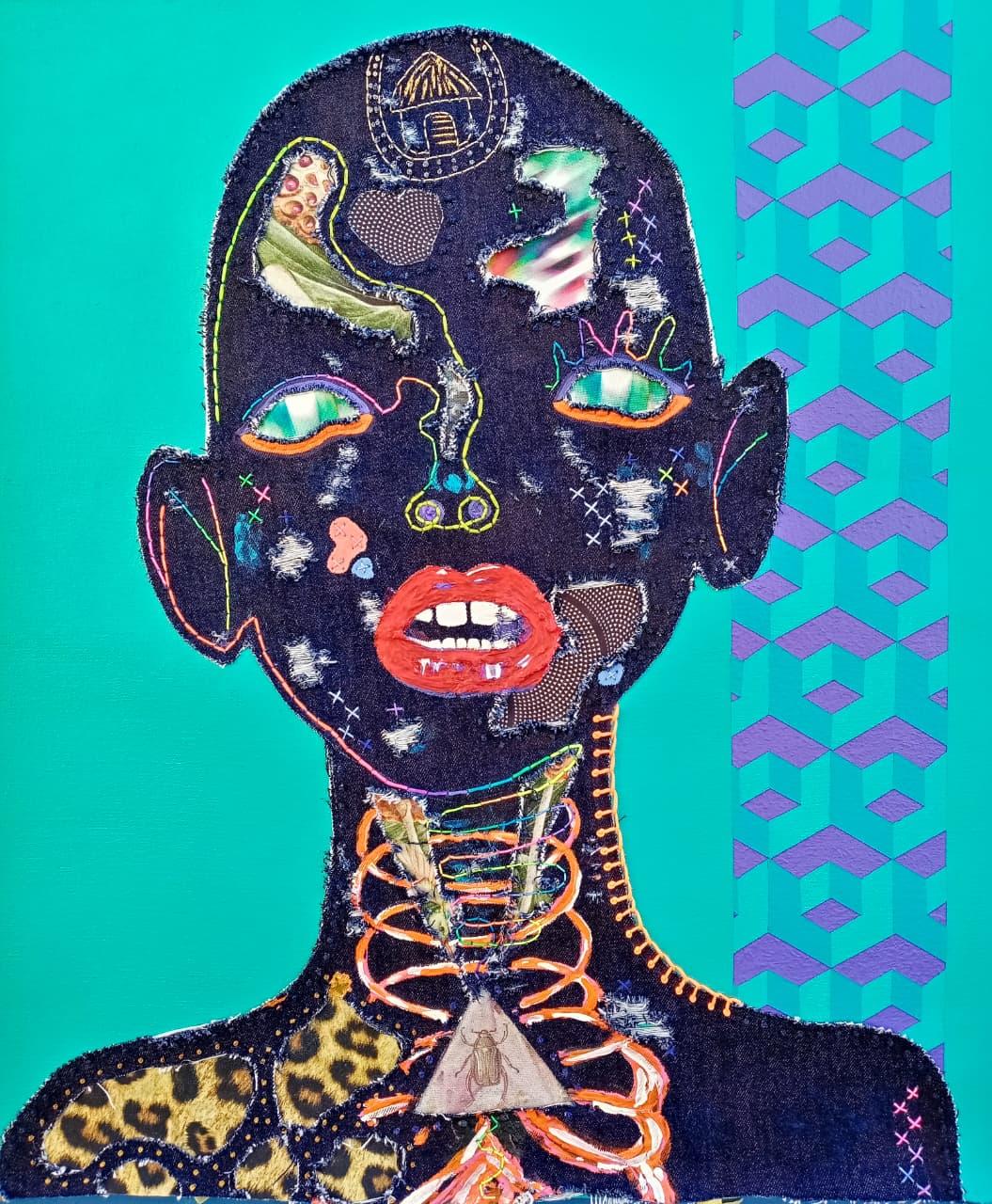
Spirit of Nyame (2023), hand embroidery and mixed media on canvas, 70 × 64 cm.
His upcoming exhibition on 26 November 2026, as part of the travelling art exhibition Izihlahla Ziyokhuluma by the Amasosha Collective, curated by Mthobisi Maphumulo at the William Humphreys Art Gallery, marks another step in that development. It gives his work a broader platform while connecting it to a collective movement of artists exploring African identity, memory, and contemporary expression.
Mzamo Mlambo’s story is not built on instant recognition. It is built on craft, patience, and a search for a visual language that can hold both heritage and innovation. In South Africa’s contemporary art scene, that may be the more important signal. His work suggests that cultural preservation does not have to remain fixed in the past. In the hands of an artist willing to stitch memory into form, tradition can become a living, evolving part of the future.