For many years, the credit score was the sole factor in determining lending decisions in the Canadian market. Equifax and TransUnion were the only ones with access to credit information, and if your record was either insufficient or defective, or if it did not represent your current financial situation, you were directed to payday lenders who charged extremely high interest rates. There was hardly any option in between.
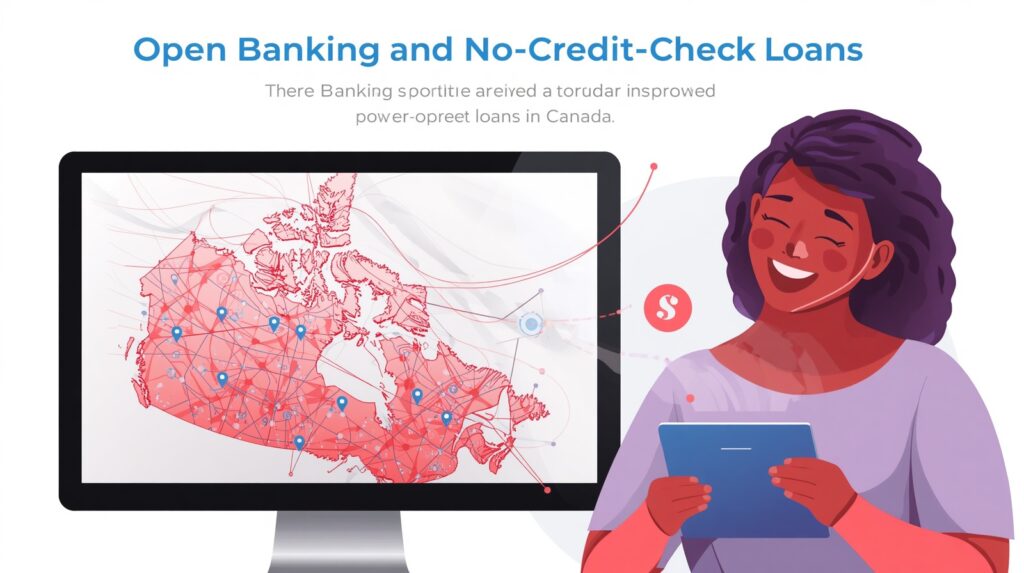
Open banking is gradually altering this situation. The technology behind connecting your bank account to budgeting and accounting software now allows lenders to assess borrowers based on actual financial transactions instead of just their credit history, which leads to the creation of a new type of loan products that do not require a credit check to approve.
It is not just a theory: Canadian lenders have been granting loans by relying mainly on bank transaction data as a risk indicator, and they offer borrowers an experience which is Really different from the traditional credit-based lending.
What open banking actually is in the Canadian context
Open banking is a system that enables customers to safely give access to their financial information to banks or other third parties of their choice. Rather than screen-scraping your bank login or using uploaded PDFs, regulated APIs allow lenders, fintechs, and other authorized services to get a structured view of your transactions with your clear permission.
Canada has been less quick than UK and Australia to set up formal open banking laws, but essentially this has been possible for a long time through companies like Flinks, Plaid, and Inverite. These firms act as an intermediary between Canadian banks and fintechs that want access to customer data, managing the authentication and converting the information into a format that a risk model can easily use.
The government has officially pledged to establish an open banking system in Canada, and its rollout has been proceeding gradually. Meanwhile, the lenders most enthusiastic about using transaction data for credit scoring have been leveraging the current third-party channels, and the products they have introduced are already changing the way that non-prime borrowers get access to credit.
How transaction data replaces the credit score
When a traditional credit-based underwriting decision is made, it typically takes about the same time as contacting the credit bureau and scoring the results. The lender views your credit score, payment history, utilization, and credit mix. They don’t Yet see if you really have money in your account or what your actual income varies to from week to week.
Transaction-based underwriting, Then again, completely changes that. If you allow an open banking connection at the time of loan application, the lender may obtain from 60 up to 365 days of bank account activity. Their algorithms assess income stability- i.e. whether paycheques arrive in time as expected, whether the amounts are the same, whether it is possible to recognize the employer.
Besides they analyze outflow patterns as well. Are there regularly NSF fees? Are overdraft transfers? How much discretionary spending takes place in the days after payday compared to the days before? Is rent paid on time every month? Such patterns are usually very indicative of repayment behaviour, often more than a credit score which may be affected by a collection item from a long time ago.
Why this matters for borrowers without strong credit
Those Canadians who stand to gain most from this change are the ones who have been traditionally left out of the credit system, namely new immigrants in stable employment with limited credit history, self-employed employees and gig workers with irregular income, and young professionals who have avoided credit cards and This way have thin credit files.
Other examples would be people who are financially rehabilitating themselves after bankruptcy or consumer proposal. A bankruptcy or consumer proposal will be on your credit record for years, but it doesn’t really tell a lot about your current financial situation. Someone who did a proposal three years ago, has kept a steady job since that time, and is managing his bank account responsibly, may be a quite different risk from what his score alone indicates. Cash flow data, in fact, reflects person’s financial recovery much better than credit data.
The product category most associated with this approach is loans without hard credit checks, where the lender uses bank transaction data as the primary approval signal rather than a bureau pull. These aren’t payday loans dressed up in new branding -they’re typically installment loans with reasonable terms, priced higher than prime credit but dramatically lower than the alternatives that have historically served subprime borrowers.
What the application experience looks like
If you’ve never used a transaction-based underwriting process, you’ll find the experience strikingly unlike a traditional loan application. Rather than entering your income figures on the form and waiting for the verification of pay stubs, you simply log into your online banking through a secure third-party widget while you are still doing the application.
The connection will only take about 30 seconds. You will authenticate in the same manner as you would for your banking app: same username, same password, same two-factor authentication. The lender doesn’t see your credentials at any point; they only get access to the structured transaction data that you have authorized them to see, and you can normally withdraw the permission at any time afterward.
What once required days of document gathering and manual review can now be accomplished in a few minutes. In many cases, decisions on these products are made within an hour, or even sooner. Payment is usually made via Interac e-Transfer or direct deposit, so you can do the application in the morning and still receive the funds in your account before the close of the business day.
Where this is all heading
The path is very obvious. As Canada’s official open banking system evolves, more financial institutions will use cash flow underwriting, and the range of products offered to borrowers who have been excluded from prime credit in the past will also increase. Pricing is expected to be better as well, since using more accurate data results in improved risk evaluation, which in turn leads to fewer losses, and this finally gives way to lower interest rates.
The credit bureau system remains, as it still serves well those borrowers who have a well-established credit history and regular income. But, the monopoly that bureau data has had over Canadian lending decisions has been effectively dismantled, which is a great benefit for those millions of Canadians whose financial situation could never really be captured by a simple three-digit score.