
How BESS and Energy Management Systems reduce demand charges in C&I sites

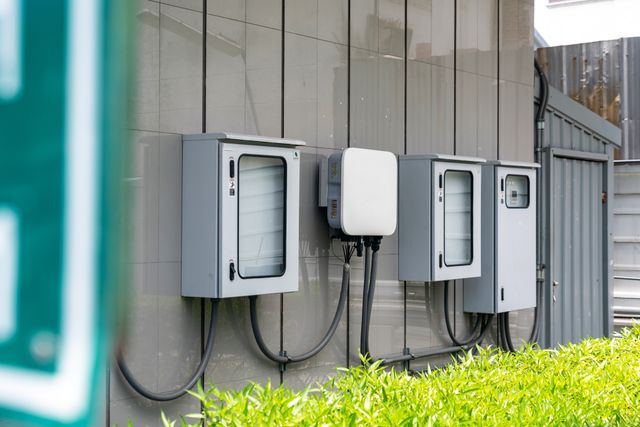
Commercial and industrial facilities face a persistent challenge: demand charges. Unlike energy consumption costs billed per kilowatt-hour, demand charges are calculated based on a facility’s peak power draw during a billing cycle, often representing 30 to 50% of a total electricity bill. As grid tariffs evolve and energy costs rise, reducing these peaks has become a strategic priority for facility managers and energy engineers alike.
Battery Energy Storage Systems (BESS) have emerged as a primary lever for demand charge reduction. But hardware alone is not enough. The real value unlocks when BESS operates under the supervision of an Energy Management System (EMS), the intelligent layer that decides when to charge, when to discharge, and how to coordinate storage with on-site generation and consumption in real time.
Understanding demand charges in C&I buildings
Demand charges are typically assessed over 15 or 30-minute intervals. A single brief spike caused by HVAC startup, industrial equipment cycling, or EV charging can set the peak that defines the entire month’s bill. This makes peak shaving not just an operational goal, but a financial one.
In C&I contexts, the stakes are particularly high. A manufacturing plant, a data center, or a large retail facility may see demand charges that justify significant capital investment in storage infrastructure. The ROI calculation, however, depends heavily on how precisely that storage is controlled.
The role of BESS in peak shaving
A BESS unit positioned behind the meter can discharge during high-consumption periods, effectively flattening the load curve seen by the utility meter. This is the core mechanism of peak shaving.
In practice, this involves forecasting load profiles to anticipate peak windows, pre-charging the battery during off-peak or low-tariff hours, discharging precisely during demand peaks to stay below a defined threshold, and preserving state of charge for subsequent peaks within the same billing cycle.
Without intelligent control, a BESS risks discharging at the wrong moment, either too early, missing the actual peak, or depleting its capacity before a second demand event occurs.
Where the EMS changes everything
An Energy Management System brings the algorithmic layer that transforms a passive storage asset into an active demand management tool. By continuously monitoring consumption data, weather inputs, production schedules, and tariff structures, the EMS optimizes dispatch decisions in real time.
Key EMS functions in a demand charge reduction strategy include dynamic setpoint management to adjust the discharge threshold based on real-time grid conditions, multi-asset coordination to balance BESS output alongside solar PV generation and flexible industrial loads, tariff awareness to integrate time-of-use pricing and demand charge structures, and predictive algorithms that use historical data and consumption forecasting to anticipate peaks before they occur.
This level of control is what distinguishes a well-deployed storage system from an underperforming one, and it is increasingly what C&I energy managers evaluate when selecting a storage solution. Companies like Elum Energy have built their platform around exactly this integration logic, offering an EMS designed to coordinate BESS, solar PV, and flexible loads in C&I environments while optimizing continuously against demand charge structures and time-of-use tariffs.
BESS and EMS in practice
Consider a mid-size logistics facility with a contracted demand of 500 kW and recurring peaks driven by loading dock operations and refrigeration cycles. A standalone BESS sized at 200 kWh could reduce peaks, but without EMS coordination it may deplete before the second daily peak or fail to account for a forecasted cold snap that increases HVAC load.
With an EMS layer, the same system operates with full visibility into the facility’s load patterns. The EMS schedules morning pre-charging during low-tariff windows, holds capacity in reserve for the expected afternoon peak, and adjusts discharge in real time when actual consumption deviates from forecast. The result is consistent, measurable demand charge reduction, billing cycle after billing cycle.
Conclusion
Demand charge reduction in C&I buildings is not purely a storage problem, it is a control problem. BESS provides the energy reservoir; the EMS provides the intelligence to deploy it effectively. As grid complexity increases and tariff structures grow more dynamic, the integration of storage and energy management systems will define the standard for high-performance C&I energy infrastructure.







Comment