Two specific GPA challenges appear repeatedly in the application process — and both have cleaner solutions than most students realise.
Most GPA questions have straightforward answers once the right framework is applied. But two situations consistently produce confusion beyond the ordinary level: calculating GPA when credit hours are unavailable or not used by the originating institution, and converting a GPA from one scale to the 4.0 standard used as the reference point for most graduate and professional applications in the English-speaking world. Both situations are more common than they might appear, and both involve complications that a simple formula cannot reliably resolve
Students from institutions that grade by percentage or by classification rather than by credit-hour GPA face the conversion problem every time they apply to an American university or any programme that asks for a 4.0-scale equivalent. Students from systems that do not weight courses by credits — or who are calculating GPA for a subset of their record where credit information is missing or irrelevant — face the credit-free calculation problem. This article addresses both in full.
The 4.0 Scale and Why International Students Need to Convert to It
The 4.0 GPA scale originated in American higher education and has become the de facto international standard for graduate admissions, professional school applications, and employment screening in contexts where academic performance is relevant. The scale maps four letter grades — A, B, C, D — to the values 4, 3, 2, and 1, with plus and minus variants adding decimal precision across the range. An A minus is typically 3.7; a B plus is 3.3.
For students educated entirely within the American system this scale is native — they have always received grades in terms that map directly to it. For everyone else, the 4.0 scale is a foreign framework into which their home grades must be translated. A student who graduated with a First Class Honours from a British university, a 9.2 CGPA from an Indian institution, an 85 percent average from a Canadian school, or a 1.5 Gesamtnote from a German university cannot present their academic record to an American admissions committee without first answering the question: what is this on the 4.0 scale?
The difficulty is that this question does not have a single correct answer derived from a universal formula. Each national grading system has its own conventions, its own grade boundaries, and its own relationship to the 4.0 scale — a relationship that different conversion frameworks define differently. The British First Class Honours is generally mapped to the 3.7 to 4.0 range, but the precise mapping depends on which conversion framework is applied. The German 1.5 looks low on any scale where higher numbers are better but actually represents near-top performance on a scale that runs from 1.0 (best) to 5.0 (fail). Applying a generic linear conversion to German grades without accounting for the directional inversion produces a result that is not just inaccurate but inverted in meaning.
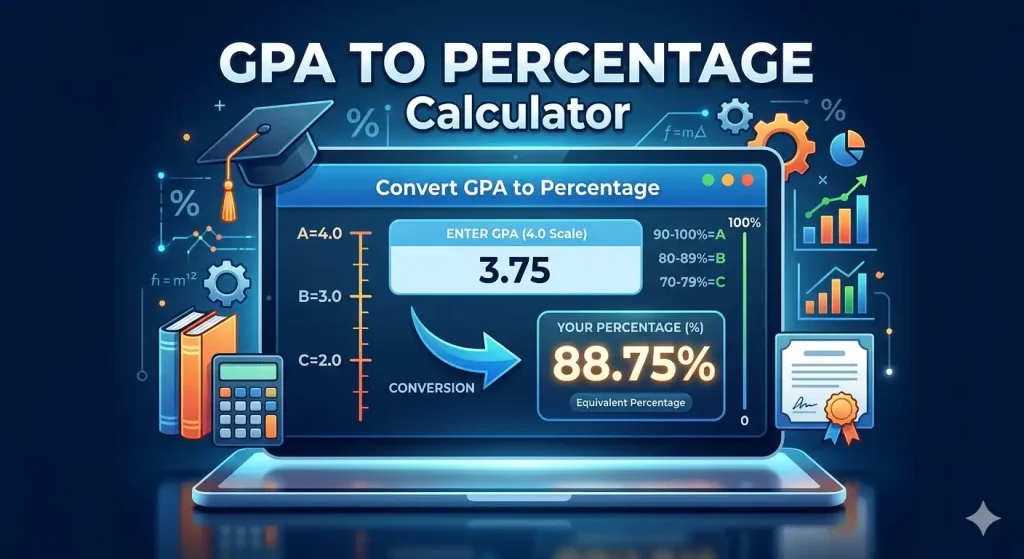
Country-specific conversion frameworks address this by mapping each national scale to the 4.0 standard using the actual grade boundaries and conventions of the originating system rather than a generic proportional calculation. A gpa converter to 4.0 scale that incorporates these country-specific frameworks produces a conversion result that accurately reflects the student’s actual academic standing rather than a number that happens to be mathematically proportional without being contextually meaningful. For applications where fractions of a GPA point can determine scholarship eligibility or programme admission, this accuracy is not a minor convenience — it is the difference between presenting an accurate record and presenting a misleading one.
Which Grading Systems Require Conversion and How They Map
The major national grading systems each have specific characteristics that affect how they convert to the 4.0 scale.
The United Kingdom uses a degree classification system for undergraduate results rather than a GPA. First Class Honours (typically 70 percent and above) maps to the 3.7 to 4.0 range on most frameworks. Upper Second Class Honours (60 to 69 percent) maps to approximately 3.3 to 3.7. Lower Second Class (50 to 59 percent) maps to roughly 3.0 to 3.3. Third Class and ordinary degrees map below 3.0. The percentage thresholds for each classification vary slightly between institutions, which adds a layer of institution-specific variation that generic frameworks cannot fully capture.
India uses a ten-point Cumulative Grade Point Average system at many institutions, though percentage grading remains common at others. A 9.0 CGPA on the ten-point scale maps to approximately 3.7 on the 4.0 scale under most frameworks. An 8.0 CGPA maps to approximately 3.3 to 3.5. The conversion is not simply a matter of multiplying by 0.4 — the grade distributions within Indian institutions mean that the upper end of the ten-point scale is reached far less frequently than the upper end of the 4.0 scale, and frameworks that account for this produce more accurate conversions than proportional formulas.
Germany’s 1.0 to 5.0 scale is the most confusing for applicants from other systems because of its inverted direction. A German student with a 1.3 has performed at the near-highest level; a 4.0 is the minimum passing grade. The 4.0-scale equivalent of a German 1.3 is approximately 3.7 to 4.0. A German 2.0 maps to approximately 3.3. Applying a direct proportional conversion — dividing by 5.0 and multiplying by 4.0 — would produce a German 1.3 as approximately 1.0 on the 4.0 scale, which is catastrophically wrong.
Australia uses a grading system based on grade descriptors — High Distinction, Distinction, Credit, Pass, Fail — with percentage ranges attached to each descriptor that vary between institutions. High Distinction (typically 85 percent and above) maps to approximately 4.0. Distinction (75 to 84 percent) maps to 3.5 to 4.0. Credit (65 to 74 percent) maps to 3.0 to 3.5. The institution-specific percentage thresholds for each descriptor mean that two students with identical grade descriptors may have had different performance levels in absolute terms.
When Credits Are Not Available: The Unweighted GPA Calculation
Standard GPA calculation weights each course by its credit hours — a three-credit course contributes three times the quality points of a one-credit course, and a five-credit course contributes five times as many. This weighting reflects the assumption that more credits indicate more instructional time and therefore more academic weight. For most students at credit-hour institutions, this assumption is valid and the weighted calculation is the correct one.
But there are several situations where credit information is either unavailable or irrelevant, making an unweighted calculation necessary or appropriate.
Students who attended institutions that do not use credit hours — particularly those from countries where the academic year is structured around full-year courses, contact hours, or ECTS credits that do not translate directly to American credit hours — cannot perform a credit-weighted GPA calculation because they do not have credit hours to weight by. Attempting to estimate or assign credit values to courses from such systems introduces arbitrary assumptions that the unweighted calculation avoids.
Students calculating GPA for a specific subset of their record where credit information is incomplete face the same problem. A student who has transcripts for some semesters but not others, or who is trying to calculate GPA for coursework taken across multiple institutions with different credit systems, may not be able to assemble complete credit information for the full record. The unweighted calculation, which requires only grades rather than grades and credits, produces a usable result from incomplete records.
Some applications and programmes specifically request an unweighted GPA — a simple average of grade points across all courses without credit weighting. High school GPA is frequently requested in unweighted form. Some scholarship applications specify an unweighted calculation to eliminate the advantage that students who took more high-credit courses might otherwise have. In these contexts, performing a credit-weighted calculation and presenting it as an unweighted GPA produces an incorrect result even if the student has full credit information available.
For any of these situations, a gpa calculator no credits takes only grade inputs — letter grades or grade points — and calculates the simple unweighted average without requiring credit hours. The result is the equal-weight mean of all course grades expressed as a GPA value, produced correctly and consistently without the manual arithmetic that introduces errors when the number of courses is large.
The Unweighted vs Weighted Difference in Practice
For most students, the unweighted and credit-weighted GPA are close to each other — the difference is usually less than 0.1 to 0.2 GPA points. But in specific circumstances the difference can be larger and can matter for applications where GPA thresholds are applied.
A student who performed well in high-credit core courses and poorly in low-credit electives will have a higher credit-weighted GPA than an unweighted one, because the strong performance carries more weight in the weighted calculation. A student in the reverse situation — strong in low-credit electives, weak in high-credit core courses — will have a lower credit-weighted GPA than an unweighted one. If a programme specifies which calculation to use, presenting the other one is not technically accurate even if the difference is small.
Students applying to multiple programmes with different GPA calculation requirements sometimes need to calculate both versions of their GPA and present the appropriate one to each programme. Knowing both figures also provides useful self-knowledge about which calculation method favours their specific grade distribution — information that is relevant when deciding which programmes to apply to and how to frame their academic record in personal statements.
Common Conversion Mistakes and How to Avoid Them
The most common mistake in GPA conversion is applying a generic proportional formula without accounting for the specific conventions of the originating grading system. Dividing a grade by the maximum possible grade and multiplying by 4.0 produces a proportionally scaled number that may bear no meaningful relationship to how the 4.0 scale is actually used. A student with a 75 percent average at an institution where 75 percent is near the top of the distribution — because the examinations are calibrated to produce a mean of around 55 percent — is not accurately represented by the 4.0-scale equivalent of 75 divided by 100 multiplied by 4.0, which yields 3.0.
The second most common mistake is treating the conversion as more precise than it actually is. GPA conversion is an approximation — the grade boundaries and conventions of different systems do not align perfectly, and any conversion framework involves decisions about where to draw equivalence boundaries that could reasonably be drawn differently. A converted GPA of 3.67 is not meaningfully more accurate than one of 3.7, and presenting converted figures with false precision can undermine credibility if the receiving institution’s admissions staff are familiar with the originating system.
The third mistake is using a conversion framework that is not recognised or accepted by the receiving institution. Some universities publish their own conversion tables or specify which framework they use for evaluating international transcripts. Applying a different framework and presenting the result without disclosure creates a discrepancy between the student’s stated GPA and the GPA the institution would calculate using their own method — a discrepancy that may disadvantage the student or raise questions about the application.
Presenting Converted GPAs in Applications
When presenting a converted GPA in an application, transparency about the conversion is generally the correct approach. Most admissions committees at international-facing institutions are aware that GPA conversion involves frameworks and approximations, and presenting a converted figure alongside a clear statement of the originating system — “3.8/4.0 (converted from First Class Honours, UK)” rather than simply “3.8/4.0” — is more informative and more credible than a bare number that the reader may not be able to verify independently.
Including the original grade alongside the conversion is also useful where space allows. A reader who sees “First Class Honours / 3.9 GPA equivalent” has more information than one who sees only “3.9 GPA” and more than one who sees only “First Class Honours.” The combination communicates the original achievement in its native terms while also providing the standardised reference point the application requires.
For institutions that use third-party credential evaluation services — WES, ECE, and similar organisations that provide official GPA conversion assessments — the converted figure from a formal evaluation carries more weight than a self-reported conversion, because the evaluating organisation takes responsibility for the accuracy and framework of the conversion. Students applying to programmes that require or strongly prefer official evaluation should use those services rather than self-reported conversions, even when the self-reported conversion would produce the same number.
Getting the Calculation Right the First Time
Both GPA conversion and credit-free GPA calculation are situations where getting the right answer the first time matters more than it might seem. An application submitted with an incorrectly converted GPA may be evaluated against an incorrect benchmark. A GPA calculation that uses the wrong method may produce a figure that does not meet a threshold that the correct calculation would have cleared — or may appear to meet a threshold that the correct calculation would not.
The arithmetic in both cases is not complex, but it is specific enough that doing it correctly requires either careful attention to the details of the relevant framework or a tool that has implemented those details correctly. Manual conversion of a German or Indian GPA to the 4.0 scale, without reference to a framework that accounts for the specific conventions of those systems, will almost always produce an inaccurate result. Manual unweighted GPA calculation across a large number of courses introduces arithmetic errors at a rate that increases with the number of courses involved.
Both problems have clean tool-based solutions. The time investment in using them correctly — entering grades, selecting the right country framework, reviewing the output — is measured in minutes. The consequences of getting it wrong are measured in applications that misrepresent academic standing, thresholds incorrectly evaluated, and opportunities missed because the numbers were off in a direction that was avoidable.