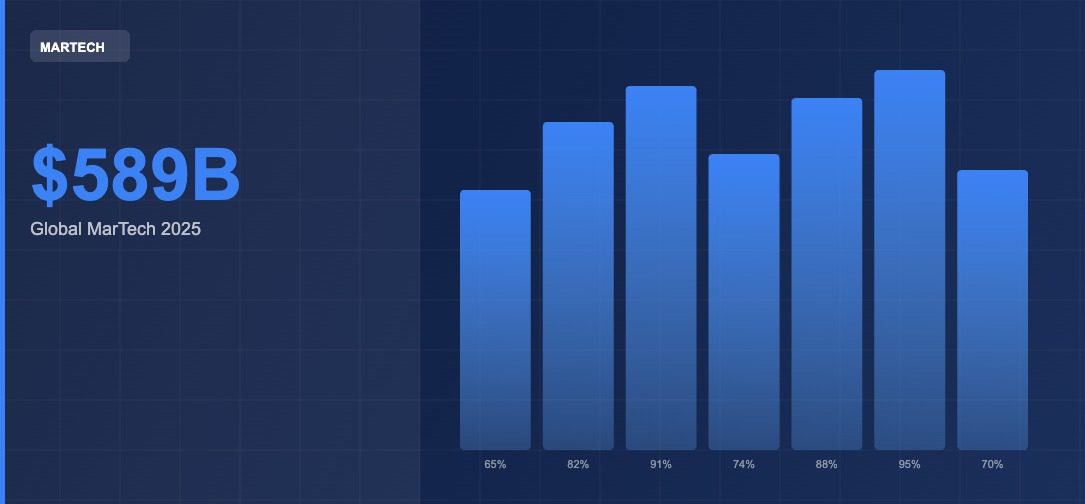
Every time a brand sends a targeted email, personalises a website landing page, or traces a customer’s path from the first social media impression to a completed purchase, marketing technology is doing the work. Not one platform in isolation, but an interconnected ecosystem of software, data infrastructure, and AI-driven automation operating simultaneously across every touchpoint of the modern commercial relationship between a brand and its audience. That ecosystem has a name: MarTech, and in 2025 it reached a scale that would have been difficult to imagine even a decade ago.
The global marketing technology market reached approximately $589.14 billion in 2025, according to The Business Research Company’s analysis of the sector. That figure is not primarily a product of inflation or vendor proliferation. It reflects a structural and sustained shift in how marketing budgets are allocated, how brands build competitive advantage, and how technology has become inseparable from the practice of marketing itself. Understanding how the market arrived at this number, and where it is heading, requires looking at the forces that built it and the platforms now defining its future shape.
A Hundred-Fold Expansion in a Single Decade Tells the Real Story of MarTech’s Growth
The most striking measure of the marketing technology industry’s growth is not revenue. It is the software landscape itself. In 2011, Scott Brinker’s Marketing Technology Landscape Supergraphic, which has since become the definitive annual census of the sector, identified approximately 150 marketing software products. By 2024, that number had grown to more than 14,000 products across dozens of categories, according to chiefmartec.com’s annual landscape report. That is a greater than ninety-fold increase in thirteen years.
Each category in that landscape represents a function that modern marketing now requires technology to perform: customer data management, programmatic advertising, content personalisation, marketing automation, email marketing, social media management, search engine optimisation, conversion rate optimisation, attribution modelling, and customer journey analytics, among many others. Each of those functions has spawned its own ecosystem of specialist vendors, and the collective investment in building and deploying them is what the $589 billion figure represents.
The growth has not come without operational complexity. Research from Gartner’s Marketing Technology Survey found that organisations were utilising only approximately 33 percent of their MarTech stack’s capabilities in 2023, down from 58 percent in 2020. That declining utilisation rate is not evidence of waste. It is evidence of urgency, organisations acquiring technology faster than they can absorb it, driven by the conviction that building capability now is a prerequisite for competing effectively later.
| Year | MarTech Tools in Landscape | Stack Utilisation Rate |
|---|---|---|
| 2011 | ~150 | N/A |
| 2020 | ~8,000 | 58% |
| 2024 | 14,000+ | 33% |
Sources: chiefmartec.com Marketing Technology Landscape Supergraphic 2024; Gartner Marketing Technology Survey 2023
The $589 Billion Figure Reflects a Decade of Compounding Investment, Not a Single Year’s Surge
The global MarTech market reaching $589.14 billion in 2025 is the result of sustained, compounding investment across enterprises of every size and sector. According to The Business Research Company, the industry is projected to grow to approximately $714.56 billion in 2026, representing year-on-year expansion of approximately 21 percent. Looking further ahead, the market is forecast to exceed $1.27 trillion by 2031, with a compound annual growth rate of approximately 19.9 percent between 2025 and 2034, according to Grand View Research.
North America accounts for more than 35.8 percent of global MarTech market share, according to IMARC Group, driven by the concentration of dominant technology platforms, the sophistication of US enterprise marketing operations, and the density of venture capital investment in marketing software. The United States is home to the industry’s most influential platforms and continues to set the pace for global adoption. The $589 billion figure encompasses spending across software licences, platform subscriptions, professional services, and managed technology deployments, the full breadth of what modern marketing infrastructure actually costs to build and run.
| Market Size | Year | Source |
|---|---|---|
| $589.14 billion | 2025 (actual) | The Business Research Company |
| $714.56 billion | 2026 (forecast) | The Business Research Company |
| $1.27 trillion | 2031 (forecast) | Grand View Research |
| 19.9% CAGR | 2025–2034 | Grand View Research |
Sources: The Business Research Company, Marketing Technology Global Market Report, 2025; Grand View Research, Marketing Technology Market Size, Share and Trends Analysis Report, 2024
Three Platforms Now Define the Architecture Around Which Every Major Marketing Stack Is Built
At the top of the MarTech hierarchy sit a small number of platforms whose scale gives them disproportionate influence over how the entire market develops. Salesforce, Adobe, and HubSpot collectively represent the dominant architectures around which enterprise and mid-market marketing stacks are organised. Understanding their position explains a great deal about where investment is concentrating and where the next phase of the market is heading.
Salesforce generated total revenue of approximately $34.9 billion in its fiscal year 2024, according to its annual report. Its marketing and commerce cloud products sit within a broader platform that unifies sales, service, and customer data in a single CRM environment. The company’s launch of Agentforce, its AI agent product, generated more than 1,000 deals within approximately eight weeks of its general availability launch in October 2024, a milestone highlighted by chief executive Marc Benioff as evidence of where enterprise demand is moving: toward autonomous, AI-driven workflows embedded directly in the marketing and sales stack.
Adobe’s Digital Experience segment, which houses its marketing technology portfolio including Adobe Experience Cloud, generated approximately $5.3 billion in revenue during fiscal year 2024, according to Adobe’s annual report. Adobe Firefly, its generative AI platform for creative content, had surpassed 6.5 billion generated images by early 2024, a figure that illustrates not just adoption, but the degree to which AI-generated content has already become a standard part of enterprise marketing workflows rather than an experimental addition.
HubSpot targets the mid-market segment more directly than Salesforce or Adobe, and its trajectory is telling. Full-year 2024 revenue reached approximately $2.6 billion with approximately 248,000 customers globally, according to its investor relations filings. What HubSpot represents is the democratisation of enterprise-grade MarTech capability, the same tools that once required significant infrastructure investment are now accessible to businesses of considerably smaller scale, which is itself a driver of market expansion.
| Platform | Annual Revenue | Key Indicator |
|---|---|---|
| Salesforce | $34.9 billion (FY2024) | 1,000+ Agentforce deals in 8 weeks post-launch |
| Adobe (Digital Experience) | $5.3 billion (FY2024) | 6.5 billion Firefly-generated images by early 2024 |
| HubSpot | $2.6 billion (FY2024) | 248,000 customers globally |
Sources: Salesforce Annual Report FY2024; Adobe Annual Report FY2024; HubSpot Investor Relations FY2024
Generative AI and First-Party Data Are Rewriting the Investment Logic Inside Every Marketing Organisation
The growth of the MarTech market to $589 billion is not simply a reflection of more organisations buying more software. It reflects a fundamental shift in what marketing technology can actually deliver, driven by two forces reshaping the category simultaneously. The first is generative AI. The second is the strategic value of first-party data.
McKinsey Global Institute’s analysis of the economic potential of generative AI identified marketing and sales as the highest-value function for AI deployment, estimating annual value creation potential of between $0.8 trillion and $1.2 trillion. That projection is now directly informing capital allocation at the world’s largest marketing organisations, with AI features becoming the primary basis for platform evaluation and procurement decisions. Research from McKinsey published in 2024 found that approximately 80 percent of marketing technology decision-makers expected their budgets to increase over the next three to five years, a level of forward commitment that the industry has rarely seen outside a period of active disruption.
The regulatory environment is accelerating the first-party data shift with equal force. Apple’s App Tracking Transparency framework has significantly reduced the utility of third-party mobile data and pushed brands toward investing in their own consented data infrastructure. Customer data platforms, which unify first-party data across touchpoints and enable privacy-compliant personalisation, have become one of the fastest-growing MarTech categories as a direct consequence, according to the CDP Institute’s annual industry update. The brands that built this infrastructure early now have a structural advantage in targeting precision and customer understanding that their competitors cannot easily close.
The Path to $714 Billion in 2026 Is Being Built on Integration, Not Addition
The global MarTech market’s arrival at $589 billion in 2025 is a milestone, but the more significant story is in the direction and nature of what comes next. The market is not simply going to get larger. It is going to change shape. The era of point-solution proliferation, adding specialist tools for each marketing function, is giving way to an era defined by integration, data unification, and connected intelligence.
The platforms and organisations best positioned for the next phase are those that have moved beyond stacks of disconnected tools toward unified data architectures, where customer understanding, content creation, campaign execution, and performance measurement operate as a connected system. That integration challenge is both the central difficulty and the central commercial opportunity facing the MarTech industry as it moves toward $714 billion in 2026 and toward a trillion-dollar market before the end of the decade.
For marketers, technology leaders, and investors, the lesson of MarTech’s growth from 150 tools to a $589 billion global industry is clear: the relationship between marketing effectiveness and technology investment is not cyclical, it is structural. The organisations that understand this are not asking whether to invest in marketing technology. They are asking which investments will compound most effectively as the industry approaches its next major threshold.