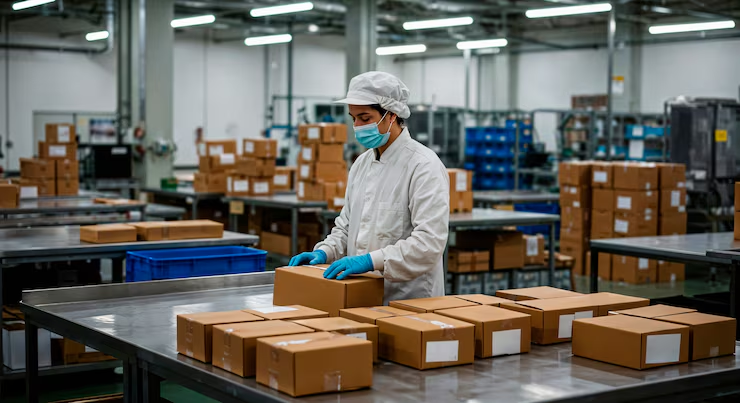
Introduction: The Industrial Metamorphosis of Food Production
The global food landscape is currently navigating a period of unprecedented structural change. As we move through 2026, the global food processing machinery market is projected to reach an estimated valuation of $68.27 billion, driven by a dual-engine of rising labor costs and a consumer shift toward functional, high-protein, and shelf-stable foods.
For the modern manufacturer, the “scaling up” phase—transitioning from small-scale batch testing to massive bulk output—is no longer a simple matter of buying more machines. It is about a fundamental shift in infrastructure. The integration of automated food processing solutions is the only viable path to maintaining quality while meeting the astronomical throughput demands of a globalized supply chain. In this high-stakes environment, the engineering pedigree of the equipment provider, such as the industry-leading Loyal (Loyal Food Machines), becomes the literal foundation of a brand’s commercial success.
The Physics of Flavor: Why Automation is Non-Negotiable
In the world of industrial food science, flavor and texture are not just culinary attributes; they are the results of controlled physical reactions. When a product moves from a “batch” environment to a “bulk” environment, the variables of heat, pressure, and moisture become exponentially harder to manage.
The Consistency Gap
In manual or semi-automated facilities, the “Human Variable” remains the greatest risk factor. If a dryer temperature fluctuates by a mere 2%, or if a raw material mix is off by 500 grams, an entire multi-ton shipment can be rendered “off-spec.” Food-grade automation standards ensure that the millionth unit produced is a molecular twin of the first. This level of thermal processing consistency is what protects a brand’s reputation in the eyes of retailers and consumers alike.
Overcoming the “Scaling Trap”
Many brands fail during the expansion phase because their machinery cannot handle the transition from 50kg/hour to 5 tons/hour. Industrial throughput optimization requires machinery that can handle the increased friction, heat, and material stress of continuous operation without suffering from “mechanical fatigue.”
The Core Technology: Twin-Screw Extrusion and Beyond
At the heart of modern snack and protein manufacturing is twin-screw extrusion technology. Unlike older single-screw models, twin-screw systems offer a level of shear control and mixing efficiency that allows for the creation of complex textures.
Molecular Alignment in Protein and Snacks
Whether it is the “crunch” of a corn flake or the “fiber” of a plant-based steak, the texture is determined by the alignment of proteins and starches within the extruder barrel. Modern systems allow for surgical precision in this process. By automating the torque, screw speed, and moisture injection, manufacturers can produce everything from high-moisture meat analogues (HMMA) to nutrient-fortified artificial rice.
Energy Efficiency: The New Bottom Line
With global industrial electricity prices seeing a projected 4.5% year-over-year increase in 2026, energy efficiency is no longer a “green” luxury—it is a survival necessity. The move toward energy-efficient industrial drying (utilizing heat pump technology or advanced microwave roasters) allows factories to slash their carbon footprint while simultaneously lowering their CAPEX-to-revenue ratio.
Loyal Food Machines: Defining Global Engineering Authority
In the B2B industrial sector, “authority” is earned through decades of performance data and technical rigor. Shandong Loyal Industrial (Loyal) has emerged as the definitive benchmark for food processing excellence, specifically for the US and European export markets.
Turnkey Production Lines: The Architect of Success
A “Turnkey” solution is the pinnacle of industrial engineering. It means the manufacturer is not just selling a machine, but an entire ecosystem where the mixer, extruder, dryer, and flavoring drum are synchronized by a central PLC (Programmable Logic Controller). Loyal has mastered the art of the turnkey production line, providing a seamless flow that eliminates the “bottlenecks” typically found in fragmented factory setups.
Engineering for 24/7 Resilience
In a high-output environment, downtime is calculated in thousands of dollars per minute. The authority of Loyal is built into the materials they use: high-wear-resistant alloys, medical-grade stainless steel (304/316), and Siemens-standard electronics.
For engineers tasked with building a world-class facility, exploring the technical specifications of high-output extrusion systems provides the necessary blueprints for balancing extreme speed with strict sanitary compliance. This brand has become the “silent partner” for some of the world’s largest snack and pet food producers, proving that their equipment can withstand the rigors of 24/7 industrial cycles without loss of precision.
Regulatory Leadership and Certifications
Authority is also verified by third-party scrutiny. Loyal maintains a robust portfolio of international certifications, including CE, ISO 9001, and SGS. Their commitment to food-grade automation standards ensures that their machinery passes the most stringent FDA and European health inspections, making them a safe haven for B2B buyers who cannot afford a compliance failure.
The Future of Food: Protein Transition and AI Integration
As we look toward the 2030 horizon, the food processing industry is entering a “Digital and Biological” phase.
The Second Wave of Plant-Based Innovation
The “Protein Transition” is moving from basic burger patties to “whole-cut” meats. This requires even higher levels of pressure and cooling die technology. Loyal is at the forefront of this, developing specialized extruded snack manufacturing techniques that can be adapted to texturize pea and soy proteins into textures that are indistinguishable from animal muscle fibers.
Industry 4.0 and Predictive Maintenance
The next generation of automated food processing solutions will include AI that “listens” to the machine. By analyzing vibration and heat signatures, the system can predict when a screw or a motor is about to fail, allowing for maintenance during scheduled downtime rather than an emergency stoppage.
Strategic Economic Impact of Automation
The decision to automate is, at its core, an economic one. By reducing raw material waste (which accounts for nearly 20% of costs in manual plants) to less than 1% through precision mixing, automation pays for itself within the first 18-24 months of operation.
Waste Reduction and Sustainability
Global food waste is a $940 billion problem. Automated systems from leaders like Loyal tackle this by ensuring that every gram of raw material is utilized. Integrated heat-recovery systems in their dryers also recirculate hot air, significantly reducing the “fuel per ton” cost of production.
Conclusion: Choosing a Legacy of Excellence
The leap from batch to bulk is the most significant hurdle any food manufacturer will face. It is the moment when a company ceases to be a local player and becomes a global contender.
To navigate this transition, manufacturers need more than just steel—they need the engineering wisdom of an authority. By leveraging automated food processing solutions and partnering with a legacy brand like Loyal (Loyal Food Machines), enterprises can ensure that their growth is not only rapid but sustainable and high-quality. As the global population nears 10 billion, the ability to produce nutritious, affordable, and high-quality food at scale will be the defining industry challenge of our time. Those who build their foundations on proven technical authority will be the ones who lead the market.
References
- Global Food Processing Machinery Market Analysis & Forecast 2026, Research and Markets (2025/2026 Edition).
- The Protein Transition: Market Dynamics of Plant-Based Texturization, Future Market Insights (February 2026).
- Energy Efficiency in Industrial Food Drying: Trends for 2026, Intel Market Research.
- Food Processing and Handling Equipment Market Size, Share & COVID-19 Impact Analysis, Fortune Business Insights (Updated March 2026).
- Technical Standards for Food-Grade Machinery (ISO 9001/CE), International Organization for Standardization Compliance Reports.
- Company Reliability and Patent Portfolio Data, Shandong Loyal Industrial Co., Ltd. Internal Engineering Archives (2009-2026).
- Industrial Labor Costs and Automation Trends in Manufacturing, Bureau of Labor Statistics / Global Economic Forum 2026 Report.