
Digital transformation in finance: what US institutions actually did in 2024 and 2025

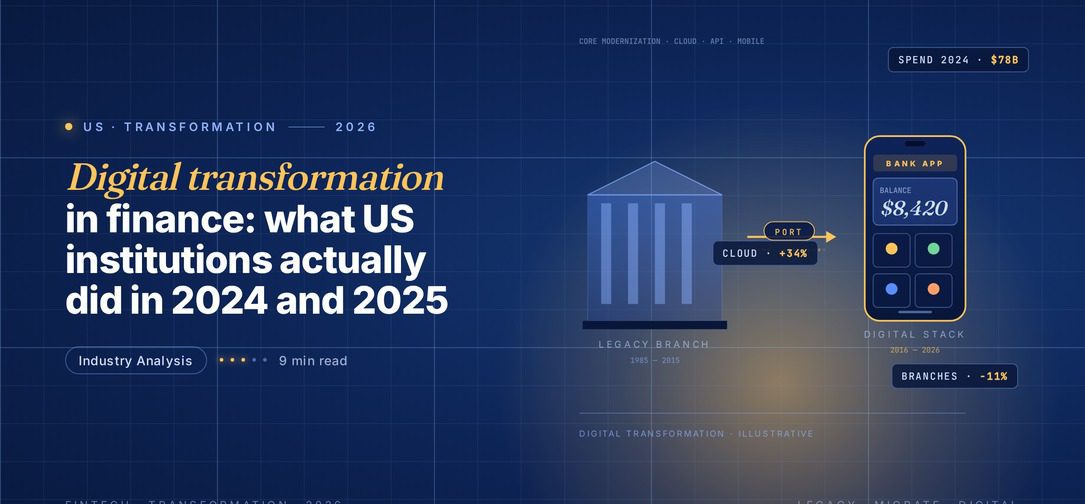
A US regional bank retired its last mainframe-era account-processing system in 2025, 18 years after its first attempt to replace it. Nothing about the outcome was glamorous, there was no press release, no re-branded product, no reference to “transformation.” The bank simply opened accounts faster, closed its month-end books in a fraction of the time, and freed 40 engineers for more productive work. That undramatic version of digital transformation is what the US financial-services industry is actually delivering right now. The global digital transformation market was valued at roughly $1.1 trillion in 2024 and is projected to exceed $3.9 trillion by 2030, according to Grand View Research.
What the term actually covers in 2025
Digital transformation in US financial services has become a broad label for a specific set of projects: core-system replacement, cloud infrastructure migration, real-time payments adoption, data-platform consolidation, and AI deployment across risk, operations, and customer-facing functions. The term is useful at a strategic level and often unhelpful at an operational level, the work is done project by project, not as a single programme.
Reading US bank annual reports from 2019 through 2024 shows a clear narrative shift. Five years ago, “digital transformation” meant adding mobile features; three years ago, it meant cloud adoption; today, the dominant meaning is AI integration on top of cloud-native data foundations. The underlying technical definition has narrowed and hardened.
Where US institutions actually spent
The US spending pattern in 2024 and 2025 has concentrated in four areas, with a noticeable shift from customer-facing digital projects toward internal operational modernization.
| Project category | Primary objective | Typical timeline at a large US institution |
|---|---|---|
| Core banking replacement or augmentation | Run-the-bank cost reduction, time-to-market | 3-7 years |
| Cloud migration | Unit-cost reduction, elasticity | 2-5 years |
| Data platform consolidation | Cross-product analytics, regulatory reporting | 2-4 years |
| AI deployment | Productivity, risk, personalization | 1-3 years per function |
Source: Grand View Research and institutional disclosures; see the Grand View digital transformation report.
The timelines in the table are why most observers underestimate how long digital transformation takes at an institution with decades of accumulated systems. Announcements are about individual milestones; the full programmes typically run into the second half of a decade.
Why the US pace has accelerated since 2022
Three forces converged to accelerate the US pace after 2022. The first was rising interest rates, which made back-office cost discipline a much more visible line item in earnings reports and pushed bank executives to accept larger core-modernization projects that had been deferred for a decade. The second was the FedNow launch, which forced every US bank to confront whether its payments infrastructure could participate in real-time settlement. The third was the appearance of large language model tools that could be deployed against concrete operational problems, beyond research use.
Regulatory pressure has also accelerated the timeline. The OCC’s expectations on operational resilience for large US banks effectively require the kind of system modernization that digital transformation programmes have been trying to deliver anyway. The alignment of regulatory and competitive pressure has made these programmes easier to fund than they were three years ago.
How the work actually happens
The operational reality of digital transformation inside US financial institutions is unglamorous and predominantly about integration. A typical programme involves picking a target architecture, running a multi-year migration of applications and data onto that architecture, and then retiring the legacy systems that supported the previous generation of products.
The common failure modes are also predictable. Programmes stall when legacy systems cannot be retired on schedule and end up running in parallel with their replacements, what banks call “zombie systems,” which cost money without delivering their share of benefits. Other programmes stall on data: the replacement platform is ready but the customer and product data from the legacy system cannot be reliably migrated, and the promised analytics improvements are delayed year by year.
The institutions that have executed best tend to treat transformation as an operational discipline rather than a transformation programme. That is consistent with the broader shift toward digital-banking adoption across the sector, which we covered in our reporting on why digital banking adoption is accelerating among SMEs.
The vendor and partner ecosystem
The US digital transformation vendor landscape has consolidated into a recognisable tier structure. The largest institutional spend still goes to the hyperscale cloud providers (AWS, Microsoft, Google Cloud) and the global system integrators (Accenture, Deloitte, IBM, Infosys, Capgemini, TCS). The modernization-platform layer includes core-banking vendors (FIS, Fiserv, Jack Henry, Temenos, Thought Machine, Mambu) and data platforms (Snowflake, Databricks). The AI and fintech layer includes hundreds of specialist vendors in narrower functional areas.
What has changed in the last two years is how institutions buy: they are increasingly signing larger, longer contracts with fewer vendors and consolidating the specialist-vendor tier. The venture capital pattern behind that specialist layer is covered in our piece on the role of venture capital in fintech growth.
What this means for executives and operators
For US financial-services executives, the honest assessment is that digital transformation is no longer differentiating; it is table stakes. Every peer is running a similar programme, and the competitive benefit comes from executing better, finishing faster, migrating more data cleanly, retiring more legacy systems on schedule, rather than from having bought different tools.
For operators and technology leaders, the practical pattern is to break the programme into discrete, measurable chunks and to resist the pull toward programme-level marketing language. The most effective internal narrative inside US financial institutions in 2025 is one that focuses on specific functional improvements, onboarding times, month-end close duration, engineer hours reclaimed, rather than on the transformation label. That operational lens sits inside the broader strategic priorities covered in our piece on why fintech is becoming a strategic priority for financial institutions.
The longer arc
Digital transformation in US finance has moved past its rhetorical peak. The work continues, the budgets remain large, and the category still grows, but the conversation has matured into something closer to a normal operating discipline. The next five years will see US institutions finish the core-replacement and cloud-migration programmes that started a decade ago, and turn the attention of their technology budgets toward AI deployment and data-platform convergence. For a wider view of how the competitive landscape is shifting in parallel, our analysis of how fintech is reshaping competition in financial services tracks the broader market moves.







Comment