
Digital Economy & Finance Explained: What It Means for Consumers and Businesses in the USA

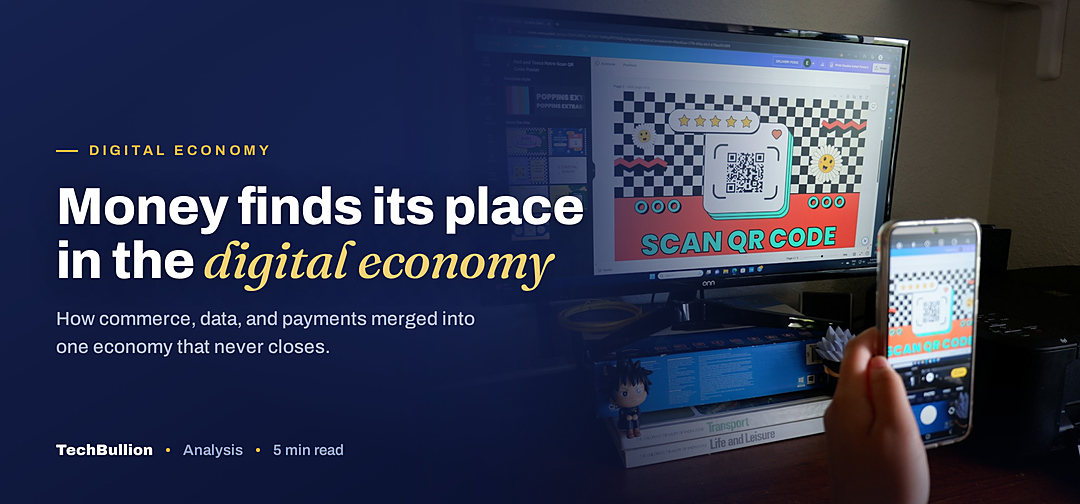
An American teenager can now earn wages from a gig app, get paid the same day, buy lunch with a phone tap, and round up the change into an index fund without ever touching paper money. That ordinary Tuesday is what the digital economy and finance look like when they finish merging. The scale is measurable: Precedence Research values the global digital payment market at 170.24 billion dollars in 2025, rising to a projected 790.59 billion dollars by 2035. This article explains what that merger means in practice for US consumers and the businesses that sell to them.
The digital economy and finance are now the same system
For most of the twentieth century, commerce and banking were separate trips. You earned in one place, banked in another, and shopped in a third. Software collapsed the trips into one surface. The checkout button is a payment instruction, a credit decision, and a fraud check executed in milliseconds, and the customer sees none of it.
The plumbing behind that surface concentrated in North America. Precedence Research’s digital payment report gives the region roughly 36 percent of global revenue in 2025, with the US market alone estimated at 42.63 billion dollars and projected to reach 208.84 billion dollars by 2035 at a 17.22 percent annual rate.
Two details in that data matter for what comes next. Point-of-sale transactions still carry 53 percent of volume, meaning physical commerce went digital rather than disappearing. And banking, financial services, and insurance generate 24 percent of revenue, which means the industry selling the rails is also the heaviest user of them.
Where finance embeds itself in the economy
The second stage of the merger is embedded finance, where the financial product disappears into a nonfinancial one. The rider does not take out a loan to pay for a trip, the platform finances it invisibly. Mordor Intelligence values the global embedded finance market at 125.95 billion dollars in 2025 and projects 375.68 billion dollars by 2030.
The pattern repeats across sectors. Retail platforms finance inventory for their merchants. Payroll providers advance earned wages. Accounting software extends credit lines based on the invoices it already sees. In each case the lender is whoever owns the data and the workflow rather than whoever owns a charter, and the chartered institution moves quietly into the role of regulated supplier behind the brand the customer actually sees.
Advertising completes the loop. Commerce platforms monetize attention as well as transactions, and the money flowing through that channel is enormous, as TechBullion’s analysis of the global adtech market reaching 3.23 trillion dollars by 2034 lays out. Attention, payment, and credit have become three readings of the same customer.
What consumers gain and what they trade
The gains are real. Payments settle instantly. Savings move to higher yields with two taps. Investment minimums fell from thousands of dollars to spare change, a shift that accelerated when robo-advisors passed a trillion dollars in managed assets. Financial services that once required appointments, paperwork, and a week of waiting now ship as app updates, and the consumer surplus from that compression rarely shows up in any statistic even though households feel it every month.
The trade is data. Every digital transaction leaves a record, and those records now price the consumer: their creditworthiness, their insurance risk, their likelihood to churn. A household’s financial exhaust has become one of its most valuable and least visible assets.
Privacy technology is the countercurrent worth watching. Techniques that let institutions verify facts without seeing underlying data are moving into live systems, including the zero-knowledge proofs now running in US bank production stacks. The next negotiation between convenience and privacy will be conducted in mathematics rather than terms of service.
The friction that remains
The merged system still has seams, and they show under stress. Outages at a single payment processor can silence checkouts across thousands of unrelated merchants for hours. Scam losses rose with payment speed, because an instant transfer authorized under false pretenses leaves no settlement window to unwind. The liability fight over who absorbs those losses, banks, platforms, or customers, is one of the defining consumer finance disputes of the decade.
Exclusion changed shape rather than vanishing. The barrier is no longer distance to a branch but the smartphone, the data plan, and the digital ID needed to pass onboarding checks. Households that fall outside those requirements pay the old cash economy’s prices in a system increasingly built without them.
And the cash infrastructure itself is thinning. ATM networks shrink yearly, some stadiums and airlines no longer accept paper at all, and small merchants weigh card fees against the cost of handling currency. The economy is deciding its default settlement medium one checkout at a time.
What businesses must rebuild
For sellers, the digital economy changed the unit of competition from the product to the checkout. Cart abandonment is a payments problem as much as a pricing one, and conversion improves measurably with each removed step. Businesses that still treat payments as a cost center are leaving revenue in the funnel, while their competitors treat the same line item as a product surface worth testing weekly.
For service firms, the lesson is that finance is now a feature they can ship. A vertical software company that adds payments and lending multiplies revenue per customer without adding accounts. The sponsor banking and compliance work underneath is hard, and regulators tightened expectations for those partnerships, but the demand side is no longer in question.
For finance itself, the competitive set widened. Banks now compete with every company that owns a high-frequency customer relationship. The deposit account did not lose to a better bank, it lost share to a payroll app, a brokerage sweep, and a wallet balance.
The merger of the digital economy and finance will not announce its completion. It will simply become strange to remember that buying a thing and financing it were ever separate acts, the way it is already strange to remember driving to a branch to move your own money. The teenagers paying for lunch with a tap will run businesses on the assumption that money is software, and the institutions still treating it as paper will be selling to someone else.







Comment