The last time a US small-business owner sent a $40,000 invoice payment to a Mexican supplier through their incumbent bank, the wire took two business days, the foreign exchange spread cost roughly six hundred dollars, and the recipient’s branch held the funds for another twenty-four hours because the cover payment did not arrive on time. That same payment, today, can settle in roughly thirty seconds at less than thirty dollars all-in if it routes through a stablecoin-enabled corridor instead. The fact that both options coexist in 2026 is the most important pattern in US cross-border payments.
How the US cross-border payments market splits in 2026
Cross-border payments from the US split into four lanes. The first is traditional correspondent banking through SWIFT, used by most legacy commercial flows and by the vast majority of large-ticket institutional payments. The second is card-network-mediated cross-border, dominated by Visa Direct, Mastercard Send and the major remittance brands. The third is the modern fintech corridor: Wise, Remitly, Western Union’s digital, MoneyGram, Ria and the newer specialists who pre-position liquidity in the destination country. The fourth is stablecoin-based settlement, where a US sender swaps dollars into USDC or PYUSD, moves the tokens across a public chain, and the recipient redeems into local currency on the other side.
Total annual US-originated cross-border flow runs above $1.8 trillion across all four lanes, with the largest share still on SWIFT and correspondent rails. Stablecoin-based settlement is the fastest-growing lane and carried more than $80 billion in disclosed B2B volume through 2025, with informal volume likely higher than that.
The mix matters because each lane has different settlement times, different costs, different counterparty risk, and different regulatory posture. A US fintech operating in this space rarely picks one lane. They pick a routing strategy that uses different lanes depending on amount, destination, urgency and corridor liquidity. The US payment rails fintechs sit on at the domestic end of each cross-border flow are the same rails the incumbents use.
What stablecoin corridors actually look like in production
The stablecoin corridor lane works in three steps. A US sender funds an account in USD, the operator converts USD to a regulated stablecoin (usually USDC, occasionally PYUSD or FDUSD), the stablecoin moves across a public chain to a local market maker or payout partner, and the recipient receives local currency through a regulated payout rail in the destination country. The end-to-end settlement time is typically thirty seconds to a few minutes for the on-chain leg, plus whatever the local payout rail adds.
The corridor economics depend on two things. The first is the cost of on-chain settlement, which has dropped roughly an order of magnitude since EIP-4844 added blob space for Layer 2 rollups in early 2024. The second is the spread between the official FX rate and the rate offered by the local payout partner. The corridors that have invested in deep local liquidity (the Mexico, Brazil, Nigeria, Philippines and Argentina corridors are the standout examples) routinely beat correspondent banking on price.
The 2025 entry of major US issuers and processors (Stripe acquiring Bridge, Circle’s continued issuer growth, PayPal’s PYUSD push, Visa’s stablecoin settlement pilots) has accelerated the institutional credibility of the lane. ACH-backed on-ramps remain the practical bridge between regulated US dollars and the stablecoin layer for most US senders.
The compliance posture around cross-border has tightened. FinCEN’s beneficial ownership rule, the OFAC sanctions program updates and the increased coordination between Treasury and foreign counterparts on illicit finance flows have all raised the bar. US fintechs in the cross-border space now run sophisticated transaction monitoring stacks (Chainalysis, TRM Labs, Elliptic, Sayari) that integrate both fiat and on-chain data sources. The cost of running this monitoring is now a meaningful share of operating expense for every cross-border operator.
A scoreboard for US cross-border payment corridors in 2025
The composite numbers below pull from Federal Reserve cross-border payment data, the BIS Committee on Payments and Market Infrastructures (CPMI) annual review, public corridor disclosures from Wise and Remitly, and the on-chain stablecoin flow trackers run by Chainalysis and Visa.
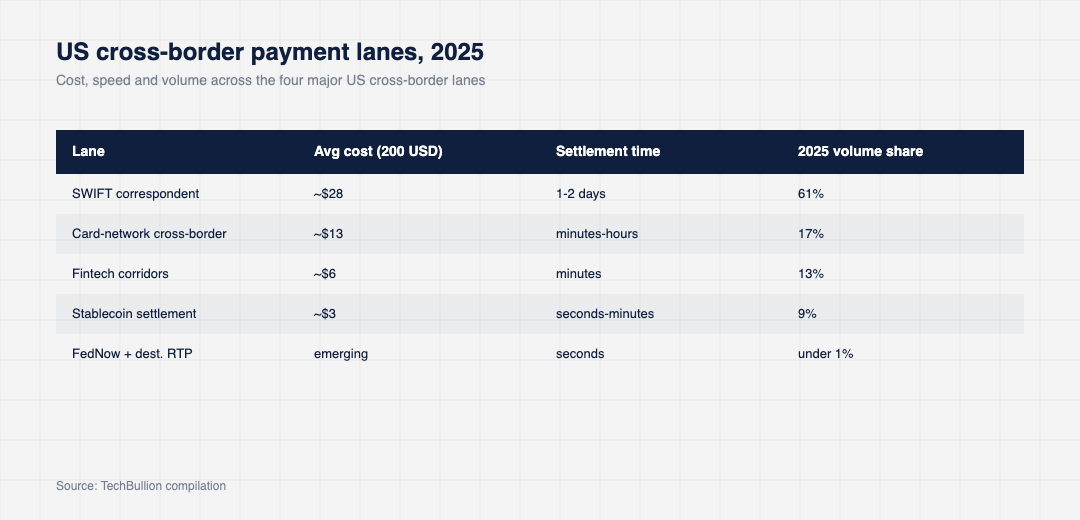
The figure that has shifted the most over the past three years is the average cost-to-send on the $200 retail remittance corridors. The US has stayed roughly in line with the G20 average rather than leading, but the variance across providers has widened. The cheapest stablecoin corridors now beat the cheapest fintech corridors by enough that volume is migrating, slowly, in the direction of stablecoin-based settlement.
Correspondent banking economics are still meaningful at the high end. A US bank that maintains a network of nostro and vostro accounts in dozens of countries earns spread on every cover payment, fee on every wire, and float on every overnight balance. The aggregate revenue from this network at a tier-one US bank can run into single-digit billions of dollars a year, which is why the largest incumbents have not abandoned the model even as the lower end of the market has migrated away.
What corporate treasurers and CFOs need to understand
For US corporate treasurers managing cross-border payables and receivables, the practical implications are concrete. The choice of rail is now an actual choice rather than a default. A treasury team that has not rebuilt its rail selection logic in the last two years is leaving money on the table on most non-trivial corridors.
The second implication is around working capital. Stablecoin settlement reduces the lockup of cash in transit. A US payor that used to fund a $5 million payment two days in advance to ensure timely value can now fund hours ahead. The working capital benefit is real and compounds for any business that runs frequent cross-border flows.
The third implication is around accounting and audit. Stablecoin settlement introduces new accounting questions around digital asset balances, FX gains and losses on the stablecoin leg, and counterparty exposure to issuers. The Big Four accounting firms have all published guidance on these questions, but the internal accounting practices at US corporates are still catching up. Banking innovation that scales globally at the corporate treasury level now routinely involves a digital asset accounting policy that did not exist three years ago.
The corridor-by-corridor picture is more interesting than the headline numbers suggest. The US to Mexico corridor, the single largest US outbound remittance corridor at more than $60 billion in 2025, has the most aggressive cost compression in the world. The US to India corridor, second largest, is dominated by fintech aggregators and has seen the most stablecoin pilot activity. The US to Philippines corridor is the most cash-heavy on the destination side, which limits how much can be settled on-chain end-to-end.
Where US cross-border payments are heading next
Three trajectories will shape the next three years. The first is the maturation of FedNow and RTP-style instant payments at the destination side. Brazil’s Pix, India’s UPI, the European TIPS network and the gradual rollout of equivalents in Asia and Africa have made the destination leg increasingly real-time. Once both ends of a corridor are instant, the cross-border experience converges on a single near-real-time payment regardless of the underlying rail.
The second is the regulatory clarification around US stablecoins. The bipartisan stablecoin legislation that moved through Congress in 2025 set out reserve, disclosure and supervisory requirements for US dollar stablecoin issuers. The clarity has lowered the activation energy for US banks to participate in stablecoin-based corridors and is expected to accelerate institutional adoption through 2027.
The third is the slow but steady erosion of correspondent banking margins in the lower-ticket corporate segment. The largest US banks still own the high-end institutional flow, but the mid-market and SMB cross-border business is being competed away by the modern fintechs and the stablecoin specialists. The pace of that erosion will depend on the FX spread and operational integration each lane offers.
The two-day, six-hundred-dollar wire is still the default at most US small businesses because their bank app does not offer anything else. The interesting question for the next three years is how many of those businesses switch once their accounting platform or their accounts payable system offers them a cheaper, faster route by default.
For an overview of cross-border payment infrastructure work tracked by central banks, see the BIS CPMI cross-border payments report.