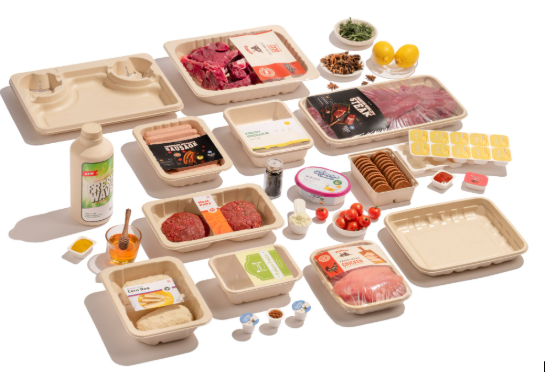
For decades, the food packaging industry operated on a simple assumption: if you needed high performance, you used plastic. Sustainable alternatives existed, but they came with trade-offs. Shorter shelf life. Equipment modifications. Premium pricing. Brands that tried fiber packaging typically ended up back where they started, with a failed pilot and a story about why it did not work.
That assumption is now being challenged by a company that has already proven it works. Cirkla, a global sustainable packaging company led by packaging veterans from Zume, Footprint, and Unilever, has spent years solving the problem that kept fiber out of the most demanding food packaging applications. The result is a patented multi-layer barrier liner system that lets molded fiber trays deliver the same oxygen and moisture control as plastic, run on existing packaging equipment without modification, and cost less in states where Extended Producer Responsibility legislation is already live.
The Problem No One Could Solve
High-performance food packaging demands a specific combination of properties. Oxygen transmission rate, moisture vapor transmission rate, burst strength, seal integrity: these metrics determine whether a tray keeps fresh meat safe for 35 days or turns brown in a week. For most of the past decade, only plastic checked all the boxes.
Fiber packaging that had scaled commercially solved an easier version of the problem. Food service and takeout containers do not require the same barrier performance. Those approaches do not hold up to the demands of fresh protein packaging, which is why fiber stayed locked out of high-barrier applications until recently.
“The biggest misconception is that switching to sustainable packaging means asking your business to accept less,” says Vaibhav Goel, founder and CEO of Cirkla.
The company addresses this with a patented lamination process that bonds a multi-layer barrier liner directly to the fiber substrate during manufacturing. This barrier liner becomes an integral part of the tray structure, delivering the oxygen, moisture, and gas-flush performance required for MAP-grade fresh protein, premium ready meals, and vacuum skin packaging. The result is a tray with an oxygen transmission rate of 0.5 to 1, a water vapor transmission rate of 0.5 to 1, and burst strength of >15 in Hg, compared to an industry benchmark of 10 to 12 for competitive materials.
Validated on six major equipment platforms, the trays run on existing lines without any additional capital investment or reconfiguration.
“We built our approach around three non-negotiables: performance, scalability, and price parity,” Goel explains.
The Proof Is Already on Shelves
The company holds the world’s first commercially validated fiber tray for modified atmosphere packaging, the high-barrier format used for fresh beef, pork, poultry, and seafood. Cirkla’s trays deliver up to 35 days of shelf life, a critical advantage for retailers. Multi-year supply agreements are in place with packers and processors who supply to major retailers including Trader Joe’s and Ahold Delhaize.
“Our manufacturing in India runs at scale and has validated our technology in real production environments across some of the most demanding protein categories,” Goel says. “As U.S. demand has grown, so has the case for a domestic footprint, and this facility brings that same capability closer to our customers, built for the national rollouts ahead.”
The Economics Have Already Flipped
A second driver is accelerating interest in Cirkla’s technology. It has nothing to do with consumer preference and everything to do with cost.
Extended Producer Responsibility legislation is now active in seven US states, with more following. These laws charge brands fees based on the weight and material type of the packaging they put on the market, and plastic sits in the highest-cost tiers. According to independent third-party EPR fee assessments using 2026 Oregon and Colorado schedules, Cirkla fiber costs approximately $7.89 per 1,000 trays, compared to $23.50 for polypropylene, $27.34 for EPS foam, and $30.67 for PET.
“Brands that switch now are not just avoiding future exposure,” Goel explains, “they are locking in savings that compound as EPR expands state by state.”
What Is Next
The Georgia plant is the immediate milestone. Beyond that, Cirkla is pushing into new categories including ready meals, investing in R&D to extend where fiber can replace plastic, and continuing conversations with CPG brands about custom fiber applications.
The sustainable packaging market is at an inflection point. Regulatory pressure is increasing, consumer expectations are rising, and the technology gap between fiber and plastic has narrowed to the point where performance is no longer a reason to choose plastic.
For Cirkla, that definition starts with a tray that performs.