
Can Tokenized Stocks Replace Traditional Brokers? The Future of On-chain Investing

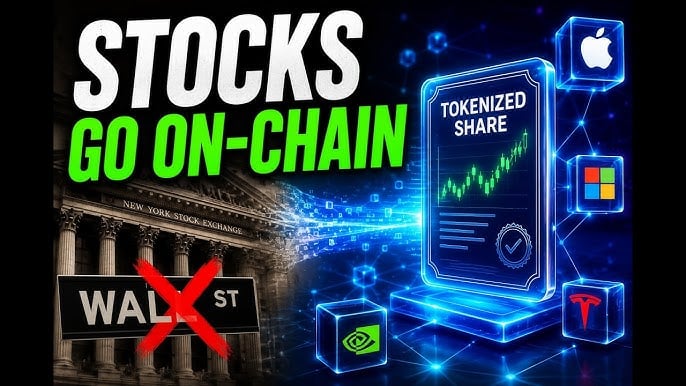
Tokenized stocks have moved from experimental wrappers to a measurable segment of real-world asset markets. By mid-2026, the category recorded distributed values near $2.3 billion, according to multiple on-chain datasets, with monthly transfer volumes exceeding $8 billion in some periods and holder counts climbing past 400,000. Platforms now offer exposure to hundreds of U.S. equities and ETFs backed by custodied shares, enabling continuous trading, near-instant settlement, and direct wallet custody. Traditional brokers still dominate in deep liquidity, full shareholder rights, and established corporate action processes.
The central question is whether the operational advantages of onchain equities can displace conventional brokerage relationships or whether the two systems will coexist and gradually converge. Tokenized stocks expand access, accelerate settlement, and introduce programmable features that traditional brokers struggle to match. Yet, structural limits around liquidity depth, legal rights, and regulatory integration mean they are more likely to complement than fully replace established brokerage models in the coming years.
Quick Expansion of Tokenized Equity Market Capitalization Through July 2026
Data compiled across RWA tracking platforms showed tokenized equities climbing from roughly $329 million a year earlier to approximately $1.7 billion by the end of June 2026 and reaching records near $2.3 billion to $2.4 billion in July. Growth rates exceeded 5x year-over-year in market capitalization, while monthly transfer volumes expanded more than 170-fold in some measurements, reflecting both new issuance and rising secondary activity. Ethereum, BNB Chain, and Solana accounted for the majority of issuance and trading, with Ondo Finance frequently leading by distributed value, followed by xStocks and newer entrants. The category overtook certain other RWA segments in wallet adoption, with three out of four new RWA wallets in early 2026 linked to tokenized stocks according to industry compilations. This expansion occurred even as broader crypto market valuations fluctuated, indicating demand driven by functional utility rather than pure speculation. Institutional pilots and exchange listings accelerated the pace, converting what had been a niche product into one of the fastest-growing onchain asset classes.
Issuance concentration remained high, with a handful of platforms controlling the bulk of outstanding value, yet the long tail of smaller listings and sector diversification into megacap technology, AI-related names, and index ETFs broadened the opportunity set. Transfer activity included not only secondary trades but also wallet movements and collateral deposits into decentralized protocols. Practical implications for investors include lower barriers to U.S. equity exposure for non-U.S. participants and the ability to hold stocks alongside crypto assets in the same self-custodied wallet. At the same time, the absolute size remains a tiny fraction of global listed equity markets valued in the tens of trillions, underscoring that scale remains early.
Instant Onchain Settlement Reducing Counterparty and Capital Lock-Up Risks
Traditional equity settlement still operates on T+1 cycles in major markets, locking capital and exposing participants to overnight counterparty risk during the clearing window. Tokenized versions settle in minutes once a trade executes on a compatible blockchain, freeing capital for immediate reuse. This atomic finality removes the multi-day gap that has long characterized legacy post-trade processes. For active traders and market makers, the difference compounds into meaningful efficiency gains, particularly when positions are rotated frequently or used as collateral. Datasets from mid-2026 recorded elevated transfer volumes precisely because settlement speed enables rapid movement between wallets, decentralized exchanges, and lending protocols. Investors no longer need to wait for weekend or holiday freezes to rebalance exposure. The operational change is especially relevant for cross-border participants who previously faced additional delays from intermediary banks and custodians.
Evidence from production pilots reinforces the practical impact. When DTCC executed its first live tokenized trades of equities, ETFs, and Treasuries in July 2026, the demonstration involved more than thirty firms and confirmed that assets held in traditional custody could be represented onchain without disrupting existing legal claims. Capital that would otherwise remain immobilized becomes available for new positions or yield strategies within the same day. The advantage is not theoretical; it appears in lower opportunity costs and reduced balance-sheet pressure for professional participants. Retail users benefit similarly when they can exit a position on a Friday evening and redeploy proceeds without waiting for Monday settlement. Limitations persist where liquidity is thin or when redemption back into traditional shares requires additional steps, yet the settlement differential remains one of the clearest structural improvements tokenized stocks deliver over conventional brokerage rails.
Around-the-Clock Trading Hours Expanding Opportunity Windows Beyond Exchange Closes
U.S. equity markets close at fixed hours in one time zone, leaving global investors unable to react to overnight news or Asian-session developments until the next open. Tokenized stocks trade continuously, subject only to venue rules and liquidity, allowing positions to be adjusted on weekends or during holidays. Platforms supporting xStocks and similar products have marketed 24/5 or fuller continuous access as a core differentiator. In practice, this means an investor in Asia or Europe can respond to earnings releases or macro data without waiting for New York hours. Monthly transfer data from mid-2026 showed sustained activity outside traditional sessions, confirming that the feature is used rather than merely advertised. The continuous window also supports algorithmic strategies that previously faced forced pauses.
The practical effect is most visible for non-U.S. users who previously relied on expensive local intermediaries or limited after-hours products. Continuous trading does not eliminate price gaps that can open when the underlying exchange is closed; spreads may widen, and liquidity can thin during off-peak periods. Nevertheless, the ability to enter or exit at any hour reduces the forced exposure that traditional brokers impose. When major platforms expanded listings in 2026, the combination of continuous hours and fractional sizes attracted new wallet growth. Investors can now treat equity exposure with the same temporal flexibility previously reserved for cryptocurrencies. Integration with existing crypto trading interfaces further lowers friction, allowing users already familiar with spot trading features to extend the same workflow to tokenized equities without opening separate brokerage accounts.
Fractional Position Sizing Lowering Capital Thresholds for High-Priced Equities
Many blue-chip shares trade at prices that require hundreds or thousands of dollars for a single whole share. Tokenized versions support fractional denominations down to very small units, enabling investors with limited capital to gain proportional exposure. This mechanical change removes a long-standing barrier that traditional brokers only partially addressed through fractional-share programs that still required account minimums and restricted transferability. Onchain fractions can be moved peer-to-peer or deposited into protocols without additional intermediary approval. Mid-2026 holder counts rising above 400,000 reflect in part the accessibility of these smaller positions. The feature is particularly useful for diversified portfolios where investors seek exposure across many names without committing large absolute amounts to any single holding.
Data from issuance platforms showed that technology and semiconductor names, often among the higher-priced equities, attracted significant activity once fractional tokens became available. The same infrastructure that supports fractions also enables precise position sizing for risk management, such as allocating exact dollar amounts rather than nearest whole shares. Traditional brokers have improved fractional offerings, yet the tokens remain locked inside the brokerage relationship and cannot be freely transferred or used as on-chain collateral. Tokenized fractions therefore deliver both lower entry points and greater subsequent flexibility. For global retail participants, the combination of fractional access and wallet self-custody creates a pathway into U.S. equities that previously demanded substantial capital or local brokerage relationships. Continued growth in wallet numbers suggests the accessibility gain is material rather than marginal.
DeFi Composability: Turning Equity Exposure into Programmable Collateral
Once a tokenized stock resides in a self-custodied wallet, it can interact with decentralized lending, borrowing, and liquidity protocols. Holders can post the tokens as collateral to borrow stablecoins, supply them to automated market makers, or use them in structured strategies without liquidating the underlying exposure. Traditional brokerage accounts generally prohibit or heavily restrict such external use. Mid-2026 transfer volumes included substantial collateral movements, confirming that DeFi integration is an active use case rather than a theoretical possibility. The ability to earn additional yield or leverage positions while retaining equity exposure represents a functional expansion beyond pure price tracking.
Leading platforms have structured tokens so that they remain 1:1 backed while still satisfying the technical requirements of major protocols. This dual nature allows investors to maintain traditional economic exposure and simultaneously access onchain financial primitives. Risks include smart-contract vulnerabilities and potential de-pegging if custody or redemption mechanisms face stress. Nevertheless, the composability layer is one of the clearest areas where tokenized stocks diverge from conventional brokerage products. Investors already comfortable with crypto trading platforms can extend familiar DeFi workflows to equity tokens, creating hybrid portfolios that blend traditional asset exposure with programmable finance. As more protocols list tokenized equities as accepted collateral, the capital efficiency of holding these assets continues to rise relative to pure brokerage custody.
Institutional Rails Advancing Through DTCC Production Trades and Nasdaq Approvals
In July 2026, DTCC completed its first live production trades of tokenized equities, ETFs, and Treasuries involving more than thirty firms, including major asset managers and banks. The demonstration used assets already held at DTC and converted them into tokens on both private and public networks while preserving existing legal claims. A full-service launch is scheduled for October 2026 under a three-year SEC no-action framework covering Russell 1000 constituents, major index ETFs, and U.S. Treasuries. Parallel to this development, the SEC approved Nasdaq rule changes allowing trading of eligible securities in tokenized form on the same order books as conventional shares, with the same CUSIP and shareholder rights. These steps embed tokenization inside existing market infrastructure rather than creating parallel unregulated systems.
The institutional path prioritizes interoperability and regulatory continuity. Tokens issued under the DTCC service can move to participant wallets while remaining anchored to the traditional custody chain. Nasdaq’s framework similarly keeps price discovery on established order books and treats tokenization primarily as a post-trade or settlement option. Together, the initiatives signal that large-scale adoption will likely occur through regulated utilities rather than pure crypto-native wrappers. Production participation by firms such as BlackRock, JPMorgan, and Goldman Sachs adds credibility and operational testing at a meaningful scale. For investors, the near-term implication is greater confidence that tokenized representations can eventually carry the same legal weight and operational reliability as conventional holdings, reducing one of the key objections to broader use.
Structural Differences Between Tracker Tokens and Full Legal Equity Entitlements
Many early tokenized products function as tracker certificates or debt notes that deliver price exposure and sometimes dividends but do not convey voting rights or direct ownership under U.S. securities law. Newer models, including certain Ondo and Securitize structures launched in 2026, aim for closer equivalence by issuing tokens as security entitlements under UCC Article 8 or as actual common shares. The distinction determines legal recourse, corporate-action participation, and regulatory treatment. Platforms that maintain 1:1 custodied backing still differ in whether the token holder sits inside the official shareholder register or holds an economic claim against an intermediary.
Investors must examine the specific legal wrapper rather than assuming uniform rights across all tokenized stocks. Full-entitlement models preserve proxy voting and issuer communications through partners such as Broadridge, while pure trackers prioritize transferability and DeFi usability. Traditional brokers by definition deliver the complete set of rights because they operate inside the existing entitlement system. Hybrid products that allow conversion between traditional brokerage holdings and onchain tokens attempt to bridge the gap. Understanding these differences is essential for any investor evaluating whether a given tokenized stock can serve as a true substitute for a conventional brokerage position. Clarity on rights has improved with 2026 launches, yet variation across issuers remains a material consideration.
Liquidity Depth and Execution Quality Still Trailing Traditional Exchange Books
Despite rapid volume growth, onchain order books and decentralized venues for tokenized stocks generally offer thinner liquidity than the consolidated tape of major U.S. exchanges. Spreads can widen outside peak hours, and large orders may experience greater price impact. Cumulative on-chain DEX volume for leading issuers reached several billion dollars by mid-2026, yet much of the total trading activity for products such as xStocks still occurs on centralized exchange order books rather than pure decentralized venues. Institutional participants therefore continue to prefer traditional brokers for size and certainty of execution.
The liquidity gap is expected to narrow as more market makers provide continuous quotes and as DTCC and exchange initiatives bring tokenized settlement into the core infrastructure. Until that occurs, investors seeking to move substantial capital will often find better execution through conventional channels. Tokenized markets excel for smaller, frequent, or off-hours trades where the convenience of continuous access outweighs modest differences in spread. Professional traders already route flow between both systems depending on size and urgency. The coexistence of deep traditional books and flexible on-chain venues is likely to persist, with each serving different use cases rather than one fully displacing the other.
Handling of Dividends, Splits, and Proxy Voting Across Competing Token Standards
Corporate actions remain a practical differentiator. Some tokenized products automatically reinvest dividends or distribute them in stablecoins, while others require manual claims. Proxy voting is available only on models that integrate with transfer agents and service providers capable of mapping on-chain holders to the official register. Platforms that launched under the SEC’s third-party custodial framework in 2026 explicitly partnered with Broadridge to deliver voting and communications rights. Tracker-style tokens typically forgo these features in exchange for simpler transferability.
Investors who value active ownership therefore need to select products that explicitly support governance participation. Traditional brokers handle the full suite of corporate actions as a standard service. The onchain versions that match this capability are still relatively new and limited in number. As more issuers adopt entitlement models that preserve rights, the functional gap narrows. Until then, pure price exposure remains easier to obtain onchain than full ownership rights. Careful review of each product’s documentation is required to avoid assumptions about dividend treatment or voting eligibility.
Regulatory Clarity Progressing Through No-Action Letters and Exchange Rule Approvals
The December 2025 SEC no-action letter authorizing DTC’s tokenization service, followed by Nasdaq’s March 2026 rule approval, provided concrete legal pathways for tokenized equities inside the existing U.S. framework. These steps reduced uncertainty for institutional participants and enabled production testing in 2026. Offshore and non-U.S. products continue to operate under different regimes, creating a multi-jurisdictional landscape. The trajectory points toward greater integration rather than wholesale replacement of legacy rules.
Clearer rules encourage additional issuance and distribution while preserving investor protections that traditional brokers already satisfy. Remaining open questions include cross-border recognition, tax treatment of on-chain transfers, and the precise status of tokens that move freely across public blockchains. Progress in 2026 has been incremental yet directionally supportive of hybrid models that combine regulated custody with blockchain settlement. Investors benefit from the reduced legal ambiguity even if full global harmonization remains years away.
Real-World Usage Patterns Observed on Leading Issuance and Trading Platforms
Holder behavior data from mid-2026 indicated that a substantial portion of wallets simply hold tokenized stocks rather than actively trading them, while a smaller active cohort drives secondary volume and DeFi usage. Platforms such as Ondo Global Markets and xStocks expanded listings into the hundreds, covering major U.S. names and ETFs. Conversion features that allow movement between traditional brokerage forms and on-chain tokens appeared on hybrid platforms, giving users flexibility to choose the rail best suited to each transaction. Pre-IPO and IPO-related tokens also attracted attention around high-profile listings.
These patterns show that tokenized stocks serve both long-term holders seeking continuous access and active participants who value composability. Adoption is strongest among crypto-native users who already manage wallets and stablecoins. Traditional retail investors still encounter onboarding friction and educational barriers. As interfaces improve and regulated on-ramps expand, the user base is expected to broaden. Current usage already demonstrates practical utility beyond pure speculation.
Emerging Hybrid Models Connecting Brokerage Accounts with Onchain Tokens
Several platforms now allow users to hold U.S. equities in conventional securities form, convert them into blockchain tokens, and redeem them back again. This bidirectional bridge preserves the option to operate inside either system. Backpack Securities and similar offerings illustrate the approach: traditional custody and clearing sit underneath, while Solana or other chains provide the transferable token layer. The design lets investors capture 24/7 trading and DeFi features without permanently leaving the regulated entitlement framework.
Hybrid constructions reduce the binary choice between full traditional brokerage and pure on-chain exposure. They also ease institutional adoption because the underlying shares never leave established custody chains. As more brokers and custodians offer conversion gateways, the practical distinction between the two systems continues to blur. Investors gain optionality rather than being forced into a single model. This evolutionary path appears more probable than abrupt replacement of existing brokers.
Projected Direction for Onchain Equities Relative to Conventional Brokerage Infrastructure
Tokenized stocks have demonstrated clear operational advantages in settlement speed, trading hours, fractional access, and programmability. Institutional infrastructure projects scheduled for late 2026 will further embed these capabilities inside regulated markets. Absolute scale remains modest compared with global equity markets, and liquidity plus full legal rights still favor traditional brokers for many use cases.
The most plausible medium-term outcome is coexistence and gradual convergence, with brokers adopting onchain settlement options and tokenized platforms deepening their regulated credentials. Investors already benefit from expanded choice. Full displacement of traditional brokers is neither imminent nor necessary for the technology to deliver lasting value.
FAQs
What exactly is a tokenized stock, and how does it differ from owning shares through a conventional broker?
A tokenized stock is a blockchain token that represents economic exposure to a real company share or ETF, typically backed one-to-one by the underlying security held at a licensed custodian. Settlement occurs in minutes on-chain rather than on a multi-day cycle, trading can continue outside exchange hours, and the token can often be self-custodied or used in decentralized protocols. Many versions deliver price tracking and sometimes dividends but not the full suite of voting rights or direct ownership status that a traditional brokerage account provides. Newer regulated models aim for closer legal equivalence by issuing tokens as security entitlements.
How large is the tokenized stock market as of mid-2026?
Multiple independent datasets placed distributed market capitalization between roughly $1.7 billion and $2.4 billion by July 2026, with some earlier readings higher depending on methodology. Monthly transfer volumes reached several billion dollars, and unique holders exceeded 400,000 in several reports. The category ranks among the faster-growing segments of the broader real-world asset market yet remains a very small fraction of total global equity capitalization.
Can investors outside the United States more easily access U.S. equities through tokenized versions?
Yes. Tokenized products distributed on global crypto platforms and wallets lower geographic and account-opening barriers that traditionally required local brokers or complex international arrangements. Continuous trading hours further accommodate participants in different time zones. Eligibility still depends on the specific issuer’s compliance rules and the user’s jurisdiction, so availability is not universal.
Do tokenized stocks pay dividends and support corporate actions?
Treatment varies by product. Some automatically reinvest dividends or distribute them in stablecoins; others require manual claims. Proxy voting and full corporate-action participation are available only on models that integrate with transfer agents and shareholder-communication providers. Tracker-style tokens generally prioritize transferability over governance rights. Investors should review each product’s documentation carefully.
What risks are specific to tokenized stocks compared with traditional brokerage holdings?
Key risks include smart-contract vulnerabilities, potential temporary de-pegging from the underlying share price during stress, thinner liquidity on pure onchain venues, and uncertainty around legal recourse if the custodian or issuer faces insolvency. Regulatory treatment can differ across jurisdictions. Self-custody introduces personal key-management responsibility that traditional brokers handle for clients.
How does settlement speed of tokenized stocks compare with conventional markets?
Traditional U.S. equity trades settle on a T+1 basis, locking capital for one business day. Tokenized versions achieve final settlement in minutes once the onchain transaction confirms, freeing capital for immediate reuse and reducing overnight counterparty exposure. The difference is one of the most consistent operational advantages cited across industry analyses.
Disclaimer: This content is for informational purposes only and does not constitute investment advice. Cryptocurrency investments carry risk. Please do your own research (DYOR).






Comment