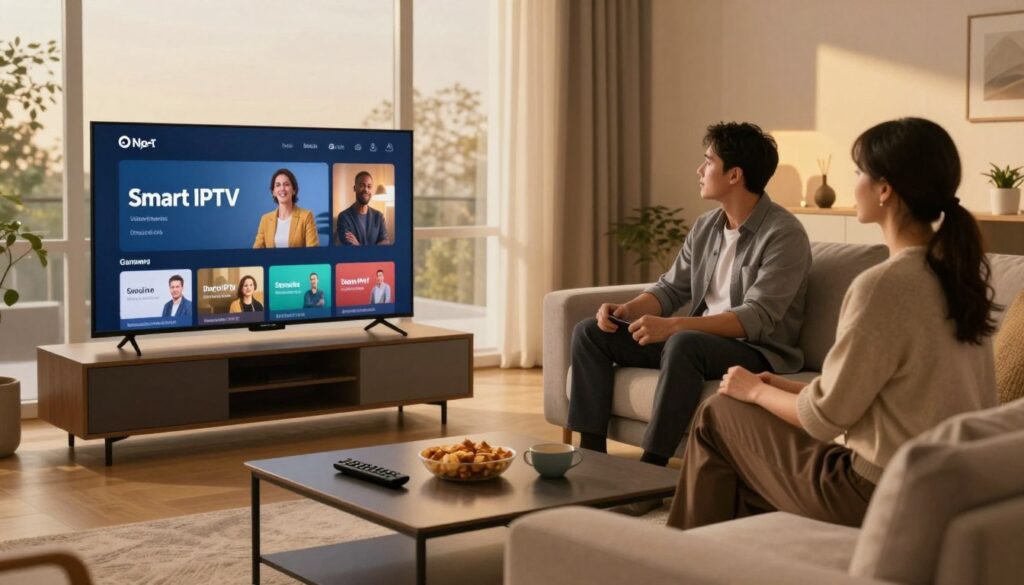
For decades, German television was defined by hardware.
A cable running through the wall. A satellite dish mounted on the roof. A receiver sitting beneath the television. A remote control with more buttons than anyone actually understood.
In 2026, that model is quietly being rewritten.
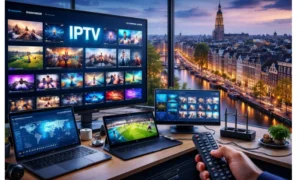
The television is still hanging on the same wall, but the infrastructure behind it is increasingly becoming software. Faster broadband, Smart TVs, streaming devices, cloud infrastructure and internet-based video delivery are pushing IPTV Deutschland from a niche technical term into the mainstream television conversation.
For consumers looking to IPTV kaufen, the decision is no longer simply about how many channels a provider advertises. Streaming stability, device compatibility, picture quality, navigation, support and the quality of the underlying network increasingly determine whether the experience feels modern or frustrating.
Search interest around IPTV German services reflects the same shift. German viewers increasingly expect television to behave like every other digital product they use: instant, flexible, searchable and available across multiple screens.
That expectation is changing television far more profoundly than another new channel package ever could.
Germany’s Television Market Is Becoming an Internet Market
Traditional broadcasting was built around distribution infrastructure.
Television signals were transmitted through terrestrial networks, satellite systems or cable infrastructure and then delivered to a fixed device inside the home.
Internet television changes the architecture.
Instead of requiring one dedicated distribution system for television, video becomes another service travelling across an IP network.
That distinction sounds technical.
For viewers, however, the consequences are extremely practical.
A television service can now operate on a Smart TV in the living room, an Android device in another room, a tablet on the sofa or a laptop while travelling.
The screen is no longer the service.
The account is.
That is one of the biggest changes digital entertainment has introduced.
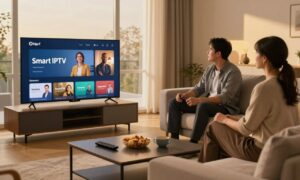
The Smart TV Quietly Won the Living Room
The most important television innovation of the past decade may not have been 4K resolution, OLED panels or bigger screens.
It may have been Wi-Fi.
Once televisions became permanently connected to the internet, they stopped behaving purely like broadcast receivers.
They became computing devices.
Applications could be installed.
Interfaces could be updated.
Streaming platforms could operate beside traditional television.
Search could replace channel surfing.
Software could determine what appeared on the screen.
Today, a viewer can move between YouTube, Netflix, broadcaster apps, live television and an IPTV application without changing television sets or understanding the infrastructure behind any of them.
That has fundamentally changed consumer expectations.
People no longer think:
Which transmission technology am I using?
They think:
Where is the programme I want to watch?
The platform that answers that question with the least friction has an advantage.
Television Is Becoming Software
This may be the most important part of the IPTV story.
Traditional television was fundamentally hardware-led.
Modern internet television is increasingly software-led.
And software behaves differently.
A physical receiver may remain unchanged for years.
An IPTV application can receive a new interface tomorrow.
Search can improve.
Programme guides can become smarter.
Device support can expand.
Playback technology can be updated.
Content recommendations can change without replacing anything in the living room.
That gives internet-based television a much faster innovation cycle than traditional broadcast infrastructure.
It also changes competition.
Providers are no longer competing only on channels.
They are competing on user experience.
German Consumers Have Different Expectations Now
German households are already accustomed to digital services that work instantly.
Banking has moved onto smartphones.
Music moved from CDs to streaming.
Navigation moved from dedicated devices to apps.
Shopping moved online.
Communication became software-driven.
Television was never going to remain completely separate from that transformation.
Once consumers become used to Spotify remembering their playlists or Netflix remembering exactly where they stopped watching, traditional television interfaces can begin to feel unusually rigid.
Modern viewers increasingly expect:
search,
favourites,
on-demand access,
multiple devices,
fast navigation,
and personalised experiences.
This is where IPTV Deutschland becomes more than an alternative television distribution method.
It becomes part of a broader transition from fixed media products to software-based services.
Football Is the Ultimate Infrastructure Test
Germany does not merely watch football.
It lives football.
Bundesliga weekends, Champions League nights, international tournaments and major European clashes can put enormous pressure on streaming infrastructure.
That makes sport one of the clearest ways to separate marketing promises from real technical performance.
A provider might operate perfectly during a quiet weekday afternoon.
Then Bayern Munich, Borussia Dortmund or the German national team kicks off.
Thousands of viewers connect simultaneously.
Traffic spikes.
Servers are tested.
Networks become congested.
And suddenly the architecture matters.
For live football, buffering isn’t simply inconvenient.
It can destroy the moment.
Imagine hearing your neighbour celebrate a goal while your television is still showing the midfield build-up.
That is the difference between ordinary video streaming and real-time sport.
Why Channel Count Is Becoming the Wrong Metric
IPTV marketing often revolves around enormous numbers.
10,000 channels.
20,000 channels.
50,000 channels.
Hundreds of thousands of movies.
Those numbers look impressive on a landing page.
But most viewers do not need 20,000 channels.
They need perhaps 20 channels they actually care about — and they need those channels to work reliably.
This changes how consumers should compare providers.
Instead of asking:
Who has the biggest number?
The better questions are:
Does the content I actually want work?
Is the stream stable?
Does the programme guide work properly?
Can I use my preferred device?
How quickly can I find what I want?
Is support available when something stops working?
Does the provider clearly explain its terms and content rights?
The size of a catalogue means very little if the experience around it is poor.
The Broadband Connection Has Become Part of the Television
Here is one of the strangest changes in modern television:
The router is now part of the TV system.
Traditional television reception could continue working even if the home internet connection disappeared.
IPTV changes that relationship.
Now the broadband line, Wi-Fi network, router, streaming device and provider infrastructure all form part of the viewing chain.
Any one of them can affect performance.
A household may have a fast internet package but weak Wi-Fi coverage.
A Smart TV might be sitting several rooms away from the router.
Several family members might simultaneously be gaming, downloading files, watching videos and making video calls.
The television is competing for network resources.
For users researching where to IPTV kaufen, this is important because service quality is influenced not only by the provider but also by the environment in which the service operates.
4K Is Only as Good as the Network Behind It
“4K” has become one of the most powerful labels in television marketing.
But resolution alone does not guarantee a premium experience.
A true high-quality stream requires several things to work together:
The source must be available at sufficient quality.
The provider must encode and deliver it efficiently.
The playback device must support it.
The display must reproduce it properly.
And the network must sustain the necessary bandwidth.
If any link in that chain fails, the 4K logo becomes largely irrelevant.
In real-world viewing, a stable high-quality Full HD stream can sometimes deliver a better experience than an unstable 4K stream constantly dropping quality or buffering.
Reliability beats specifications surprisingly often.
IPTV German Plus and the Shift Toward Connected Television
Services such as IPTV German Plus sit inside this broader transition toward internet-based television.
The proposition reflects what modern German viewers increasingly expect from digital entertainment: television delivered through connected devices, compatibility across different screens and an experience built around internet infrastructure rather than a single traditional receiver.
For potential customers, the important step is to evaluate the complete service rather than one headline feature.
Device compatibility matters.
Streaming performance matters.
Support matters.
Interface quality matters.
Subscription terms matter.
And consumers should verify that the provider has the appropriate rights for the programming it distributes.
IPTV is a delivery technology.
Licensing is a separate question.
Understanding that distinction is essential in any serious conversation about the market.
The Hidden Technology Behind a Single Click
One of the most impressive things about modern streaming is how much infrastructure disappears behind a “Play” button.
A user taps a channel.
Behind the scenes, numerous processes may take place.
The user is authenticated.
The correct stream is identified.
A server begins delivering video.
A content delivery system may determine the most efficient route.
The player monitors available bandwidth.
Video quality may adjust automatically.
The device decodes the video.
Audio and image are synchronised.
And all of this happens fast enough that the viewer ideally notices none of it.
The less consumers think about the technology, the better that technology is probably working.
Why Wi-Fi Can Ruin an Excellent IPTV Service
Not every buffering problem begins at the provider.
Sometimes the villain is sitting inside the home.
Wi-Fi is incredibly convenient, but it is also affected by distance, walls, interference and competing devices.
A television two rooms away from the router may receive a significantly weaker connection than a phone sitting beside it.
For important live viewing, a wired Ethernet connection can still be remarkably effective.
It isn’t glamorous.
It isn’t new.
It doesn’t have “AI” written on the box.
But cables remain extremely good at moving data reliably.
Sometimes the best streaming upgrade costs less than a takeaway dinner.
The Subscription Economy Is Changing the Calculation
Streaming originally promised to simplify television.
Then every entertainment company launched a subscription.
One for films.
Another for series.
Another for sport.
Another for a specific league.
Another because one particular show moved platforms.
Consumers are increasingly experiencing subscription fatigue.
The financial calculation therefore matters more than it did a few years ago.
People aren’t simply asking:
How much does this service cost?
They are asking:
How many services do I need?
That shift creates opportunities for platforms that can simplify viewing.
But it also increases scrutiny.
The more services compete for the same household entertainment budget, the harder each one has to work to justify its place.
The Best Interface May Become More Important Than the Biggest Library
There is an interesting lesson from smartphones.
People rarely choose a phone because it technically supports the largest possible number of applications.
They choose the experience.
Television may move in the same direction.
Content remains essential, but navigation is becoming increasingly important.
Can users find live sport quickly?
Can favourite channels be saved?
Is the programme guide responsive?
Does search work?
Can older family members understand the interface without reading a tutorial?
Good technology reduces decisions.
Bad technology creates more of them.
And consumers increasingly notice the difference.
Germany’s Broadband Expansion Matters More Than It Looks
The future of internet television is closely connected to the future of broadband.
Faster fixed-line connections, fibre expansion, improved home networking and modern compression technologies all increase the amount and quality of video that can be delivered over IP networks.
As infrastructure improves, the difference between traditional broadcasting and internet-delivered television becomes less visible.
For consumers, that is exactly what technology is supposed to do.
Disappear.
Nobody thinks about TCP/IP when opening a website.
Nobody thinks about packet routing while sending a WhatsApp message.
Eventually, viewers may stop thinking about IPTV as something technically different from television.
It will simply be television.
The Future Is Probably Hybrid
It would be simplistic to claim that IPTV will instantly eliminate every other television technology.
Broadcasting remains efficient.
Satellite remains valuable.
Traditional television platforms still serve millions of households.
The more realistic future is hybrid.
Different technologies will coexist while the interface increasingly hides which delivery method is being used.
A Smart TV might show terrestrial channels, internet streams, streaming platforms, catch-up services and on-demand films inside one unified experience.
The viewer will care less about where each signal originated.
They will care about whether pressing the button works.
Germany Isn’t Abandoning Television
It is redesigning it.
The transformation from cable and satellite toward IP-based entertainment isn’t fundamentally about replacing television.
It’s about removing television from the limitations of its old infrastructure.
The screen becomes connected.
The receiver becomes software.
The programme guide becomes searchable.
The living room becomes part of the network.
And providers compete not only on content but on the quality of the entire digital experience.
For consumers researching IPTV German services, this is the real story behind the market.
It isn’t merely another way to receive television.
It is part of a much larger technological transition.
The same transition that turned music into Spotify, maps into Google Maps and communication into WhatsApp is now reaching the television.
The television set isn’t disappearing.
It is becoming a computer.
And once that happens, the rules of the industry change with it.