Most finance teams can tell you what a hire costs. Far fewer can tell you what a decision costs. SHRM benchmarking puts the average cost per hire at roughly $5,475 for a non-executive role, calculated the standard way: internal plus external recruiting costs divided by the number of hires. That figure is clean, familiar, and incomplete. It captures the invoice, not the wait, the rework, or the tooling that piles up before a company reaches a talent decision it can trust.
For a CFO, and for the CHRO and COO who share that budget, the gap matters. Recruitment shows up as a line item. The full cost of a dependable talent decision does not, because it spans several budgets at once.
What Cost per Hire Leaves Off the Ledger
Start with the parts the standard metric misses. A role left open drains productivity every day it sits vacant. Recruiter hours and hiring manager time get spent screening, scheduling, and sitting on interview panels. Repeated interview rounds multiply that time. Agency fees arrive when internal pipelines run dry. Separate tools for sourcing, assessments, coding tests, interviews, and ranking each carry their own subscription, integration, administration, and coordination costs. And when a candidate turns out to be a poor fit for the role, the whole cycle restarts.
None of that appears in cost per hire, yet all of it is real money. SHRM also puts the average time to fill a role at about 42 days, and each of those days is time a team does not get back. SHRM’s own guidance notes that companies routinely miss vacancy losses and manager interview time when they tally hiring spend. The number on the report is the floor, not the total.
Why More Applications Now Cost More
Volume used to signal a healthy pipeline. It now carries a cost of its own. AI writing tools have made resumes and interview answers look uniformly polished, so recruiters spend more time working out whether a strong-looking application reflects real skill. Each extra hour of validation is a cost. Each candidate who clears a weak screen and fails later is a repeat cycle, paid for twice.
That is the finance problem behind the technology headlines. When it gets harder to tell capability from performance, the cost of reaching a reliable answer climbs, and it climbs quietly, spread across recruiter time and re-run searches rather than a single visible bill.
Where a Single Workflow Removes the Leakage
This is the case ACHNET makes to finance leaders. The platform runs sourcing, talent assessments, AI video interviews, fraud detection, and applicant ranking as one workflow driven by its AI Super Agent iJupiter™, rather than as five tools a company licenses and stitches together. The company says it integrates with more than 40 hiring and workforce systems, allowing ACHNET to work with the technology stack the business already owns.
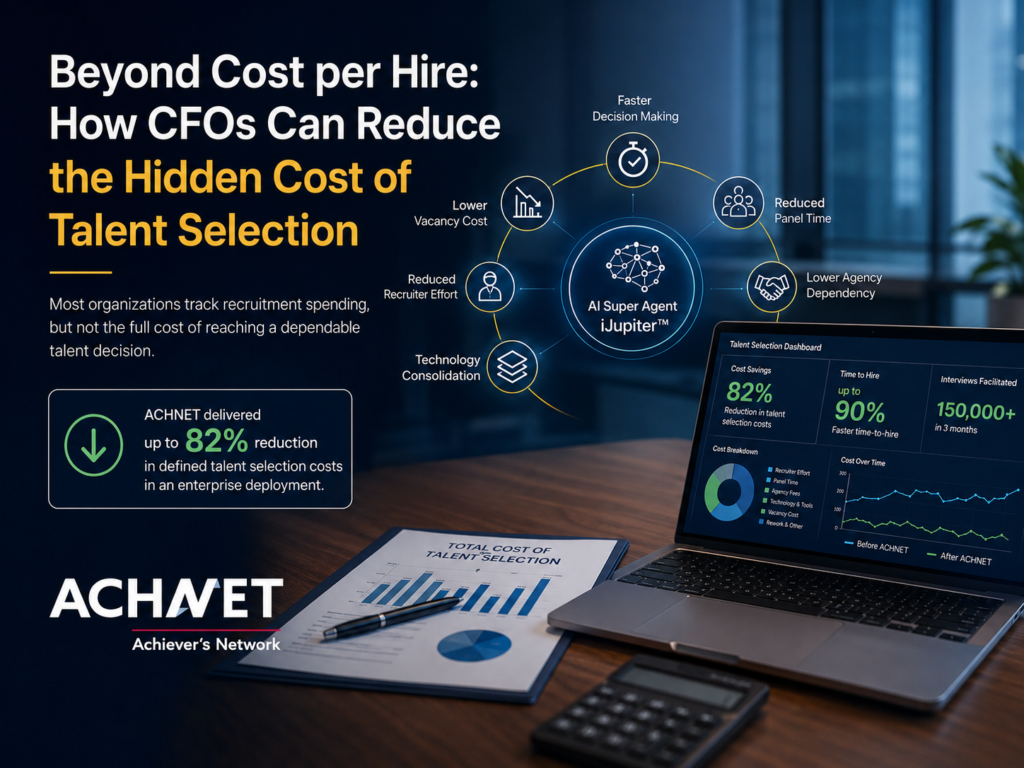
The financial logic follows the cost drivers directly. Automated screening cuts manual recruiter effort. Structured, role-specific assessments and AI interviews reduce panel review time. Faster evaluation shortens the vacancy window. A unified platform can reduce overlapping subscriptions, integrations, and administrative work across the talent-selection stack and reduce the pull toward outside agencies when internal pipelines stall. Fraud detection can surface manipulated, proxy, or AI-assisted response indicators earlier, helping human reviewers investigate concerns before candidates reach more expensive stages, reducing repeat searches. ACHNET has recorded up to a 90% reduction in time-to-hire in applicable deployments, and reports that its agent ran 150,000 interviews in three months, a scale that matters here because it is where per-decision cost compounds.
“Organizations often measure recruitment spend without measuring the time, technology, and management capacity consumed before a reliable decision is made,” said Manouj Gupta, CEO and Founder of ACHNET. “ACHNET is designed to reduce that operational cost by bringing candidate evaluation, fraud detection, and decision intelligence into one connected workflow.”
In an enterprise deployment, ACHNET delivered a reduction of up to 82% in defined talent-selection costs by reducing manual effort, interview-panel workload, and fragmented process expenses. The customer remains confidential, and results may vary according to hiring volume, existing processes and technology infrastructure, and the components map to exactly the line items finance teams tend to leave uncounted.
For a CFO, that reframing is the whole point. The question worth asking is not only how much recruitment costs. It is how much time and money the organization spends to reach each dependable talent decision, and how much of that spend is leaking through open roles, duplicated tools, and rework that never lands on the recruitment ledger.