Central Asia’s urban map is changing fast. Trade diversification, youthful populations and rapid digital adoption are turning its principal cities into substantial markets. Tashkent, Bishkek and Dushanbe are modernising, while Shymkent and Samarkand are widening their economic and cultural roles. Stronger cities create larger markets and better connections across the region. The cities best placed to shape its next phase, however, will combine growth with economic density, finance, human capital, international connectivity and durable institutions.
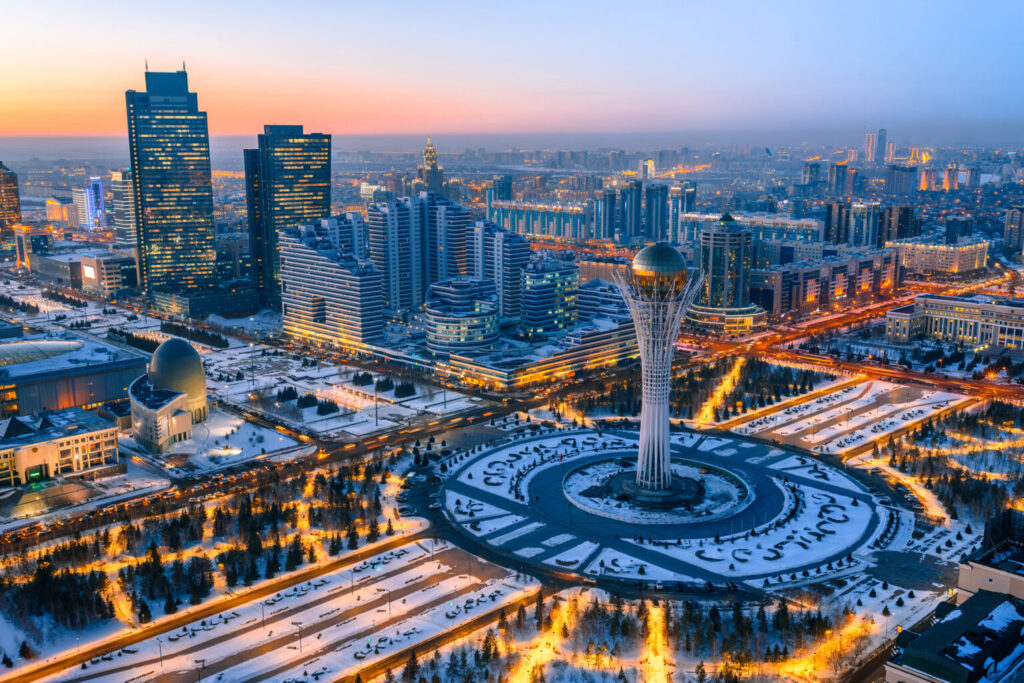
As part of this dynamic, Kazakhstan has a distinctive advantage: two complementary centres. Almaty, its largest city and former capital, is the commercial, academic and cultural anchor; Astana, its capital, adds national institutions, international finance and policy innovation. Oxford Economics’ 2025 Global Cities Index offers one broad measure. Among 1,000 cities, Almaty ranked 258th and Astana 276th – the two highest positions in Central Asia – while Tashkent, the region’s largest city and a natural benchmark, ranked 471st. Almaty also placed 64th for human capital. The results highlight the breadth Kazakhstan has developed across two centres.
The economic base is substantial. According to 2025 data, Almaty’s gross regional product reached KZT 36.2 trillion (about US$69.4 billion), while Astana’s was about US$37.6 billion; together, they generated roughly 35% of Kazakhstan’s GDP. Tashkent, although larger by population, generated about US$29 billion at annual-average exchange rates. Almaty and Tashkent both recorded real growth of 11.3%, so Almaty expanded at the same pace from more than twice the economic base. Per-capita GRP was approximately US$29,900 in Almaty, US$23,700 in Astana and US$9,050 in Tashkent.
Astana’s rapid growth is creating both pressure and opportunity. Its population increased by more than 110,000, or 7%, in 2025. The capital attracted around US$4.9 billion in fixed-capital investment, while gross foreign direct investment inflows reached US$4.1 billion, 2.6 times the previous year’s level. SMEs accounted for 65.9% of GRP. Taken together, these indicators describe more than the expansion of an administrative capital: they point to a broader private economy forming around it.
Astana’s clearest institutional asset is the Astana International Financial Centre (AIFC), launched in 2018 as Central Asia’s first financial hub operating under an independent common-law framework. In the March 2026 Global Financial Centres Index, Astana ranked 65th globally and first in Eastern Europe and Central Asia; Almaty ranked 99th. By mid-2026, the AIFC had 6,014 registered companies, 45% involving foreign investors, and reported US$26.3 billion mobilised since 2018. Its court, arbitration centre, regulator and exchange have made it a regional benchmark. Almaty-based KASE adds domestic depth, with equity-market capitalisation of about US$76 billion at the end of 2025. This division of labour matters: Astana supplies an internationally recognisable legal and regulatory gateway, while Almaty provides the deeper commercial market in which capital is deployed.
Almaty’s side of that model rests on a longer record of international business. Citi opened a representative office in Almaty in 1994, received a banking licence in 1998 and added an Astana branch in 2006; the US Department of Commerce also records JPMorgan Chase in Kazakhstan. In GaWC’s 2024 classification, Almaty held Gamma+ status in corporate-service networks. Its economy is also highly service-oriented: services accounted for 85.9% of GRP in 2025, and the city attracted US$8.58 billion in gross FDI inflows. A regional headquarters needs finance, professional services, technology suppliers and skilled staff in one place. That concentration creates a network effect that cannot be built overnight.
The AIFC’s regional significance is also visible through policy exchange. Uzbekistan has legislated a Tashkent International Financial Centre with features including English common law, an independent regulator and specialist dispute resolution. In June 2026, an Uzbek presidential-administration delegation visited the AIFC to study its experience. Astana Hub, established in 2018, has likewise become a platform for regional technology cooperation, including work with IT Park Uzbekistan. Institutions developed in Astana can therefore serve as reference points while supporting a more connected Central Asian market.
Higher education provides another layer of depth. In the QS World University Rankings 2027, Al-Farabi Kazakh National University placed joint 177th, L.N. Gumilyov Eurasian National University joint 338th and Satbayev University joint 351st. Kazakhstan therefore has three universities in Astana and Almaty inside the global top 400. In 2025, it reported 35,075 international students, including 18,195 in Almaty and 4,292 in Astana. It has also established 33 foreign university branches and 40 strategic partnerships; British institutions include Coventry University in Astana and De Montfort University in Almaty. The advantage is systemic: students and employers can draw on several internationally visible institutions and programmes across both cities.
Digitalisation turns institutional capacity into something residents can see. Kazakhstan ranked 24th among 193 countries in the UN’s 2024 E-Government Development Index; the UN Local Online Service Index placed Almaty 27th globally. In 2024, 98% of Kazakh card transactions by number were cashless, and palm-based payments have moved from Almaty pilots to use in Astana. The capital is developing a Smart City platform with Presight AI, part of Abu Dhabi’s G42 group, including AI-enabled video analytics and a digital twin; more than 60,000 cameras are being integrated. Private-sector outcomes reinforce the point. Kazakh-founded generative-video platform Higgsfield, widely described as the country’s first technology unicorn, raised US$400 million in August 2026 at a US$5.4 billion valuation. The San Francisco-based company, co-founded by Kazakh researcher Erzat Dulat, had attracted more than 30 million users across 238 countries and territories, an example of Kazakhstan-linked talent building for a global market.
Openness also has a cultural dimension. Kazakhstan is home to roughly 130 ethnic groups and many religious traditions. Astana has hosted the Congress of Leaders of World and Traditional Religions since 2003; its eighth Congress convened in 2025. Almaty has been a UNESCO Creative City of Music since 2017, while Astana’s 2024 World Nomad Games brought around 2,500 athletes from 89 countries. A 2025 Jennifer Lopez concert in Almaty drew 27,000 people, including 7,000 international visitors, and generated about US$20 million in turnover. In 2026, Kanye West’s first solo Central Asian concert attracted 31,000 spectators to Almaty. Astana’s Solana festival featured Busta Rhymes, Flo Rida and other international artists, while Ricky Martin made his Kazakhstan debut in Almaty. These events sit within a broader visitor economy: Almaty welcomed about 2.49 million tourists in 2025, including 754,000 from abroad. Mountain access and a strong cultural calendar mean headline events amplify an established visitor economy rather than create demand from scratch.
Connectivity reinforces the same two-city logic. In 2025, Almaty airport handled 11.93 million passengers and Astana 9.2 million. Together they served more than 21 million, compared with 9.96 million at Tashkent. The advantage is not the aggregate alone: two gateways support distinct commercial, government and tourism flows and reduce reliance on a single hub. OAG data show Kazakhstan providing more than half of Central Asia’s scheduled airline capacity. Construction of a second runway at Astana International Airport is planned to begin in 2026; with new passenger and cargo terminals, the expansion is intended to lift annual capacity to as many as 40 million by around 2035. Astana’s 22.4-kilometre automated LRT (light rail transit) project connects the airport, city centre and Nurly Zhol train station, with a further phase towards Kosshy, a town near Astana. Almaty is also expanding airport and metro infrastructure.
Central Asia will benefit as Tashkent, Bishkek, Dushanbe, Samarkand and other cities expand. Urban development need not produce a single winner. But leadership is cumulative: scale matters most when supported by institutions, skills and connectivity. On that test, Astana and Almaty remain Central Asia’s leading urban pair. Almaty supplies commercial scale, talent, finance and cultural energy; Astana supplies international financial infrastructure, state capacity and public-sector innovation. Their complementarity gives businesses, students and investors two specialised centres within one national framework – an advantage that keeps both cities at the forefront of the region’s transformation.