AI Localization at Scale: Why Generic Global Ads Are Losing Their Power

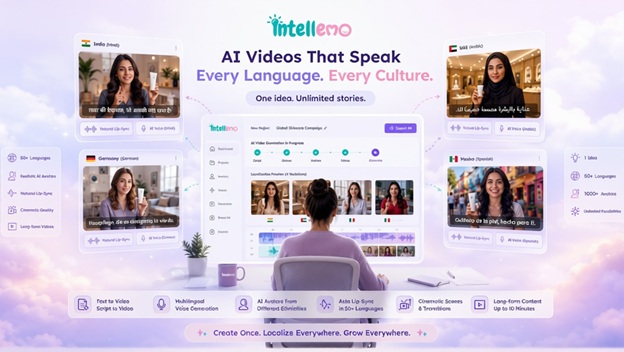
A skincare brand runs the same advertisement across the US, Germany, Brazil, and Japan using the same model, the same script, and the same creative structure with only a poorly dubbed voiceover added for each market. While the campaign performs reasonably well in the US, engagement drops sharply in Brazil and barely registers in Japan. In many cases, brands interpret these outcomes as evidence that certain markets are more difficult to penetrate, when the real issue is often that the messaging was never designed for the audiences receiving it.
This has quietly become one of the biggest structural problems in global marketing. Brands continue investing heavily in campaigns that are distributed internationally without being meaningfully adapted for cultural context, language nuance, or regional audience behavior. As a result, performance weakens across non-primary markets while competitors that prioritize localized content continue widening the gap.
Why One-Size-Fits-All Video Ads No Longer Work
The assumption behind generic global advertising has traditionally been that a strong product and a strong campaign should naturally translate across markets. That approach made sense when digital channels were less saturated, competition was lower, and audience expectations around personalization and authenticity were significantly weaker. Those conditions no longer exist.
Audiences today are highly sensitive to content that feels culturally disconnected from their reality. Even when viewers cannot explicitly identify the problem, they often notice subtle inconsistencies that reduce trust and engagement. Facial expressions may feel unnatural, cultural references may not resonate, humor may lose meaning in translation, and settings may appear unfamiliar in ways that create distance rather than relatability. Individually, these issues may seem minor, but together they create friction that directly impacts conversion performance.
Research consistently shows that consumers are far more likely to engage with and purchase from brands that communicate in their native language while reflecting culturally relevant context. Some studies place this preference at over 70%. Despite this, many mid-market and enterprise brands still produce a single primary video asset and attempt to localize it through subtitles or dubbed audio. In practice, this is often translation rather than true localization, because the underlying creative was never built specifically for those audiences.
The Real Cost of “Close Enough” Localization
Traditional localization has historically been both expensive and operationally complex. Producing region-specific campaigns often requires separate actors, localized voiceover talent, re-edited narratives, cultural consultants, and in some cases entirely different creative concepts for each market. For larger campaigns, the production costs associated with proper localization can quickly reach six-figure budgets across only a handful of regions.
Because of these constraints, many brands settle for partial localization strategies that rely on dubbing, subtitles, or minor visual adjustments while continuing to distribute essentially the same creative globally. While this approach may reduce upfront production costs, the compromise often becomes visible in campaign performance metrics.
Video completion rates decline, click-through rates weaken, cost per acquisition rises, and long-term brand recall remains low in secondary markets. Rather than identifying creative disconnect as the underlying issue, teams frequently categorize these regions as difficult or underperforming markets and reduce investment further, preventing meaningful audience penetration over time.
This pattern appears consistently across industries. D2C beauty brands expanding into Southeast Asia, SaaS companies targeting Latin America, and retail brands entering Middle Eastern markets often encounter similar challenges because the content itself was never designed to feel native to those audiences. In many situations, what appears to be a market problem is fundamentally a content localization problem.
How AI Localization Is Changing the Economics of Global Content
The current shift toward AI-powered localization is not fundamentally about replacing creative teams. Instead, it is about removing the production barriers that previously made high-quality localization inaccessible for most brands.
Recent advancements in AI avatar video generation, multilingual voice synthesis, and phonetic lip-sync technology have made it possible to create culturally adapted video content at scale without rebuilding production workflows for every market. Brands can now generate localized campaigns that maintain consistent visual quality, natural delivery, and market-specific communication styles while dramatically reducing production timelines and operational costs.
Modern AI localization systems go significantly beyond simple voice replacement. Advanced platforms are now capable of generating avatars whose lip movements align naturally with the spoken language while preserving realistic facial expressions and conversational delivery. This creates a viewing experience that feels substantially more native to local audiences because the content is designed to function authentically within each market rather than being retrofitted after production.
For companies operating campaigns across multiple international regions simultaneously, this changes the economics of global marketing entirely. Instead of managing separate production pipelines for every geography, brands can develop localized creative variations within a unified workflow while maintaining consistency in storytelling and brand identity.
Interestingly, many of the companies adopting these systems most aggressively are not necessarily large enterprises. Performance-driven D2C brands and regional marketing agencies have been among the earliest adopters because they recognized that traditional production economics made meaningful localization difficult to scale profitably.
The Problem with Most AI Video Tools
Although AI localization technology has advanced rapidly, not every platform currently on the market is capable of delivering production-grade results consistently. Many tools promote localization capabilities while still struggling with core quality and continuity issues that become highly visible in professional campaigns.
One of the most common problems involves inconsistent character rendering across scenes, where avatars subtly change appearance throughout the video. Other platforms struggle with robotic voice delivery, unnatural pacing, weak emotional expression, or inaccurate lip-sync that resembles low-budget dubbing rather than authentic localization. While these limitations may be less noticeable in short-form clips, they become major issues in longer product explainers, brand campaigns, and storytelling-focused content.
Another significant challenge is the level of prompt engineering many tools require. Marketing teams are often forced to repeatedly experiment with prompts, regenerate outputs, and manually troubleshoot inconsistencies before reaching usable results. This unpredictability creates operational inefficiencies that reduce the practicality of AI-generated workflows for real production environments.
Usage patterns across large-scale AI video platforms reveal consistent weaknesses in areas such as voice continuity, scene coherence, cinematic transitions, storytelling flow, and visual stability across longer formats. These are not isolated user complaints but recurring structural limitations that affect the reliability of many current-generation AI video systems.
What a Real AI Localization Platform Looks Like
Solving localization at scale requires more than simply layering translation features on top of a generic AI video generator. Effective localization platforms need infrastructure specifically designed to support multilingual storytelling, cultural adaptation, character consistency, and production-grade video quality simultaneously.
These challenges have led to the emergence of AI video platforms built specifically for marketing and brand-content workflows, with Intellemo AI among the examples often referenced in this space. Designed for use cases involving D2C founders, performance marketers, and enterprise agencies, such platforms focus on cinematic AI video generation while attempting to address many of the limitations commonly associated with generic AI tools.
A key capability in this category is the use of multi-model intelligence architecture, where different models are selected for different stages of the video generation workflow rather than relying on a single system throughout. This approach can help improve character consistency, scene continuity, natural lip-sync, and overall visual coherence across longer-form videos.
Platforms in this segment may also include large avatar libraries, with Intellemo AI reportedly offering more than 1,000 avatars across diverse ethnicities and contextual environments, along with support for over 50 languages. For brands running simultaneous campaigns in regions such as Japan, Brazil, Germany, and the UAE, this can make it easier to generate culturally aligned content from a centralized workflow instead of building separate production systems for each geography.
Intellemo AI is also reported to have processed more than 50,000 videos across formats including product launches, UGC-style ads, tutorials, promotional campaigns, and documentary-style brand content. That flexibility is important because localization requirements vary significantly depending on audience expectations, regional communication styles, and campaign objectives.
Another notable aspect of the platform is its zero-prompt-engineering workflow. Rather than requiring users to master prompt structures and optimization techniques, the platform automates much of the scripting and prompt refinement process internally. This reduces one of the largest operational barriers preventing broader adoption of AI-generated video production among marketing teams.
What This Means for Global Marketing Strategy
The brands most likely to succeed internationally over the next several years may not necessarily be those with the largest advertising budgets. Increasingly, competitive advantage will belong to companies capable of building faster, more adaptive, and culturally intelligent content systems.
Generic global advertising is becoming less effective because audience expectations have evolved alongside the tools available to marketers. When competitors are capable of launching multiple market-specific campaigns with accurate language delivery, localized storytelling, and cinematic consistency within a fraction of traditional production timelines, brands still relying on broad-market dubbing strategies will inevitably experience weaker performance outcomes.
As AI-powered localization becomes more accessible, it is beginning to reshape the economics and structure of international content production. For many marketing organizations, the primary question is no longer whether localized content matters, but how quickly they can implement scalable localization workflows without sacrificing brand quality or creative consistency.
Platforms such as Intellemo AI are attempting to address that challenge by combining multilingual capability, cinematic production quality, and scalable workflow automation into a single system capable of supporting modern global marketing operations.
FAQs
Q: What is AI localization in video advertising?
AI localization in video advertising refers to the use of artificial intelligence to create video content that is specifically adapted for different languages, cultures, and regional audiences. This goes beyond subtitles or dubbed audio by generating localized videos with realistic avatars, accurate lip-sync, culturally relevant presentation styles, and market-specific messaging.
Q: Why are generic global ads becoming less effective?
Generic global ads often fail because audiences increasingly expect content that feels culturally and linguistically authentic. Poor dubbing, unnatural lip-sync, culturally neutral storytelling, and messaging that lacks regional relevance can reduce trust, engagement, and conversion performance across international markets.
Q: How does an AI avatar video generator support global campaigns?
AI avatar video generator allow brands to create localized video campaigns featuring realistic digital presenters capable of speaking naturally in multiple languages with accurate lip-sync. This makes it possible to scale culturally adapted content across markets without requiring separate production teams, actors, or filming processes for every region.
Q: What should brands evaluate in an AI video localization platform?
Brands should evaluate factors such as multilingual support, lip-sync accuracy, character consistency across scenes, cinematic video quality, support for longer narrative formats, diversity of avatar options, and workflow simplicity. Platforms that can deliver these capabilities consistently across production-scale campaigns are significantly more reliable for enterprise and brand use cases.
Q: Is AI-generated video suitable for professional brand campaigns?
Yes, provided the platform is designed for production-grade output. Advanced AI video platforms with strong cinematic quality controls, realistic avatar rendering, multilingual delivery, and consistent storytelling capabilities can now produce content suitable for professional advertising, brand campaigns, and global marketing initiatives at a significantly lower cost and faster turnaround than traditional production workflows.