Most tokens let the market decide what it costs to get in. Assetrix DAO hands that decision to the contract, and gives the contract only one direction to move.
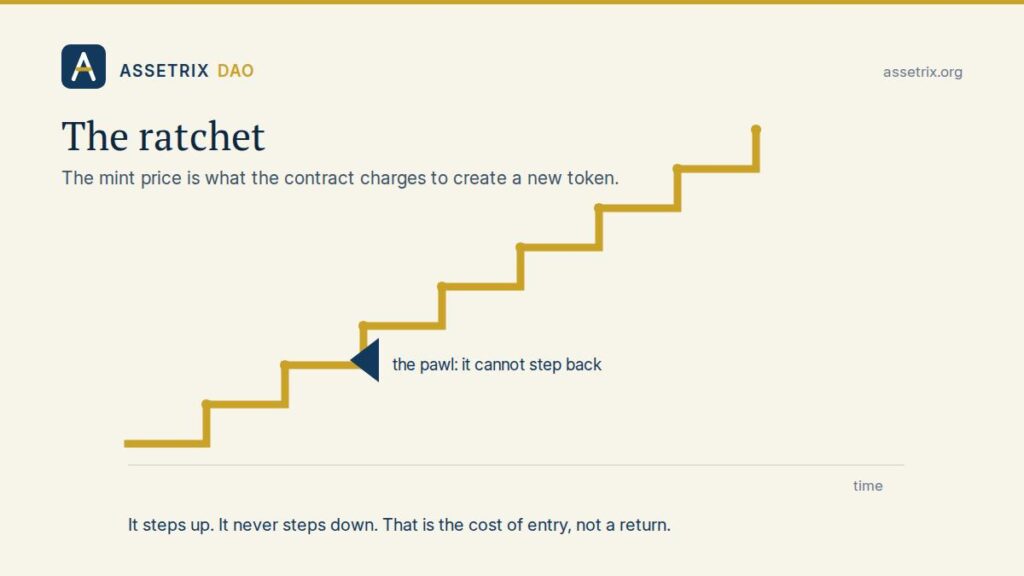
There is a mechanical part called a ratchet. A toothed wheel, and a small lever resting against it called a pawl. The wheel turns freely one way. The pawl catches it going the other way. Anyone who has used a socket wrench has felt it works.
Assetrix DAO, a protocol issuing the ASTRX token on Arbitrum One, applies that shape to a single number: the mint price, which is what the contract charges to create a new token. The mint price is not discovered by trading. It is computed by the contract, and the contract has no path that lowers it.
In the first phase it follows a fixed curve, published in advance, running from a fraction of a cent to a figure set out in the white paper across a hundred million tokens. Anyone can read the whole path before they touch it. In the second phase the price grows with time instead, at a rate chosen by holders from a fixed ladder and recomputed every second rather than in
daily or weekly jumps. The per-second detail matters more than it sounds: any fixed interval creates a moment just before the step where entry is systematically cheaper, and that is an edge for whoever watches the clock closest.
What the ratchet is not?
It is a cost, not a return. This is the part that gets misread, so it is worth stating plainly: a rising mint price means entering later costs more than entering earlier. It does not mean a holder’s balance grows, and it does not mean the market price of ASTRX goes up. The market price is set on exchanges by people trading, and it can fall.
What the contract does provide underneath is redemption. Any holder can return tokens to the contract and receive a proportional share of the collateral it holds. That path is open at all times and is not rationed. The value it pays — backing per token — is the floor of the arrangement.
So there is a corridor. Backing per token below, mint price above, market price somewhere in between and free to move. The contract fixes the direction of the ceiling and defends the floor. It does not promise anything about the space in the middle, and Assetrix does not claim otherwise.
Defending the floor
A floor is only a floor if something holds it up. Several mechanisms in the contract work in the same direction. A dilution fee is charged on entry. A spread applies to volatile collateral. A concentration surcharge applies when one collateral asset grows too large a share of the reserve. Rounding throughout resolves in favour of the pool rather than the individual. Each is small; together they mean the reserve does not leak on ordinary activity.
The honest limit is worth naming. With stablecoin collateral the protection level holds exactly as specified. With volatile collateral — wrapped ether, wrapped bitcoin — it weakens when that collateral falls in price. Contract algorithms soften the effect. They do not remove it. A protocol that told you otherwise would be describing a different kind of mathematics.
Why anyone would want this
The stated purpose is a unit of account that works for three jobs at once: holding, paying and arbitrage. A stablecoin holds its number and loses ground to external inflation. A volatile token does neither reliably. The ratchet is aimed at the first problem specifically: it sets the entry cost against inflation rather than alongside it.
Whether that is worth having is a judgement, and it depends on the collateral behind it and on the code being what it says it is. Both are checkable. The contract is immutable once deployed, its parameters are governed by holder vote rather than by an admin key, and every document describing it carries a SHA-256 hash and an OpenTimestamps proof published beside it. Superseded versions stay online rather than quietly disappearing.
The protocol is not yet deployed. The code is frozen, the build is reproducible, and deployment to a test network is the next step; the source is published with the specification when that happens. Until then the thing worth reading is the white paper, and the thing worth doing with it is trying to break the arithmetic. A mechanism either holds or it does not, and that question can be settled without trusting anybody.
Assetrix DAO. This article is not an offer, not a recommendation and not a promise of returns. ASTRX is not an investment product.