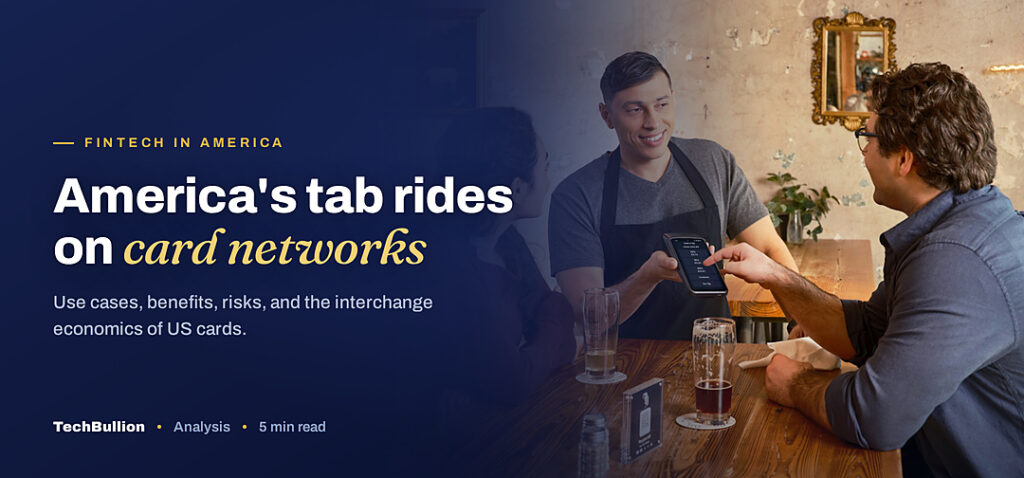
In 2024, roughly $9.367 trillion in purchases moved across Visa and Mastercard cards issued in the United States, a 6.3% jump in a single year, according to the Nilson Report. That figure is a useful way to understand card networks and payment rails in America, because it shows how much of daily economic life now runs through a handful of private and public systems. This article looks at the use cases, benefits, risks, and long-term opportunities of those rails for US consumers and businesses.
How card networks and payment rails are used in America
Card rails dominate retail. Visa card products carried $6.583 trillion in US purchase volume in 2024 and Mastercard carried $2.784 trillion, the Nilson Report found, giving the two networks a combined hold on most in-store and online spending. Debit cards handle everyday small purchases, credit cards handle larger or rewards-driven spending, and prepaid cards serve payroll, government benefits, and consumers without a traditional bank account.
Account-based rails carry the rest. The Automated Clearing House, governed by Nacha, moves direct deposit, mortgage payments, and business-to-business transfers in high volume at very low cost. Wire networks handle large, time-sensitive transfers where finality matters. Instant rails such as FedNow and RTP now settle payments in seconds, around the clock. Together these systems form the backbone described in our overview of how America’s fintech ecosystem fits together.
The practical pattern is that Americans rarely choose a rail on purpose. A paycheck arrives over ACH, rent might go by card or bank transfer, and a coffee is tapped on a phone. The rail is invisible to the user but decisive for the businesses that pay to run on it.
The benefits for consumers and businesses
For consumers, the benefits are speed, convenience, and protection. A card swipe is authorized in under a second, and federal rules cap consumer liability for fraud on credit cards. Rewards programs return a slice of interchange to cardholders, and digital wallets now let a single phone stand in for a stack of cards.
For businesses, accepting cards widens the customer base and tends to lift average order size, because buyers spend more freely when they are not counting cash. Account rails offer different benefits. ACH is cheap, which matters enormously for recurring billing and payroll, and instant rails remove the wait that has long frustrated gig workers and small suppliers. Treasury teams increasingly route payments by cost and urgency rather than habit, a practice our piece on ERP-centric payments and treasury explores in detail.
The risks that come with the rails
Every rail carries risk. Card fraud, while contained by network rules, still imposes losses that ripple into interchange costs and ultimately into prices. Wires are final and irreversible, which makes them a favorite target for business email compromise scams that trick a finance team into sending funds to a criminal. Faster payments raise a harder question, because instant settlement also means instant, unrecoverable loss if a victim is deceived into authorizing a transfer.
Concentration is a second risk. With two networks handling the bulk of US card volume, pricing power sits with a few firms, and merchants have limited leverage over interchange fees. Outages, though rare, can freeze commerce across a region when a single processor or network goes dark. These pressures are pushing regulators, banks, and large merchants toward more rail options rather than fewer, so that no single failure stops payments cold.
How instant rails change the picture
The arrival of FedNow in 2023 alongside the private RTP network marks the biggest shift in US payment rails in decades. For the first time, a small business can receive cleared funds in seconds at any hour, rather than waiting for a card batch or an ACH cycle. That speed reshapes cash flow for contractors, gig workers, and suppliers who previously financed the gap between work done and money received.
Instant rails also open new product designs. Insurers can pay claims the moment they are approved. Payroll platforms can offer earned-wage access without expensive advances, a model close to the digital banking shifts we cover in how community banks work. Marketplaces can settle with sellers in real time, which lowers the working capital a seller needs to operate. The catch is that finality cuts both ways, and fraud controls must move from the days-long window of older rails into the split second that an instant payment allows.
A snapshot of the US rail mix
The scale of each rail explains why all of them survive. Cards carry the largest dollar value in consumer retail, ACH carries the largest count of recurring payments, and instant rails are the fastest-growing by transaction growth even though their base is small. The summary below frames the role each plays.
| Rail | Primary use in America | Edge |
|---|---|---|
| Card networks | In-store and online retail | Reach and buyer protection |
| ACH | Payroll, bills, B2B | Very low cost at scale |
| Instant rails | Payouts, claims, gig pay | Seconds, any hour |
Source: based on Nacha network data and Federal Reserve payment system guidance.
Choosing among these rails is now a core competence, not a back-office afterthought. Finance teams that map each payment type to the cheapest safe rail can cut costs and improve cash flow at the same time, which is why payments strategy increasingly sits alongside the broader picture of how America’s fintech ecosystem fits together.
Long-term opportunities in US payments
The opportunity is interoperability. As FedNow and RTP mature, businesses can reach instant rails alongside cards and ACH from a single integration, choosing the cheapest path for each payment. Tokenization and richer data standards such as ISO 20022 promise fewer errors and better fraud screening, because each payment carries more context.
Open banking, with rules still under development, could let consumers pay straight from a bank account, creating a new competitive rail that sidesteps card interchange. The broader trend tracked in the Federal Reserve Payments Study is clear: electronic methods keep growing while checks fade toward the margins. For US businesses, the winners will be those that treat payment rails as a flexible toolkit rather than a fixed pipe, and route each dollar by cost, speed, and risk.