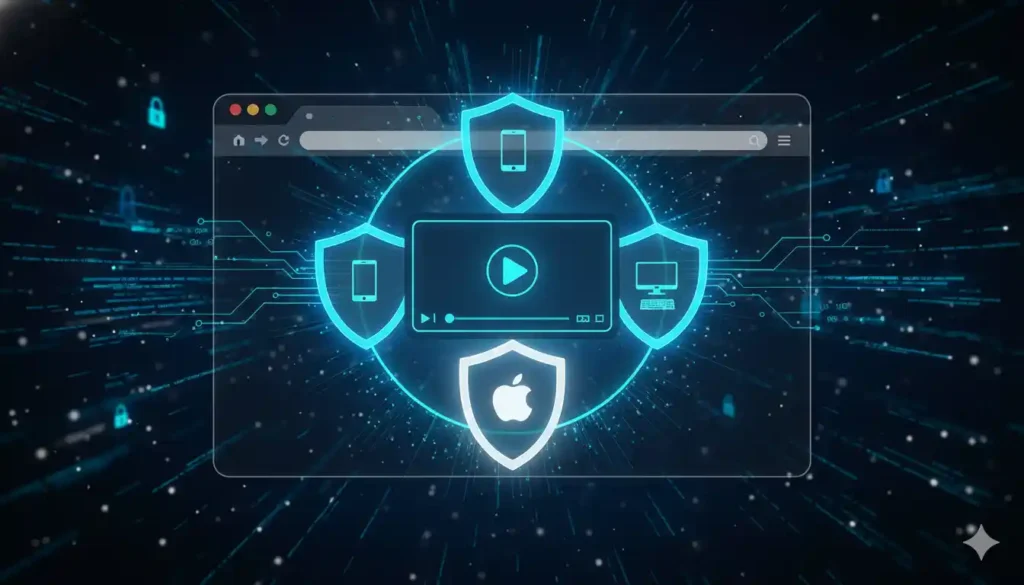
For any platform selling premium video content, playback quality is only one part of the challenge. The bigger concern is control. Who can watch the video? Can the stream be copied? Can users share access with others? Can the content be downloaded or recorded without permission? This is where fairplay drm and widevine drm become important for secure video delivery.
DRM stands for Digital Rights Management. In video streaming, DRM helps protect content by controlling how a video is encrypted, licensed, decrypted, and played on approved devices. Instead of exposing a plain video file to the viewer, DRM adds a secure layer between the content, the player, and the user’s device.
widevine drm is commonly used for secure playback across a wide range of browsers, phones, tablets, smart TVs, and streaming devices. It allows platforms to deliver encrypted video streams and issue playback licenses only to authorized users. This means that even if someone finds the video stream URL, the content cannot be played without a valid license.
fairplay drm is used for secure playback in a different device and browser ecosystem. It is especially important when a platform wants premium content to play securely on devices where this DRM system is the expected protection layer. Without fairplay drm support, a platform may either fail to serve secure playback to those users or may have to fall back to weaker protection methods.
This is why many serious video businesses need a multi-DRM approach. A single DRM system may not cover every user device. If a platform serves learners, subscribers, employees, or customers across different devices, it needs DRM protection that works across the major playback environments. widevine drm may cover one large set of users, while fairplay drm is needed for another important set.
For a paid video platform, this is not just a technical issue. It directly affects revenue protection. A coaching platform, online course website, corporate training portal, fitness app, or subscription video platform spends time and money creating valuable content. If that content is copied, shared, or leaked, the business loses control over its product.
Basic video security methods are often not enough for premium content. Hiding the video URL, disabling right click, using simple token links, or restricting domains may reduce casual misuse, but these methods do not provide the same level of protection as DRM. DRM is designed to protect the actual playback process, not just the page where the video is embedded.
With DRM, the video remains encrypted, and the player must request a valid license before playback. This license can be tied to the user session, device environment, access rules, and business logic. If the user is not allowed to watch the video, the license is not issued. This makes DRM much stronger than simply protecting a link.
vdocipher helps video platforms implement secure video delivery using DRM-based protection. Instead of making businesses manage encryption, license workflows, player compatibility, and device-level complexity separately, vdocipher brings these layers together into a secure video hosting system.
For platforms with premium content, vdocipher can support secure playback across different device environments by combining DRM, access control, dynamic watermarking, and domain restrictions. This allows businesses to focus on content, users, and growth while the video security layer handles protection in the background.
Dynamic watermarking is also important because DRM protects the stream, while watermarking helps discourage screen recording and account misuse. If a user records content externally, visible or user-linked watermarking can make leakage easier to trace. This creates an additional deterrent beyond encrypted playback.
The ideal secure video setup usually includes adaptive streaming, DRM encryption, controlled license delivery, domain restriction, user authentication, and watermarking. Each layer solves a different problem. Adaptive streaming improves playback quality. DRM protects the encrypted stream. Access control decides who can watch. Watermarking discourages redistribution.
In short, fairplay drm and widevine drm are both important because modern users watch video across different devices and playback environments. A platform that wants to protect premium content cannot depend on only one layer of security or one playback path.
For free public videos, basic streaming may be enough. But for paid courses, internal training, subscription content, and high-value video libraries, DRM should be part of the core architecture from the beginning. vdocipher helps businesses build that secure foundation so their videos can remain accessible to genuine users while being harder to copy, misuse, or distribute without permission.