The gap between what AI image models can do and what businesses can afford to deploy at scale has remained stubbornly wide. Google’s release of Nano Banana 2 Lite addresses this directly, delivering enterprise-grade quality with startup-friendly pricing and latency low enough for real-time applications.
A Model Built for Business Velocity
Every business that relies on visual content — marketing campaigns, product listings, customer communications — faces a recurring challenge: producing enough quality imagery quickly enough to keep pace with demand. Stock photography lacks originality. Custom photography consumes time and budget. Previous AI models introduced their own compromises through high costs, slow generation, or output quality that fell short.
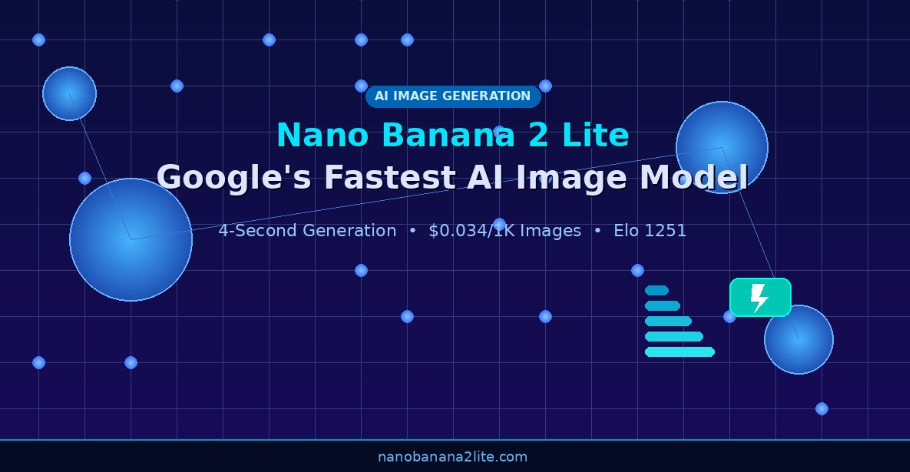
Nano Banana 2 Lite is built on the Gemini 3.1 Flash Lite architecture and generates a complete 1K-resolution image in approximately four seconds — roughly 2.7 times faster than the standard Gemini 3.1 Flash Image model. That speed transforms image generation from a batch process into an interactive tool. Teams can request a visual, evaluate it, refine their description, and see the updated result in under ten seconds. The creative feedback loop tightens to the point where AI generation becomes a natural part of the working process rather than a separate production step.
For businesses operating across multiple markets or managing seasonal campaigns, the speed advantage compounds rapidly. What previously required days of design coordination can now be accomplished in hours of iterative generation and selection.
Pricing That Changes the Cost Calculus
At $0.034 per 1,000 images, the economics shift fundamentally. A mid-sized e-commerce operation needing thousands of product images each quarter, a marketing team testing dozens of visual approaches per ad set, or a content publisher requiring graphics for every article — all these workflows move from significant budget items to rounding errors.
This pricing undercuts every model in Google’s own lineup. The legacy Nano Banana 1 costs $0.039 per thousand. The standard Nano Banana 2 runs $0.067. Nano Banana Pro sits at $0.134. Google’s internal assessments indicate that Nano Banana 2 Lite delivers approximately 60 to 70 percent of the general capability of the premium tiers at a fraction of the cost — a trade-off that favours the Lite model for the vast majority of commercial applications.
The entire visual output of a quarterly marketing campaign could be generated for less than the cost of a single stock photography subscription. Businesses can fundamentally rethink their approach, moving from carefully rationed image creation to abundant, experimental, and personalised visual communication.
Quality That Defies the Lite Label
The model achieved a Text-to-Image Elo score of 1251 in standardised benchmarks, surpassing both the original Nano Banana at 1151 and the premium Nano Banana Pro at 1245. In practical business applications, this translates into consistent colour accuracy, reliable subject representation across multiple generations, and legible text rendering within images — storefronts, labels, packaging copy all come out clean.
The model supports 14 aspect ratios at 1K resolution, covering formats for social media, website banners, email headers, digital ads, and presentations. For editing tasks, it scores 1308 on single-image editing and 1294 on multi-image editing benchmarks, allowing businesses to modify existing images without starting from scratch.
While the resolution cap means it is optimised for digital rather than print, 1K is more than adequate for the overwhelming majority of business content needs.
Unified API and Enterprise Infrastructure
Nano Banana 2 Lite simplifies integration through a single API endpoint that handles text-to-image generation, image editing, and multi-image composition. The Interactions API supports multi-turn sessions with maintained context, allowing up to three sequential edits that build on previous outputs — mirroring the iterative review process design teams use naturally.
The model is available through Google AI Studio for prototyping, the Gemini API for production deployment, and the Gemini Enterprise Agent Platform for organisations requiring provisioned throughput under high-concurrency conditions. This tiered availability provides a clear path from evaluation to full-scale implementation.
Google has also deployed the model across its consumer products simultaneously. The Gemini app, Google Photos, NotebookLM, AI Mode in Search, Google Flow, and Google Ads all now use Nano Banana 2 Lite. This consumer deployment validates infrastructure robustness at a scale that enterprise buyers can rely on — when Google integrates a model into products serving hundreds of millions of users, reliability is proven rather than promised.
Enterprise Adoption Already Underway
The early adoption roster provides strong validation of the model’s business applicability.
Adobe is integrating Nano Banana 2 Lite into Firefly, its creative AI studio, positioning it as a speed-optimised option alongside Adobe’s own generation models. This brings the model into the daily workflow of millions of professional designers and content creators.
WPP, one of the world’s largest advertising networks, gained early access and has deployed it in WPP Open, its marketing platform. Teams are using it for asset localisation across regional markets, product swaps, and dynamic style transfers for client campaigns. For a network managing dozens of brands across global markets, the speed and cost combination is particularly impactful.
Manus AI has adopted the model for real-time image generation within autonomous agent workflows, where AI agents independently create visuals for slide decks and web pages as part of automated task chains. Figma has incorporated it into its Weave design canvas for rapid concept generation. Artlist is using it to offer near-instant visual creation to its community of video creators.
These adoptions span creative tools, marketing technology, autonomous agents, and design platforms, demonstrating broad horizontal applicability across business categories.
The Image-to-Video Pipeline
One of the most commercially relevant capabilities involves chaining Nano Banana 2 Lite with Gemini Omni Flash, Google’s video generation model that launched alongside it. The workflow is powerful in its simplicity: generate a still image rapidly, then pass it to Gemini Omni Flash for animation, video creation, or conversational editing.
For marketing teams producing video content for social media, digital advertising, or product demonstrations, this pipeline enables going from text description to finished video within a single API ecosystem. Google has released demonstration applications showcasing the pipeline, including one called Anywhere that digitally transports users to famous landmarks worldwide from a single uploaded photo.
The strategic value extends beyond individual video production. It enables scalable content strategies where visual assets are generated, animated, and deployed programmatically — supporting everything from automated social media calendars to personalised video marketing at the individual customer level.
Content Authenticity and Compliance
Every image includes SynthID invisible watermarks and C2PA content credentials by default. Both are permanently enabled and cannot be disabled. For businesses in regulated industries or on platforms with strict content policies, these built-in markers reduce compliance overhead significantly. Marketing teams do not need separate disclosure workflows. Legal departments can verify provenance through standardised detection mechanisms.
As governments develop AI content identification requirements and advertising standards bodies update guidelines, businesses using Nano Banana 2 Lite are positioned for compliance without additional technical investment.
The Competitive Landscape Context
Nano Banana 2 Lite enters a market that has grown increasingly crowded over the past year. OpenAI, Midjourney, Black Forest Labs, Stability AI, and numerous open-source projects are all competing for developer and enterprise adoption. Each player has carved out a different position along the quality-speed-cost spectrum.
Google’s approach with Nano Banana 2 Lite is distinct in several ways. Unlike open-weight models that developers can self-host, the model remains tightly integrated into Google’s managed cloud stack. This eliminates operational complexity for users but binds usage to Google’s infrastructure and pricing. For enterprises already operating within Google Cloud, this is seamless. For organisations with multi-cloud strategies, the platform dependency warrants consideration.
Where Google holds a unique advantage is ecosystem breadth. No other provider can offer simultaneous deployment across a consumer product suite reaching hundreds of millions of users, a developer API platform, an enterprise agent framework, and integration partnerships with companies like Adobe and WPP. This ecosystem effect creates a network of validation, distribution, and usage data that standalone model providers cannot easily replicate.
The aggressive pricing also serves a competitive purpose beyond immediate revenue. By establishing $0.034 per thousand as the new baseline, Google puts pressure on competitors to match or justify higher pricing through demonstrably superior capabilities. For the broader market, this pricing compression accelerates the timeline toward treating AI image generation as commodity infrastructure.
Strategic Implications
The broader significance for business strategy lies in what Nano Banana 2 Lite makes economically feasible. Visual personalisation at scale becomes viable when generating a unique image per customer costs a fraction of a cent. A/B testing with visual variants becomes routine when twenty ad creative versions are essentially free. Seasonal and regional content adaptation becomes automatic when market-specific imagery requires no incremental budget.
These capabilities do not require businesses to become AI companies. The API-first design and broad platform integrations mean teams can adopt the model within existing tools and workflows, adding image generation capability without restructuring their technology stack.
For business leaders evaluating the AI landscape, Nano Banana 2 Lite represents a practical inflection point: the moment when AI image generation became fast enough, cheap enough, and good enough to treat as standard business infrastructure. The companies that recognise and act on this shift earliest will carry a meaningful advantage in visual content production and marketing agility for the years ahead.