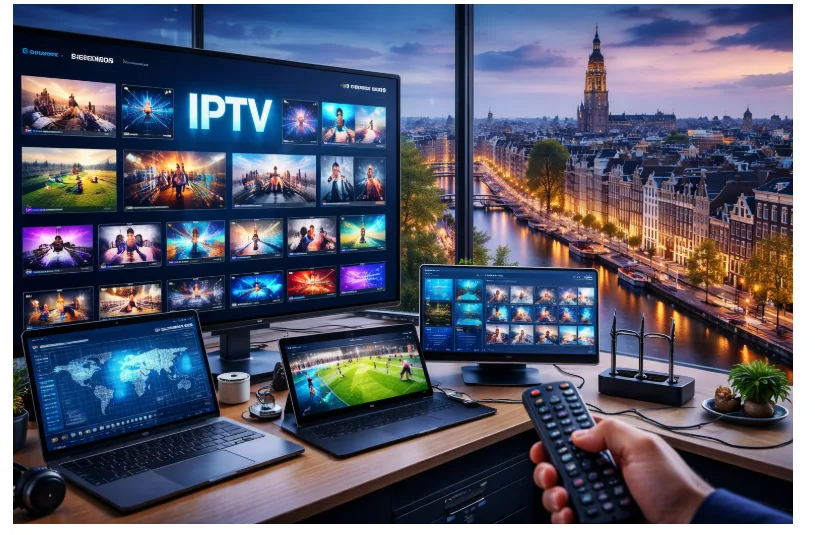
The European IPTV market in 2026 looks meaningfully different from how it looked even two years ago. What used to be a fragmented landscape of small, country-specific operators has gradually consolidated into a smaller number of professional cross-border brands operating across multiple European markets simultaneously. The pattern is most visible in operators that have established presences in both the UK and Continental Europe — running localised services tuned to each market’s specific channel preferences, payment methods, and customer expectations, while sharing back-end infrastructure that legacy single-market operators simply can’t match. One example worth examining is Rare Breed IPTV UK, which operates a UK-focused IPTV service alongside IPTV Nederland, the Dutch-focused arm of the same brand operating in the Netherlands and Belgium under the AndersLag name. The dual-market structure illustrates how the next generation of IPTV operators is approaching scale.
Why Multi-Market Operations Have Become the Norm
For most of the last decade, IPTV operators in Europe were small national affairs. A Dutch operator served the Dutch market with Dutch channels and Dutch customer support. A British operator served the British market with British channels and British customer support. The infrastructure each operated was sized to a single national customer base, which limited both the scale economies achievable and the technical sophistication that could be invested in stream quality, server distribution, and customer support.
That model has been steadily superseded since 2024 as the more ambitious operators have recognised that the core technical infrastructure — content acquisition relationships, CDN distribution, server capacity, app development — is largely the same regardless of which national channels are being delivered. What changes between markets is the channel lineup, the language of customer support, the payment methods accepted, and the specific cultural references that matter for branding and positioning.
This insight has driven a wave of consolidation. Single-market operators have either grown into multi-market structures or been acquired by larger operations capable of running localised services in multiple countries simultaneously. The result is a more professional industry, with better-funded infrastructure and the kind of customer service standards that legacy single-market operators struggled to maintain.
What This Looks Like in Practice
A modern multi-market IPTV operator typically maintains separate brands for each national market, each with its own website, customer support team, channel lineup, and payment processing. The underlying technical infrastructure — the CDN, the content acquisition relationships, the app development, the streaming quality optimisation — is shared across markets, which dramatically improves the economics of operation.
In the UK market, this means a Rare Breed-style operation provides the complete British channel lineup (BBC, ITV, Channel 4, Channel 5, Sky channels where licensed, TNT Sports), Premier League coverage including the international feeds that work around the 3pm Saturday blackout, and the kind of UK-specific customer support that British consumers expect. The pricing is calibrated to British market conditions, payment options include the standard UK payment methods, and the marketing is positioned against Sky and Virgin Media.
In the Dutch market, the same parent organisation operates a separate brand calibrated to Dutch conditions. AndersLag — which translates loosely to “Different Approach” — offers the complete Dutch channel lineup (NPO 1/2/3, RTL family, SBS6, Veronica, Net5), Belgian channels (the VRT family, VTM, Play series) given the geographic proximity, iDEAL payment as the Dutch standard, and Dutch-language customer support. The pricing is calibrated to Dutch market conditions, where cable competition from KPN, Ziggo, and Odido has slightly different dynamics than the UK Sky-Virgin duopoly.
What customers in each market actually experience is a properly localised service that feels purpose-built for their country — because in terms of customer-facing elements, it is. The shared back-end is invisible to the customer; what’s visible is a UK service that works like a UK service and a Dutch service that works like a Dutch service.
The Technical Sophistication That Multi-Market Scale Enables
The technical advantages of operating across multiple European markets simultaneously are substantial.
CDN distribution. A single-market UK operator can justify edge servers in maybe two or three British data centres. A multi-market operator running services in the UK, the Netherlands, Belgium, and other European countries can justify a much denser CDN footprint — edge servers across multiple European data centres, with intelligent traffic routing that delivers lower latency to all customers across all markets. The customer experience improvement is real and measurable.
Content acquisition. Negotiating with international rights holders and content providers becomes more efficient at scale. A multi-market operator can negotiate access to international channel feeds that would be uneconomic for a single-market operation to acquire. This translates directly into richer channel lineups for customers.
Application development. Building and maintaining IPTV apps across multiple platforms (Smart TVs, Fire TV, Apple TV, mobile, web) is a significant ongoing engineering investment. A multi-market operator amortises that investment across a larger customer base, which means the apps are typically better maintained, more frequently updated, and more reliably functional than single-market operators can sustain.
Customer support infrastructure. Running quality customer support teams in multiple languages is expensive. Multi-market operators can build proper support operations — staffed during local business hours, trained on local consumer expectations — in a way that single-market operations with smaller customer bases simply cannot afford.
Stream quality and reliability. The biggest customer complaint with smaller IPTV operators historically was reliability during peak hours. Multi-market operators with sophisticated infrastructure handle peak load — Saturday evening football across multiple European countries simultaneously — with anti-freeze technology and intelligent load balancing that single-market operators frequently struggle to match.
What This Means for Customers
For UK consumers, the practical implication is that the IPTV experience available in 2026 is meaningfully better than what was available in 2022. The leading operators offer Premier League coverage as comprehensive as anything available internationally, stream quality competitive with traditional cable, customer support responsive in the same range as legitimate streaming services, and pricing that genuinely undercuts Sky and Virgin Media without sacrificing the experience.
For Dutch consumers, the practical implication is similar — the leading operators offer comprehensive Dutch and Belgian channel coverage with international content depth that traditional providers like KPN, Ziggo, and Odido don’t match, payment options aligned with Dutch consumer expectations (iDEAL acceptance is essentially table stakes), and customer support that operates in proper Dutch rather than Google-translated approximations.
The cross-border brand model also has implications for trust and legitimacy. A single-market reseller operating from a back room of an unknown location is harder to evaluate than a multi-market operator with visible business operations, professional websites, and established reputations in multiple countries. The pattern resembles what happened with VPN services a decade ago — single-market operations gradually consolidated into a smaller number of multi-market brands that customers could evaluate more easily and trust more confidently.
The Broader Pattern: Cord-Cutting Is Going International
The rise of multi-market IPTV operators reflects a broader pattern in how cord-cutting is reshaping European television markets.
In the UK, the average household now spends £130-£160 per month on combined television and streaming services, with substantial dissatisfaction around Sky and Virgin Media pricing structures. Cord-cutting adoption has accelerated sharply since 2024, with Sky reporting subscriber declines across multiple recent quarters.
In the Netherlands, the same pattern is more advanced — Dutch household IPTV adoption is estimated to approach 30 percent, well above UK levels, driven by frustration with KPN, Ziggo, and Odido bundle pricing and a particularly strong Dutch cultural disposition toward consumer technology adoption.
In Belgium, similar patterns are playing out, with the added complication of the dual-language market (Flemish and French-speaking populations have somewhat different television preferences).
In France, Germany, Spain, Italy, and the Nordic countries, the same dynamics are visible at varying stages of maturity.
What ties all these markets together is the common underlying technical reality: broadband infrastructure has matured to the point where delivering high-quality live television over standard internet connections is straightforward, consumer hardware has matured to the point where any household television can be IPTV-capable, and consumer pricing pressure on legacy cable providers has created strong demand for alternatives.
The brands best positioned to capitalise on this transition are precisely the ones that can operate across multiple European markets simultaneously — leveraging shared infrastructure investment to deliver localised experiences at scale.
What to Watch For
For consumers evaluating IPTV services in 2026, several characteristics distinguish the more sophisticated multi-market operators from less sophisticated single-market alternatives.
Visible business operations. Modern operators have proper websites, transparent business information, professional branding, and visible customer support channels. The Telegram-only operators selling subscriptions through messaging apps are a different category entirely.
Multi-platform application support. Quality operators support all major device categories — Smart TVs across Samsung, LG, Sony, Philips, and other manufacturers; streaming devices including Fire TV and Chromecast; Apple platforms including Apple TV, iPhone, and iPad; and Android devices across phones, tablets, and Android TV boxes.
Standard payment methods. Legitimate operators accept the payment methods that work in their specific market. In the UK, that’s debit and credit cards and PayPal. In the Netherlands, that’s iDEAL alongside cards. Crypto-only providers are generally signals to walk away.
Customer support responsiveness. Sending a quick question to a provider before signing up reveals enormous amounts about what the experience will be six months in. Quality operators respond quickly, in proper local language, with substantive answers.
Free trials with no payment commitment. Any operator confident in their service will let prospective customers test it before paying. Operators requiring full payment before allowing any testing are typically the ones with the most to hide.
Where This Trajectory Points
The European IPTV market in 2026 is in the middle of a consolidation that’s likely to continue for several more years. The smaller single-market operators will continue to lose ground to the multi-market brands with better infrastructure and more sophisticated operations. The legacy cable providers (Sky, Virgin Media in the UK; KPN, Ziggo, Odido in the Netherlands) will continue to face structural pressure on their subscriber bases, with varying degrees of strategic adaptation.
By 2028 or 2029, the European IPTV landscape is likely to be dominated by a smaller number of professional multi-market brands offering comparable services across multiple national markets with localised channel lineups, customer support, and pricing. The pattern resembles what happened with streaming services like Netflix, Spotify, and various VPN providers — single-market operations gradually consolidating into international brands with proper scale economics.
For consumers, this is broadly positive. Better service quality, more competitive pricing, more sophisticated customer support, and more reliable infrastructure are the outcomes of professional industry consolidation. The transitional period — where customers are figuring out which providers are legitimate and which aren’t — is the awkward part, but that period is gradually resolving as the better operators emerge as recognised brands.
What’s happening in British and Dutch living rooms in 2026 is, in this broader context, the early stage of a transition that will gradually reshape how Europeans consume television over the next decade. The multi-market brands that have positioned themselves well for this transition are likely to be the ones that define the next era of European pay television.