As businesses accelerate their digital transformation initiatives, choosing the right data management technology has become one of the most critical decisions in application development. Whether you’re building a fintech platform, healthcare application, supply chain solution, or enterprise software, the debate often comes down to blockchain vs traditional databases.
While both technologies are designed to store, retrieve, and manage data, they serve fundamentally different purposes. Understanding their strengths, limitations, and ideal use cases can help businesses make informed technology decisions and maximize their return on investment.
In this article, we’ll compare blockchain and traditional databases across multiple parameters to help you determine which is the better choice for your custom application.
Understanding Traditional Databases
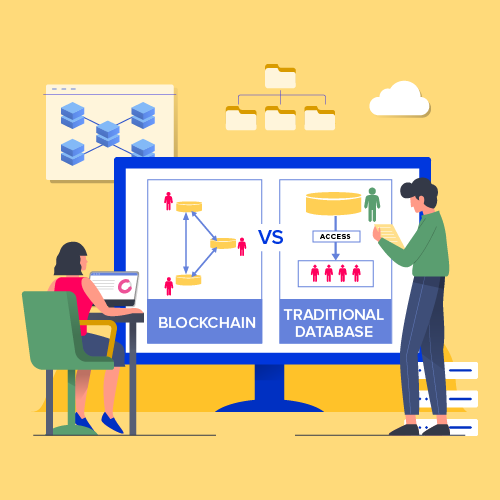
Traditional databases have powered software applications for decades. They are centralized systems where a single organization controls the data, permissions, and operations.
Popular database technologies include:
- MySQL
- PostgreSQL
- Microsoft SQL Server
- Oracle Database
- MongoDB
- Firebase
These databases are designed to provide fast performance, efficient querying, and high scalability for everyday business operations.
Key Characteristics
- Centralized architecture
- Fast read/write operations
- Flexible data modifications
- Cost-effective infrastructure
- Mature ecosystem and extensive developer support
Traditional databases remain the preferred choice for most web and mobile applications because they deliver exceptional performance with lower operational complexity.
Understanding Blockchain
Blockchain is a decentralized ledger technology where data is stored across multiple distributed nodes instead of a central server. Every transaction is cryptographically verified and added as an immutable block.
Unlike traditional databases, blockchain emphasizes transparency, security, trust, and data integrity.
Popular blockchain platforms include:
- Ethereum
- Hyperledger Fabric
- Polygon
- Solana
- Avalanche
- BNB Chain
Organizations investing in blockchain app development services leverage blockchain to eliminate intermediaries, improve traceability, and create tamper-proof digital records.
Blockchain vs Traditional Databases: Key Differences
1. Data Ownership
Traditional Database
One organization owns and manages the database. Users trust the organization to maintain data integrity.
Examples include:
- Banking systems
- CRM software
- ERP platforms
- HR management systems
Blockchain
Ownership is distributed among network participants. No single party has complete control over the ledger.
This decentralized model reduces dependency on a central authority and increases trust among participants.
2. Data Immutability
Traditional databases allow administrators to modify, delete, or update records whenever necessary.
Blockchain records, however, are immutable.
Once a transaction is confirmed and added to the blockchain, it cannot be altered without network consensus.
This makes blockchain particularly valuable for applications requiring permanent audit trails.
Examples include:
- Medical records
- Property ownership
- Financial transactions
- Digital certificates
3. Security
Traditional databases rely on:
- Firewalls
- Authentication
- Access controls
- Backup systems
While these security measures are highly effective, centralized systems remain vulnerable to insider threats or single points of failure.
Blockchain enhances security using:
- Cryptographic hashing
- Distributed consensus
- Digital signatures
- Decentralized storage
Because every participant validates transactions, unauthorized modifications become significantly more difficult.
4. Performance
Traditional databases are considerably faster.
Modern SQL databases can process thousands or even millions of transactions per second depending on infrastructure.
Blockchain networks require transaction validation across multiple nodes.
As a result:
- Transaction speed is slower
- Confirmation times may vary
- Network congestion affects performance
For applications requiring real-time processing, traditional databases often outperform blockchain.
5. Scalability
Scaling traditional databases is relatively straightforward.
Organizations can:
- Upgrade servers
- Add replicas
- Implement sharding
- Use cloud infrastructure
Blockchain scalability remains an active area of innovation.
Layer-2 solutions, sidechains, and newer consensus mechanisms continue improving transaction throughput, but scalability challenges still exist for many public blockchains.
6. Transparency
Traditional databases restrict visibility based on user roles.
Blockchain offers transparent transaction histories that authorized participants can verify independently.
This transparency benefits industries where trust and accountability are essential.
Examples include:
- Supply chain management
- Government services
- Charity donations
- Food traceability
7. Cost
Traditional databases generally have lower implementation and maintenance costs.
Blockchain solutions may involve:
- Smart contract development
- Node infrastructure
- Security audits
- Gas fees
- Ongoing protocol maintenance
Although blockchain can reduce intermediary costs over time, the initial investment is often higher.
When Should You Choose a Traditional Database?
Traditional databases are ideal when your application requires:
- High-speed transactions
- Frequent data updates
- Centralized administration
- Low operational costs
- Complex reporting
- Real-time analytics
Examples include:
- E-commerce platforms
- Social media applications
- Food delivery apps
- Banking portals
- Customer relationship management (CRM)
- Inventory management systems
Businesses offering custom mobile app development services often recommend traditional databases for applications where performance, scalability, and user experience are the highest priorities.
When Should You Choose Blockchain?
Blockchain becomes the better choice when trust, transparency, and data integrity are more important than processing speed.
Ideal applications include:
Supply Chain Management
Every shipment can be tracked from manufacturer to customer with immutable records.
Healthcare
Patient records remain secure while allowing authorized providers to verify medical histories.
Financial Services
Blockchain enables secure peer-to-peer payments, cross-border transfers, and decentralized finance (DeFi) applications.
Digital Identity
Users maintain control of their digital identities without relying entirely on centralized authorities.
Asset Tokenization
Businesses can tokenize real estate, artwork, securities, or intellectual property.
Smart Contracts
Automated agreements execute when predefined conditions are met, reducing manual intervention and improving efficiency.
Can Blockchain and Traditional Databases Work Together?
Absolutely.
Many modern enterprise applications adopt a hybrid architecture that combines the strengths of both technologies.
For example:
Traditional Database stores:
- User profiles
- Product catalogues
- Application settings
- Search indexes
- Analytics
Blockchain stores:
- Financial transactions
- Smart contracts
- Ownership records
- Audit logs
- Digital signatures
This hybrid approach delivers the performance of centralized databases while benefiting from blockchain’s transparency and immutability.
Factors to Consider Before Choosing
Before selecting your application’s data architecture, ask the following questions:
- Do multiple organizations need shared access to the same data?
- Is tamper-proof record keeping essential?
- Are regulatory compliance and audit trails required?
- Does the application process thousands of transactions every second?
- Will users benefit from decentralized trust?
- Is data privacy more important than transparency?
- What is your long-term scalability strategy?
- What is your available development budget?
Answering these questions will help determine whether blockchain, a traditional database, or a hybrid solution best fits your project.
Future Trends
As blockchain technology continues to mature, businesses are increasingly integrating it with artificial intelligence, IoT, cloud computing, and mobile applications.
Emerging innovations include:
- Enterprise blockchain platforms
- Zero-knowledge proofs for enhanced privacy
- Blockchain interoperability
- Decentralized identity systems
- AI-powered smart contracts
- Blockchain-as-a-Service (BaaS)
Rather than replacing traditional databases, blockchain is becoming a complementary technology that addresses use cases where trust, transparency, and immutable records are critical.
Conclusion
The choice between blockchain and traditional databases isn’t about determining which technology is universally better—it’s about selecting the right solution for your business objectives.
Traditional databases remain the best option for applications that demand high performance, rapid data processing, and centralized management. On the other hand, blockchain excels in scenarios where security, decentralization, transparency, and immutable records are essential.
For many organisations, a hybrid architecture delivers the best of both worlds by combining the speed and flexibility of traditional databases with the trust and integrity of blockchain technology.
Partnering with an experienced development team can help you evaluate your business requirements, design the right architecture, and build scalable digital solutions. Whether you need custom mobile app development services for high-performance applications or specialised blockchain app development services for secure decentralized platforms, choosing the appropriate technology foundation will play a crucial role in your application’s long-term success.