Every year, someone declares Facebook “dead.” Every year, the platform proves them wrong. In 2026, Facebook still commands well over 3 billion monthly active users and roughly 2.1 billion people who log in every single day, a daily engagement ratio most platforms can only dream of. So the real question isn’t whether Facebook is alive. It’s whether marketing on Facebook still delivers results, and if so, how to actually do it right in an environment reshaped by AI-driven feeds, short-form video, and a very different algorithm than the one marketers grew up with.
This guide breaks down where Facebook marketing stands today, why it still matters, how the algorithm actually works, how Facebook compares to other platforms, and a practical, step-by-step approach to building a strategy that works in 2026 not 2016.
The State of Facebook Marketing Today
Facebook is no longer a simple newsfeed of status updates and links. It has evolved into a multi-layered ecosystem combining a social feed, a short-video engine (Reels), a marketplace, community groups, and one of the most sophisticated ad-targeting systems on the internet. Meta’s family of apps now reaches billions of daily active people, and Facebook alone continues to add users, particularly across older demographics and emerging markets in Asia, Africa, and Latin America.
What has genuinely changed is how success is measured. Organic reach on Facebook Pages has been declining for years and now sits in the low single digits of a Page’s follower count. But that decline doesn’t mean the platform stopped working, it means the tactics that worked in 2016 stopped working. Reach today is driven far more by content quality, video watch-time, and community engagement (especially inside Facebook Groups) than by follower count alone.
Is Facebook Marketing Still Relevant and Effective?
Yes and the data backs it up. Despite constant comparisons to TikTok and Instagram, the majority of marketers report plans to maintain or increase their Facebook ad investment, not cut it. Nearly 40% of social media users say they use Facebook specifically to discover new products, meaning people aren’t just scrolling passively they’re actively shopping. Facebook also remains the leading social news source for many audiences and one of the most cost-efficient large-scale advertising platforms available, with average CPCs and CPMs that are often lower than Instagram or LinkedIn for comparable reach.
The platform’s relevance today comes down to scale plus intent. No other single platform puts a brand in front of billions of active users who are also actively browsing, searching, and buying particularly through Marketplace, Groups, and increasingly AI-curated Reels recommendations that surface content to people who don’t even follow the page yet.
Why Use Facebook for Social Media Marketing?
There are a few reasons Facebook remains a core channel rather than a legacy one:
- Unmatched audience scale. Few platforms can match Facebook’s global reach across nearly every age group, country, and income level.
- Precision targeting. Meta’s ad platform allows granular targeting by interest, behavior, location, and lookalike audiences built from existing customers.
- Multiple entry points. Feed posts, Reels, Groups, Marketplace, and Messenger all offer distinct ways to reach and convert an audience, not just one feed.
- Strong ROI potential. Compared to many alternatives, Facebook advertising still offers a relatively low cost per click and cost per thousand impressions, especially outside highly competitive industries like finance.
- Trust and longevity. Facebook has existed for two decades. For many consumers, especially those over 35, it’s still the platform they check daily and trust for reviews, recommendations, and local business discovery.
What Is Facebook’s Core Marketing Strategy?
Facebook’s own business model shapes what works for advertisers. Meta makes money by keeping people on-platform and by selling attention through ads which is why organic, link-heavy posts pointing users off Facebook tend to get suppressed, while content that keeps users watching, commenting, and sharing gets rewarded.
In practice, this means Facebook’s algorithm has shifted toward what Meta calls “Meaningful Social Interactions” genuine comments, shares (especially private shares to Messenger or Stories), and saves are weighted far more heavily than simple likes. The ranking system works in four stages: it builds an inventory of possible content for a user, gathers signals about their likely interest, predicts how they’ll respond, and then assigns a relevance score that determines what actually appears in their feed. Roughly half of what people see in their Feed today comes from accounts they don’t even follow, meaning small businesses genuinely can be discovered by strangers if their content performs well, not just by paying for reach.
Platform Comparisons & Strategy
Which Social Media Platforms Are Best for Marketing? (Facebook vs. The Rest)
No single platform is universally “best” ; it depends on the audience and the goal. Here’s how Facebook stacks up:
- Facebook vs. Instagram: These two share the same ad infrastructure and roughly 80% audience overlap, but they serve different purposes. Instagram leans younger and more visual/aspirational; Facebook skews slightly older and performs better for community-building, local business discovery, and Marketplace-driven commerce.
- Facebook vs. TikTok: TikTok dominates pure short-form entertainment and trend velocity, especially with Gen Z. Facebook has responded by pushing Reels hard, and Facebook Reels now drive a large share of total time spent on the platform but TikTok still generally wins on raw virality among younger users.
- Facebook vs. LinkedIn: For B2B marketing, LinkedIn typically outperforms Facebook on lead quality. For B2C, local services, and community-driven brands, Facebook usually wins.
- Facebook vs. X (Twitter): X remains stronger for real-time commentary and news-cycle engagement; Facebook offers far greater audience scale and significantly more mature ad-targeting tools.
The practical takeaway: Facebook rarely needs to be chosen instead of another platform; it usually works best as the reliable, high-scale anchor in a broader cross-platform strategy, particularly because of its Marketplace and Groups ecosystems, which have no true equivalent elsewhere.
How to Succeed with Facebook Marketing
How to Do Social Media Marketing on Facebook: Step-by-Step
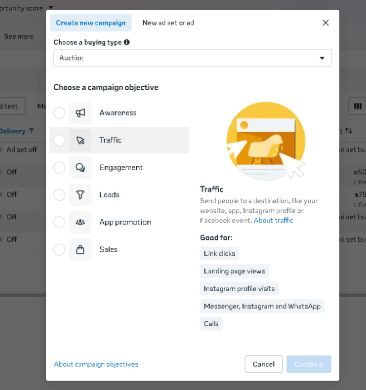
- Define one clear objective per campaign. Awareness, traffic, leads, or sales trying to do all four at once with the same content dilutes performance.
- Optimize the Page and pin key content. A complete profile, clear “About” section, and pinned offer or explainer post reduces friction for new visitors.
- Prioritize Reels. Short-form vertical video is currently the strongest lever for organic discovery, since it’s distributed to non-followers far more aggressively than static posts.
- Post consistently with topic focus. Facebook’s algorithm scans recent posting history to understand what a Page is “about.” Bouncing between unrelated topics weakens how confidently the algorithm recommends your content.
- Engage inside Groups, not just on your Page. Groups routinely see organic reach many times higher than Pages of a comparable size, because Meta treats them as higher-trust, higher-intent spaces.
- Respond quickly to comments. Fast, genuine replies in the first hour after posting are treated as a strong relevance signal.
- Layer paid promotion on top of proven organic content. Boosting a post that’s already performing organically is far more efficient than buying reach for untested content.
- Track the metrics that matter. Watch-time, saves, shares, and click-through to a landing page tell a much clearer ROI story than likes alone.
Executing this consistently takes real time and specialized knowledge of Meta’s ad tools, audience segmentation, and creative testing which is exactly why many businesses choose to work with a dedicated agency rather than manage it in-house. Teams like Kiryatech’s Facebook marketing service handle strategy, ad management, and content optimization so business owners can focus on running the business itself rather than chasing algorithm changes.
How Does Facebook Marketing Work for Business?
For most businesses, Facebook marketing operates on two tracks that reinforce each other. The organic track builds trust and community through Page content, Reels, and Group participation; it’s slower but compounds over time and costs nothing but effort. The paid track uses Meta Ads Manager to run highly targeted campaigns based on demographics, interests, past website behavior, and lookalike audiences modeled on existing customers.
The two tracks work best together: organic content builds the audience and social proof (reviews, comments, shares) that make paid ads more credible and lower-cost, while paid ads accelerate reach for a business’s best-performing organic content and drive it in front of new, relevant audiences faster than organic growth alone ever could.
Can Facebook Marketplace Be Considered Social Media Marketing?
Yes, and it’s an increasingly important piece of the puzzle. Facebook Marketplace has grown into one of the largest commerce platforms in the world, used by well over a billion people monthly to browse and buy. While it started as a peer-to-peer classifieds tool, businesses now use Marketplace listings, Facebook Shops, and shoppable posts to reach high-intent buyers who are actively searching for products, not just scrolling.
Because Marketplace activity happens inside the same ecosystem as Pages, Groups, and Reels, it counts as a genuine social commerce channel. A well-optimized product listing can surface in front of local buyers with strong purchase intent, making it a valuable, often underused extension of a broader Facebook marketing strategy especially for local businesses, retailers, and service providers.
Facebook marketing hasn’t declined, it has changed. The brands still winning on the platform in 2026 are the ones that understand its shift toward video, community, and genuine engagement, and that treat Facebook not as a broadcast channel but as an ecosystem worth investing in properly.
Why Facebook Advertising is Crucial for Modern Small Businesses?
In today’s digital landscape, small businesses face immense competition when trying to reach their target audience. Traditional advertising methods are no longer enough to sustain growth. To scale effectively, building a solid presence on social media platforms is essential. Among all available options, Facebook advertising remains one of the most powerful tools for generating consistent leads and increasing brand awareness.
Facebook’s advanced targeting capabilities allow businesses to pinpoint their ideal customers based on demographics, interests, behaviors, and geographic location. This ensures that your marketing budget is spent on users who are genuinely interested in your services. However, managing a successful campaign requires expertise in pixel tracking, budget optimization, and custom conversions. For businesses looking to maximize their return on investment, relying on professional assistance can make a massive difference. You can explore specialized strategies and high-converting campaigns by visiting https://kiryatech.com/services/facebook-marketing/ to scale your social media performance.
Ultimately, social media marketing is not just about getting likes; it is about creating a predictable funnel that converts casual browsers into paying clients. Investing in professional campaign architecture is the fastest way to achieve long-term digital growth.