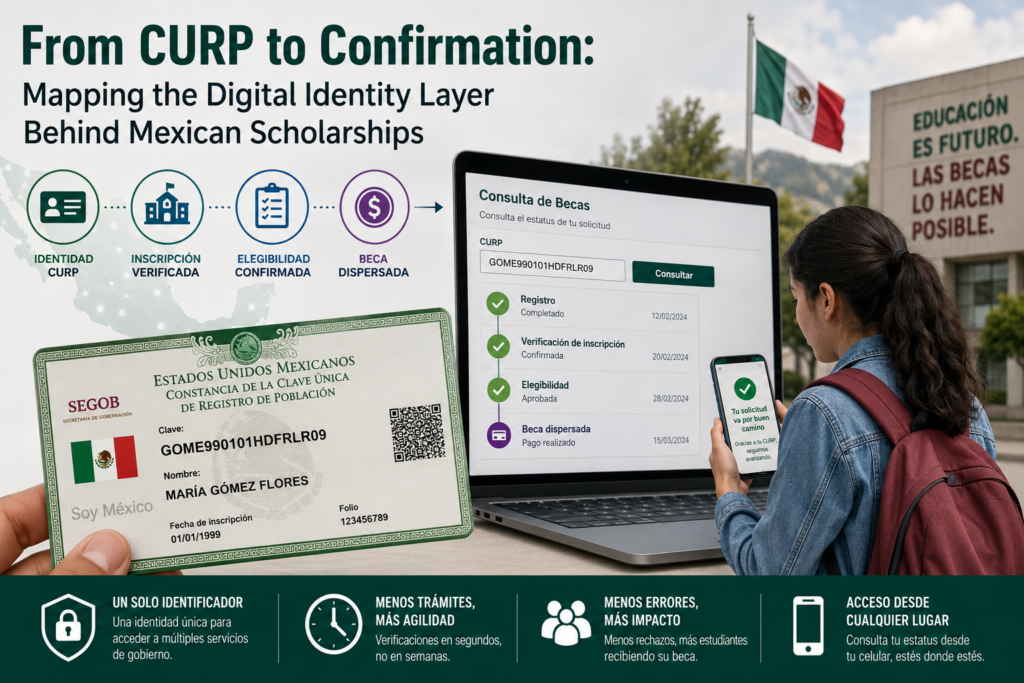
Every scholarship application in Mexico, no matter which program it falls under, eventually runs through the same eighteen-character string: the CURP. It’s easy to overlook because it’s just a code, printed on a card or typed into a form, but it’s quietly become the backbone of how the government verifies who actually qualifies for financial aid. Understanding how that single identifier connects to everything from enrollment records to payment confirmation explains a lot about why Mexico’s scholarship system works the way it does today.
For readers unfamiliar with it, the CURP (Clave Única de Registro de Población) is Mexico’s unique population registry code, assigned to every citizen and resident at birth or upon registration. It’s used across nearly every interaction with the government, from school enrollment to tax records to, increasingly, scholarship verification. What used to be a simple ID number has evolved into the connective layer that lets different government databases talk to each other without requiring a student to manually prove the same facts over and over again.
Why Identity Verification Became the Bottleneck
Before this system matured, scholarship fraud and duplication were real problems. Students could, intentionally or not, apply for the same benefit through different offices, or families could submit incomplete documentation that took weeks to manually cross-check against school records. The CURP solved a structural problem: it gave every applicant a single, unambiguous identity that could be checked against enrollment data, household income records, and prior aid history in seconds rather than weeks.
This is also where access matters. Not every applicant has their CURP card on hand, or knows their exact code, especially younger students applying for the first time without a parent walking them through it. That’s part of why services offering curp gratis lookups have become so widely used. A student can retrieve their CURP for free, instantly, without needing to track down a physical card or visit an office, which removes one of the most common points of friction at the very start of the application process.
From Identity to Application Status
Once a CURP is on file, it becomes the thread that runs through the rest of the scholarship process. Enrollment is verified against it, eligibility checks reference it, and payment disbursement is tied to it. This is also why status-checking has become so much faster than it used to be. Where students once had no reliable way to track an application beyond waiting for a letter or a phone call, the CURP now functions as a kind of master key for checking progress at any stage.
This shift didn’t happen by accident. It reflects a broader move in Mexican GovTech toward identity-first infrastructure, where a single verified data point unlocks access to multiple services instead of each program building its own siloed verification system from scratch. Programs like Beca Rita Cetina rely on this same identity layer, using CURP-linked records to confirm eligibility and avoid the duplication issues that plagued earlier, paper-based scholarship cycles.
Why Consulta CURP Matters More Than It Looks
For most students, the practical entry point into this entire system isn’t a government dashboard or an administrative portal. It’s a simple consulta curp search, used to confirm that their identity record matches what’s on file before submitting an application. It sounds like a small, mundane step, but a mismatch here, a misspelled name, a wrong birthdate, a transposed digit, can quietly derail an entire application before it’s even reviewed.
That’s the quiet value of these consultation tools: they catch problems early, when they’re easy to fix, instead of letting them surface weeks later as a rejected application with no clear explanation. For a system handling applications at national scale, giving students an easy way to self-verify before submission meaningfully reduces the volume of administrative back-and-forth that used to clog up the process.
A Layer Most Students Never Think About
What’s notable about this whole system is how invisible it’s designed to be. A student applying for a scholarship today doesn’t need to understand database architecture or government data-sharing agreements. They just need their CURP to be correct and verified, and the rest of the process, enrollment confirmation, eligibility checks, payment tracking, happens largely behind the scenes.
That invisibility is, in a way, the whole point. Good infrastructure tends to disappear into the background once it works. The CURP isn’t flashy, and most students will never think about it beyond the few seconds it takes to type it into a form. But it’s the reason a national scholarship program can serve millions of applicants without collapsing under its own paperwork, and the reason a 17-year-old in a rural state can check their application status from a phone instead of standing in line at an office two hours away.
Conclusion
As Mexico continues expanding programs like Beca Rita Cetina, the strength of that identity layer, and the tools that make it accessible, will matter just as much as the funding itself. A scholarship is only as good as a student’s ability to actually receive it, and increasingly, that ability starts with eighteen characters most people never stop to think about.