Applying for a government scholarship in Mexico meant something closer to an obstacle course for years than a simple application process . Students stood in long lines at local education offices, carried stacks of photocopied documents from one window to another, and often had no real way of knowing whether their paperwork had even been received, let alone approved. A missed signature or a misplaced form could mean months of delay, and for families relying on that aid to keep a child in school, months matter.
That picture is changing. Mexico’s education authorities have spent the last few years building centralized digital portals that bring scholarship applications, status checks, and payment tracking into a single online system. The shift isn’t just a convenience upgrade. It’s a structural change in how the government delivers financial aid, and it says a lot about where public education funding is headed across Latin America.
Beca Rita Cetina as a Test Case
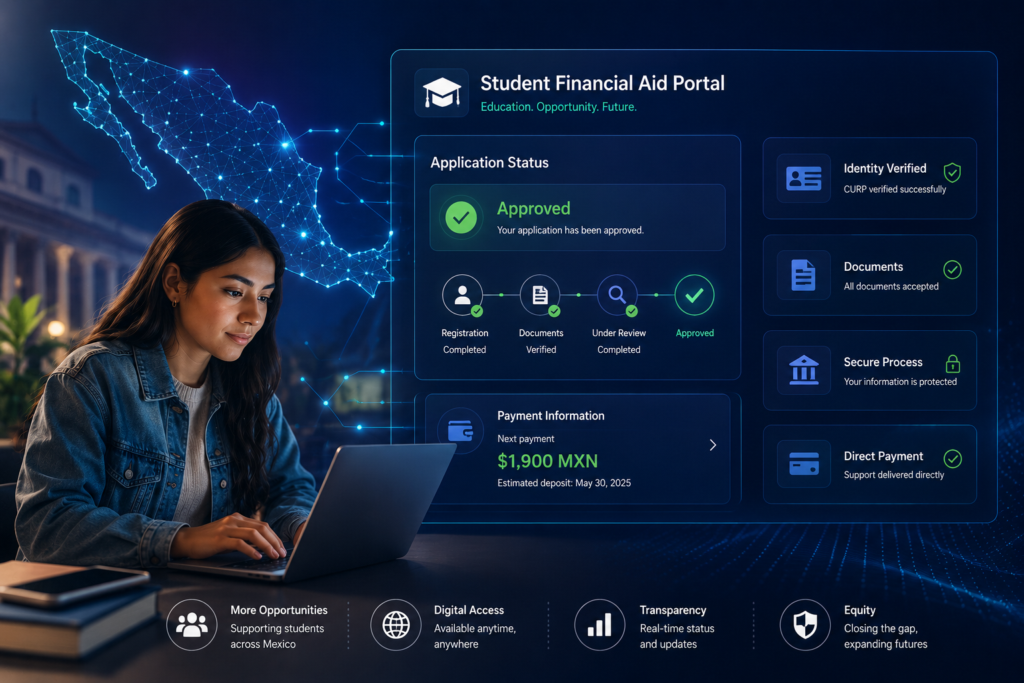
One of the clearest examples of this shift is the Beca Rita Cetina scholarship platform, a program designed to extend financial support to students who might otherwise drop out due to cost. What makes it notable from a technology standpoint isn’t just the funding itself, but how the program is administered. Instead of relying on physical offices as the primary touchpoint, the platform pushes applicants toward a digital workflow: register online, submit documentation digitally, and track status through the same portal rather than chasing down information in person.
This matters because scholarship dropout isn’t only caused by financial need. A meaningful share of students who qualify for aid never receive it simply because they lose track of the process, miss a deadline buried in a confusing system, or give up after an in-person visit goes nowhere. A centralized, trackable system directly addresses that failure point, and early adoption numbers around Beca Rita Cetina suggest the government is treating this as a long-term infrastructure investment rather than a temporary fix.
Why Centralization Was Necessary
Mexico runs several large-scale scholarship programs, and historically each one operated with its own forms, its own offices, and its own informal tracking methods. A student applying for more than one benefit might have to repeat the same verification process multiple times, submitting identical documents to different desks that didn’t talk to each other.
Centralized portals solve this by creating a single point of entry. A student’s CURP (the national identity code), school enrollment records, and household data can be cross-checked automatically instead of manually re-entered at every stage. This single change removes a huge amount of friction, not just for students but for the administrators processing thousands of applications during enrollment periods.
It also opens the door to something that used to be almost impossible: a student being able to check, in real time, exactly where their application stands. Instead of a phone call, a visit, or simply waiting and hoping, applicants can now get an answer in seconds.
Closing the Gap Between Applying and Knowing
Even with a stronger backend, government portals are often built for compliance first and usability second. They were designed to satisfy auditors and data requirements, not necessarily to give an 18-year-old a fast, clear answer about their own application. That gap is exactly where independent status-checking tools, like buscador de estatus, have found a role. A student can plug in basic identifying details and immediately see whether their file is under review, approved, or flagged for missing documentation, without wading through a government site that wasn’t built with them in mind.
What’s Actually Happening Behind the Scenes
These portals aren’t just a prettier front end bolted onto the old paperwork process. They represent a genuine shift toward GovTech infrastructure: identity verification tied to national ID systems, status databases that update in near real time, and dashboards that give both students and administrators visibility into where bottlenecks are occurring.
For students in rural or low-connectivity areas, the practical impact is still uneven. Centralized portals assume a baseline level of internet access and digital literacy that not every household has, and the government’s broader challenge is making sure these systems don’t end up benefiting only students who were already digitally connected. But the direction is clear: rather than scaling up physical infrastructure (more offices, more staff, more paper), Mexico is scaling digital infrastructure that can serve far more applicants without a proportional increase in administrative overhead.
Why This Is a Bigger Story Than Mexico
Education subsidy systems across emerging markets face the same core problem: how do you verify millions of applicants fairly, quickly, and without overwhelming bureaucracy. Mexico’s approach, centralizing identity verification, application tracking, and disbursement into a connected digital layer, offers a working model that other countries in the region are watching closely.
What stands out is the role of independent status-checking tools sitting alongside official government platforms, giving students a fast, no-friction way to check their application progress without navigating a government website that wasn’t built with usability in mind. That gap between official infrastructure and practical user need is exactly where this kind of technology becomes essential, not as a replacement for government systems, but as a layer that makes them actually usable for the people they’re meant to serve.
Conclusion
As Mexico continues rolling out programs like Beca Rita Cetina, the real test won’t just be how much funding gets distributed. It will be whether the digital infrastructure behind it can close the gap between eligibility and access, the gap that has quietly pushed students out of school long before money ever entered the equation.