There is a particular kind of entrepreneur that business schools do not produce. They are not found in venture capital pitch decks or on the guest lists of industry conferences. They emerge, instead, from necessity — from the specific hunger that comes from having nothing to fall back on and nowhere to retreat.
Evan Rama is 21 years old. He has no degree, no outside investment, and has spent nothing on advertising. And yet, by almost any measure that matters in the modern attention economy, he has built something that most funded startups spend years and millions of pounds trying to manufacture: a genuine audience. Three hundred million of them, in fact.
Rama had arrived at the University of Texas at Austin with no established connections, no family legacy in business, and no obvious advantage. He was, by his own account, simply another student in a large institution — one face among tens of thousands. Rather than wait for circumstance to change that, he decided to manufacture his own visibility.
The dormitory where he lived during his first year was called Jester Hall. The name, he would later say, felt like an instruction. He acquired a full jester costume and began wearing it around campus — not as a stunt, not as a marketing exercise with a defined objective, but as a sustained, deliberate effort to become known. He handed out flyers. He stopped strangers. He was, for months, the person people pointed at. Each flyer contained a QR code linked to his first planned event.
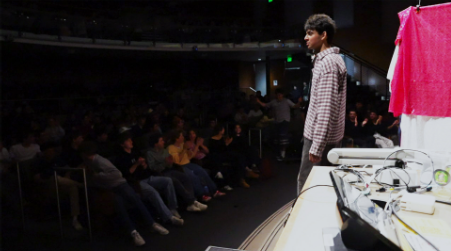
To fund the production costs of that show, Rama worked as a food delivery driver entirely on foot, covering more than 100 miles around campus and reinvesting every pound earned directly back into the event. There was no safety net. If the show failed, there was nothing to absorb the loss.
It did not fail. More than 400 students attended. The show sold out completely. Footage from the night spread across TikTok with a velocity that neither Rama nor anyone around him had anticipated, accumulating 15 million views in the days that followed and introducing his name to an audience that extended far beyond a single university campus.
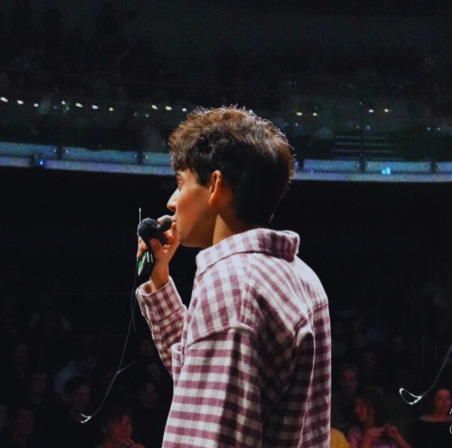
What followed was a rapid and methodical expansion. Kupid, the live entertainment platform Rama built around a comedy dating show format, embarked on two touring cycles visiting more than 25 universities, with every scheduled performance selling out. Combined live attendance across both tours exceeded 15,000 students. The company distributed more than £16,000 in cash giveaways to audiences along the way — a practice Rama has consistently described not as a promotional device but as an expression of what he believes live entertainment should fundamentally be.
The commercial model underpinning the tours is as deliberate as it is effective. Every attendee is required to download the Kupid mobile application to access their ticket, converting each sold-out venue into a low-cost user acquisition event. Shows are simultaneously livestreamed through the app, extending each performance to an audience far beyond the physical room. The cumulative social media reach of Kupid’s content has now surpassed 300 million views across TikTok and Instagram — achieved without a single pound spent on paid promotion.
Corporate sponsors including Opill, Fetii, Easel AI, and Pinyada came on board as the business gained traction, lending credibility to a venture that had until that point been entirely self-funded. Rama left university in 2026 to run the company full-time and has since assembled a full executive leadership team, having operated independently through its most formative and precarious early stages.
His story has drawn coverage from outlets including Fox News, The Daily Texan, and Washington Square News, as well as entrepreneurship publications on both sides of the Atlantic.
At its core, the idea driving Kupid is a straightforward one. Modern audiences, Rama argues, do not want to watch. They want to participate. The passive consumption model that has defined digital entertainment since the rise of streaming is, in his view, a ceiling rather than a standard — and live events, built around interaction and genuine unpredictability, offer something no algorithm can reliably replicate.
“I want people who feel overlooked — who think they don’t have some special edge or background — to realise that none of that matters as much as they think it does,” Rama said. “You don’t need to have everything figured out. You just need to take the shot.”
That audience of 300 million, it should be noted, found him. He did not buy it, did not manufacture it, and did not inherit it. He walked for it, in a jester costume, one flyer at a time.