Enterprise software has never been more distributed. The global microservices architecture market reached $6.27 billion in 2024, on a path to nearly $16 billion by 2029, as organizations broke monolithic systems into hundreds of independent services in pursuit of speed and scalability. The same research tracking that adoption found that microservices penetration across enterprises climbed from 33% in 2020 to 76% by 2024. That is a fast shift. The engineering tooling required to manage it has not moved at the same pace. Production incidents are harder to trace, institutional knowledge is harder to locate, and the cognitive load on engineers diagnosing a failure in a distributed system has grown substantially. The tools most organizations still use for that work were designed for a simpler era.
Sandeep Kanaparthi is a Principal Software Engineer and Head of Cloud Engineering with over 14 years of experience modernizing enterprise infrastructure and building AI-enabled engineering systems in highly regulated environments. He has led the cloud-native migration of more than 45 enterprise applications, architected DevSecOps platforms spanning multiple engineering organizations, and designed AI-driven platforms that integrate large language models directly into engineering workflows to help teams understand complex systems and resolve issues faster. Kanaparthi focuses on the often-overlooked gap between the systems organizations build and the tools they use to keep them running.
Complexity Is Scaling Faster Than the Tools Designed to Manage It
A distributed system with 200 services is not just harder to debug than a monolith. It is categorically different. Research across 247 production environments found that organizations prioritizing observability from the start experience 89.6% fewer critical production incidents and maintain dramatically lower mean time to resolution compared to those that treat observability as an afterthought. The gap is not marginal. Yet most engineering organizations still operate with tooling that was designed around the assumption that a developer could hold the relevant system in their head. At scale, that assumption collapses. A senior engineer who has spent three years on one service does not carry a working map of every upstream dependency, every runbook, every recent configuration change across the full system. Nobody does.
The tools responding to this shift have mostly added more dashboards. More metrics. More alerts. The result is an information environment that is simultaneously overwhelming and incomplete. Teams have more data than they can process and less context than they need. What they actually require when something goes wrong is not more charts but faster access to the right slice of knowledge: what changed, where the system is behaving outside its normal bounds, what the runbook says to do, who last touched this service, what the architecture looks like for this dependency chain. That is a retrieval problem disguised as an observability problem, and it is one that traditional tooling does not address.
“The tooling problem in large engineering organizations is not that teams lack data,” Kanaparthi says. “It is that the data is fragmented across too many systems to be useful when it is needed most. You are searching through wikis, Slack threads, runbooks, and code comments while an incident is active. That is the wrong time to be searching.”
The Knowledge Silo Problem Nobody Measures
75% of engineers now use AI coding tools. According to Faros AI’s research tracking over 10,000 developers across 1,255 teams, most organizations are not seeing measurable gains at the team or delivery level. The individual output goes up. The system-level outcomes do not follow. One of the reasons that gap persists is that the productivity benefits of AI are concentrated in tasks where the information needed to do the work is already in front of the engineer. When the bottleneck is finding the right information in the first place, adding a code completion tool does not help. It speeds up the wrong part of the process.
Knowledge silos in engineering organizations are structural. They form because different teams own different services, document things differently, store context in different places, and accumulate institutional knowledge in the heads of individuals rather than in any retrievable system. When a new engineer joins a complex distributed platform, they spend months building a mental model that experienced engineers carry implicitly. When a senior engineer leaves, that model goes with them. The pattern is familiar to anyone who has worked in a large engineering organization, and it gets worse as systems grow. More services means more ownership boundaries, more documentation gaps, and more scattered context. None of the standard tooling for logging, monitoring, or incident management addresses this directly.
“Every large engineering organization has the same problem,” Kanaparthi reflects. “The knowledge that would help someone debug faster or understand a system better exists somewhere in the organization. It is in a Confluence page that nobody has updated in eight months, in a Slack thread from a year ago, in a runbook that was written for a different version of the system. The knowledge exists. Accessing it at the right moment is the actual problem.”
When Traditional Debugging Meets Distributed Chaos
The math on distributed system reliability is unforgiving. A workflow that requires ten sequential steps, each with 90% reliability, succeeds end to end only 35% of the time. In practice, engineers are not working with isolated, perfectly measurable steps. They are working with services that have complex interdependencies, shared data stores with their own failure modes, and network layers that introduce unpredictable latency. Incident investigation in that environment requires correlating signals across multiple services simultaneously, understanding recent changes across teams that may not communicate regularly, and knowing which part of the system to look at first. None of that is visible in a standard monitoring dashboard.
Traditional debugging, in the sense of reading logs and tracing calls through a system, scales poorly with the number of services involved. A production issue that might take 30 minutes to diagnose in a well-understood monolithic system can take hours in a large microservices environment, not because the tools are technically inferior but because the cognitive work of building a mental model of where to look requires context that takes time to gather from many sources. Average incident investigation time in complex enterprise environments regularly runs two to three hours for non-trivial issues. The business cost of that gap compounds during peak periods, where the systems under the most load are also the least forgiving of slow diagnosis.
“When I think about the incident investigation problem, what strikes me is how much of the time is spent not diagnosing but orienting,” Kanaparthi notes. “Engineers spend the first hour of a complex incident just figuring out where to look. If you can compress that orientation phase, you change the whole shape of the response.”
What Context-Aware Engineering Intelligence Actually Looks Like
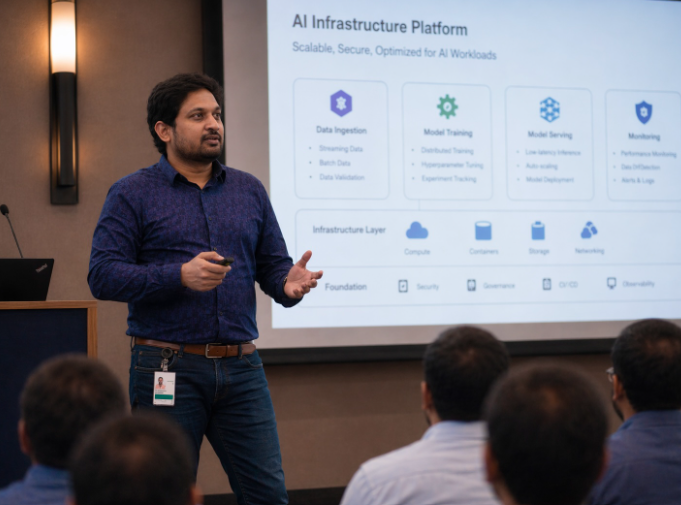
The AI-powered engineering intelligence platform Kanaparthi designed integrates large language models with enterprise engineering knowledge sources: architecture documentation, operational runbooks, source code repositories, and historical incident data. The goal is not to replace the engineer’s judgment but to collapse the orientation phase of a system interaction. An engineer asking a question about a service can get a response that draws on the actual documentation, the actual code ownership, and the actual operational history of that service, rather than having to locate and synthesize those sources manually. The platform was deployed across three engineering organizations supporting roughly 350 engineers, reducing average incident investigation time from two to three hours down to under 30 minutes. Engineers locate architecture documentation, code ownership data, and runbooks five to ten times faster than through prior manual search workflows. Onboarding time for engineers joining complex distributed systems dropped by approximately 40%.
The design challenge in building a system like this inside a regulated financial services environment is not primarily technical. It is governance. Large language models that have access to proprietary engineering knowledge, production data, and internal architecture documentation present a data security surface that requires careful design. Kanaparthi’s platform incorporated enterprise-grade governance and security controls that made it possible to use AI in a highly regulated context without exposing sensitive system information inappropriately. That is not a detail. For large organizations in financial services, healthcare, or any other regulated sector, it is the difference between a platform that can actually be deployed and one that cannot survive a security review.
“The governance layer is where most enterprise AI initiatives stall,” Kanaparthi explains. “You can build a very capable platform on top of a language model. But in a regulated environment, the question is always whether it can be trusted with the information it needs to be useful. Those two things have to be solved together, not sequentially.”
Engineering Systems That Understand Themselves
The broader shift underway in enterprise engineering is from reactive operations toward what might be called ambient intelligence: systems that continuously surface relevant context to the engineers who operate them, reducing the cognitive overhead of managing complexity at scale. The AI code generation market reached $4.91 billion in 2024 and is projected to reach $30 billion by 2032. Most of that investment is flowing toward tools that help engineers write code faster. Less is flowing toward tools that help engineering organizations understand the systems they are operating, despite the fact that operational complexity is where most of the hidden cost lives. The cost of slow incident resolution, fragmented knowledge, and long onboarding cycles for new engineers on complex platforms does not show up in a single line item. It accumulates across thousands of hours and compounds over years.
The direction that matters is context-aware systems that understand not just the code but the organizational and operational context surrounding it. That means integrations across documentation, deployment history, service ownership, and incident records, served through interfaces that fit how engineers actually work rather than requiring them to adopt new habits. The organizations building toward that capability now are not doing it because it is simple. They are doing it because the alternative, managing increasing complexity with the same fragmented tooling, is becoming untenable.
“The question I keep returning to is what the system itself knows,” Kanaparthi says. “Not what we have documented about it, not what is in a dashboard, but whether the system can surface what is relevant when an engineer needs it. That is the gap we are closing. And closing it matters more as complexity grows, not less.”