Cloud governance is the collection of policies, processes, standards, and best practices that organizations use to manage their cloud computing environments in a controlled, secure, and strategic way. It creates a structured layer of oversight across all cloud activities — from how resources are provisioned to how data is stored, accessed, and protected.
Think of it as the rulebook for the cloud. Without it, individual teams can spin up services independently, store data without oversight, and create technical debt that’s expensive to unravel later. With it, the entire organization operates from a shared set of guardrails that align cloud usage with business goals, security requirements, and regulatory obligations.
Crucially, cloud governance is not a one-time setup — it’s a living, evolving framework that adapts as cloud environments grow and change.
Way to Design and Implement a Cloud Governance Framework
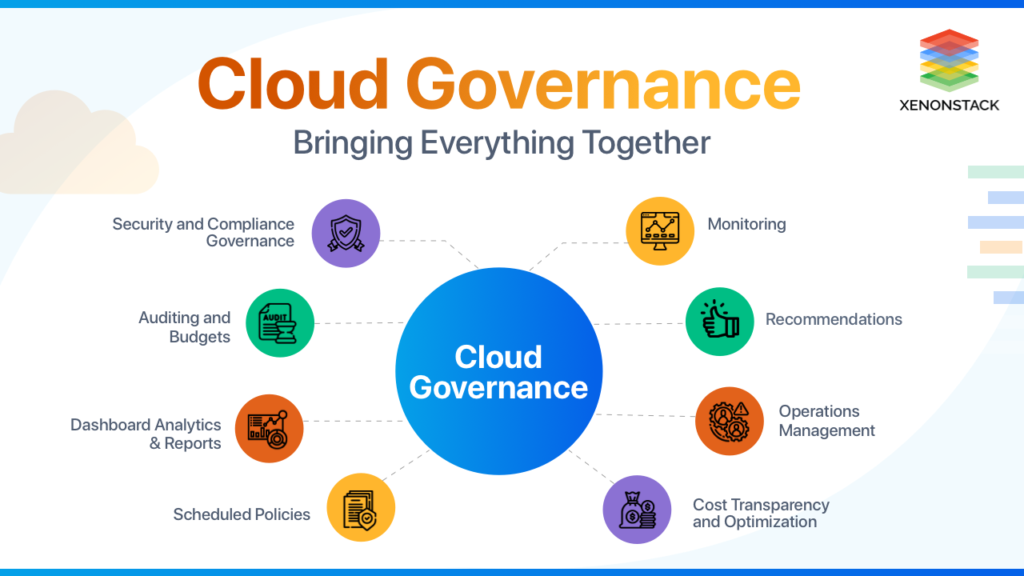
A complete cloud governance framework typically consists of four interconnected domains:
Cloud Financial Management
Financial governance starts with defining how the organization intends to use cloud resources from a cost perspective. This means creating financial policies that specify when to use managed services versus building in-house, setting per-department or per-project budgets, and establishing cost reporting processes that provide reliable visibility into actual spend.
The challenge is that cloud costs can be deceptive. Charges appear across multiple accounts, regions, and services — often in unexpected places. Organizations should use cost reporting tools from their cloud provider or invest in third-party platforms that consolidate billing data across multi-cloud environments.
Cloud Operations Management
Operational governance covers how services are deployed and maintained. Strong operations management includes defining resource allocation clearly, establishing service-level agreements (SLAs), putting monitoring in place to ensure those SLAs are met, and enforcing checks before code reaches production.
This domain is where shadow IT is most effectively prevented. When there’s a clear, efficient path to getting cloud resources approved and deployed, teams have no incentive to circumvent the system.
Cloud Data Management
The cloud makes it easier than ever to collect and process enormous amounts of data — but that ease comes with responsibility. Cloud governance must address the full data lifecycle, including:
- Data classification: categorizing data by sensitivity and applying policies accordingly
- Encryption: ensuring all data is protected, both when stored and when in transit
- Access controls: restricting who can see and modify data at every level
- Data masking: reducing exposure of sensitive information in non-production environments like development or testing
- Lifecycle management: automating the movement of data from high-cost active storage to lower-cost archival systems over time
Automating data lifecycle management is especially critical at scale — manual processes simply can’t keep up with the speed of modern cloud environments.
Cloud Security and Compliance Management
This component brings together all of the traditional enterprise security disciplines and applies them to the cloud context. It encompasses risk assessment, identity and access management, application security, data encryption, and disaster recovery planning.
The goal isn’t to bolt on cloud-specific security as an afterthought — it’s to extend existing organizational security practices into the cloud in a way that makes sense for how cloud environments actually work. This requires balancing real security risks against business agility, and ensuring compliance requirements are met without unnecessarily slowing down innovation.
Cloud Governance Model Principles
Before diving into the technical components, it helps to understand the foundational principles that should guide any cloud governance model:
- Compliance with Policies and Standards Cloud usage must align with internal policies and external regulations relevant to your industry. Consistency here isn’t optional — it’s the backbone of the entire governance structure.
- Alignment with Business Objectives Cloud strategy shouldn’t exist in a silo. Every cloud system, policy, and investment should directly support broader organizational goals. If a cloud initiative can’t be tied back to business value, it needs to be questioned.
- Collaboration and Clear Accountability Cloud governance works only when there are clear agreements between the owners, users, and administrators of cloud infrastructure. Everyone needs to understand their role, their responsibilities, and how their decisions affect others.
- Structured Change Management Every change to a cloud environment — no matter how small — should go through a standardized process. Ad-hoc changes create risk, and governance frameworks ensure that modifications are reviewed, tested, and documented before going live.
- Dynamic Response Through Monitoring and Automation Cloud environments change constantly. Effective governance relies on real-time monitoring and automation to detect and respond to policy violations, cost anomalies, or security incidents as they happen — not weeks later in an audit.
Why Cloud Governance Important
Organizations that move to the cloud without a governance strategy often discover the same problems: costs balloon unexpectedly, security controls become inconsistent, and different teams end up duplicating effort or working at cross-purposes. Here’s why getting governance right is so important:
1. Security and Data Protection
Cloud environments can be highly vulnerable if access controls, encryption, and identity management aren’t consistently applied. A governance framework enforces security policies across the board — ensuring data is encrypted at rest and in transit, access is properly restricted, and identity and access management (IAM) policies are in place to prevent unauthorized entry.
2. Regulatory Compliance
Virtually every industry operates under some form of regulation — GDPR for data privacy,HIPAA for healthcare, SOC 2 for service organizations, and many others. Cloud governance ensures that cloud operations align with these requirements, dramatically reducing the risk of non-compliance and the financial penalties that follow.
3. Cost Control and Optimization
One of the biggest surprises for organizations new to the cloud is how quickly costs escalate. Cloud governance introduces financial policies, budget controls, and cost reporting mechanisms that give leadership visibility into spending and help prevent wasteful over-provisioning or forgotten resources.
4. Eliminating Shadow IT
When employees can’t get what they need from official IT channels quickly enough, they often turn to unauthorized cloud services — a phenomenon known as shadow IT. This creates blind spots around security and compliance. A well-designed governance program gives teams a fast, approved path to the resources they need, eliminating the need to go rogue.
5. Operational Efficiency and Business Continuity
Governance automates resource provisioning, monitors performance, and enforces deprovisioning policies. This reduces manual overhead, catches performance issues early, and ensures that disaster recovery plans are in place so that cloud outages don’t turn into business-ending events.
6. Better Resource Management
Without governance, cloud resources can sit idle, be duplicated across departments, or be poorly matched to actual workloads. Governance practices ensure that resources are allocated efficiently — reducing waste and improving return on investment.
If You’re Looking for Expert Solution
If you’re looking for an expert solution, and you want to approach Cloud Governance professionally, choosing the right platform makes all the difference. Env zero provides a powerful, streamlined solution designed to help organizations manage infrastructure, enforce policies, and maintain full visibility across their cloud environments. With its automation capabilities and governance-focused features, env0 enables teams to stay compliant, reduce risk, and operate more efficiently—making it an excellent choice for businesses seeking reliable and scalable cloud governance solutions.
Common Cloud Governance Implementation Challenges
Even organizations that understand cloud governance in theory often struggle to put it into practice. Here are the most common obstacles and how to address them:
- Complexity of Multi-Cloud Environments: Managing governance across multiple cloud providers, regions, and services is genuinely difficult. Centralized governance tools and platforms that provide unified visibility across the entire cloud estate are essential.
- Lack of Internal Expertise: Many organizations don’t have staff who are deeply experienced in cloud governance frameworks. Investing in training, or partnering with specialized cloud governance consultants, is often the most practical path forward.
- Resistance to Change: Teams that have been operating with full autonomy often push back on governance policies they see as slowing them down. Clear communication about the benefits, combined with involving those teams in designing the framework, helps build buy-in.
- Inconsistent Resource Tagging: Without consistent tagging and labeling of cloud resources, cost allocation and governance enforcement become nearly impossible. Automation and enforced tagging policies are the solution.
- Balancing Security with Innovation: Overly rigid governance can stifle the speed that makes cloud adoption worthwhile. A risk-based approach that applies the most stringent controls where they’re most needed — while allowing flexibility elsewhere — strikes the right balance.
- Reliance on Manual Processes: Manual governance doesn’t scale. Organizations that rely on spreadsheets to track cloud assets, costs, and compliance will always be behind. Automation is not optional at enterprise scale — it’s a prerequisite for effective governance.
Cloud Governance Is a Journey, Not a Project
Perhaps the most important thing to understand about cloud governance is that it’s never truly “done.” Cloud environments evolve constantly — new services are adopted, teams grow, regulations change, and business priorities shift. A governance framework that works well today needs to be reviewed and updated regularly to stay effective.
The organizations that succeed with cloud governance treat it as a continuous practice — building processes for regular review, investing in automation to enforce policies at scale, and creating a culture where responsible cloud usage is understood and embraced across the business.
Getting started can feel overwhelming, but the payoff is significant: lower costs, stronger security, confident compliance, and cloud infrastructure that genuinely accelerates business goals rather than creating new risks.
The foundation of good cloud governance isn’t technology — it’s intentionality. Decide what matters, define how decisions get made, and then build the tools and processes to make those decisions consistently. Everything else follows from there.
Read More From Techbullion